

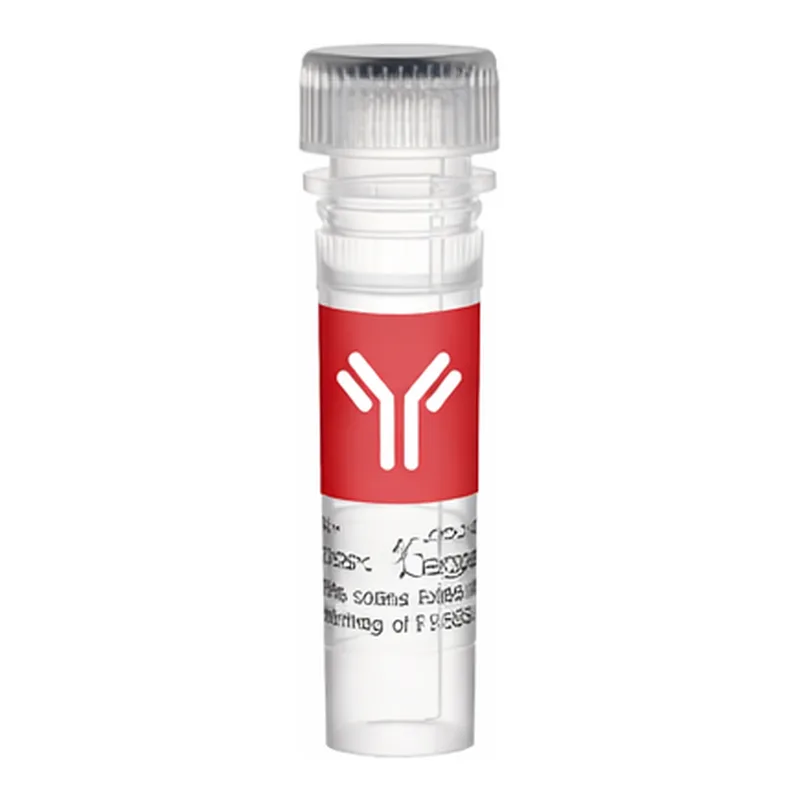
Thermo Fisher Scientific CD254 (RANK Ligand) Monoclonal Antibody (12A668)
RANK Ligand에 특이적인 Mouse monoclonal antibody로, WB, IHC, ICC/IF, Flow, ELISA, ChIP 등 다양한 응용에 사용 가능. Protein G로 정제된 액상 형태이며, 인간, 마우스, 랫트에 반응. 단기 4°C, 장기 -20°C 보관.
- 판매단위
- pk
카탈로그
1개 옵션 · 카탈로그 번호를 클릭하면 복사됩니다Thermo Fisher Scientific · Thermo Fisher Scientific CD254 (RANK Ligand) Monoclonal Antibody (12A668)
Thermo Fisher Scientific CD254 (RANK Ligand) Monoclonal Antibody (12A668)
Applications and Tested Dilutions
| Application | Tested Dilution |
|---|---|
| Western Blot (WB) | 0.5–2 µg/mL |
| Immunohistochemistry (Paraffin) (IHC-P) | 5 µg/mL |
| Immunocytochemistry (ICC/IF) | 20 µg/mL |
| Flow Cytometry (Flow) | Assay-dependent |
| ELISA | Assay-dependent |
| ChIP assay | 1:10–1:500 |
Product Specifications
| Specification | Description |
|---|---|
| Species Reactivity | Human, Mouse, Rat |
| Published Species | Not Applicable |
| Host / Isotype | Mouse / IgG1, kappa |
| Class | Monoclonal |
| Type | Antibody |
| Clone | 12A668 |
| Immunogen | A bacterially expressed fusion protein containing amino acid residues 1–317 of mouse RANKL was used as immunogen. |
| Conjugate | Unconjugated |
| Form | Liquid |
| Concentration | 1 mg/mL |
| Purification | Protein G |
| Storage Buffer | PBS |
| Contains | 0.02% sodium azide |
| Storage Conditions | Store at 4°C short term. For long term storage, store at -20°C, avoiding freeze/thaw cycles. |
| Shipping Conditions | Ambient (domestic); Wet ice (international) |
| RRID | AB_2537675 |
Product Specific Information
- Staining of formalin-fixed tissues is enhanced by boiling tissue sections in 10 mM sodium citrate buffer (pH 6.0) for 10–20 min, followed by cooling at room temperature for 20 min.
- Suggested positive control: activated T cells or RAW cells; antigen standard for TNFSF11 (transient overexpression lysate).
Target Information
This gene encodes a member of the tumor necrosis factor (TNF) cytokine family, functioning as a ligand for osteoprotegerin and a key factor for osteoclast differentiation and activation. It acts as a dendritic cell survival factor and regulates T cell-dependent immune responses.
T cell activation induces expression of this gene, leading to increased osteoclastogenesis and bone loss. It activates antiapoptotic kinase AKT/PKB via a signaling complex involving SRC kinase and TRAF6, suggesting a role in regulating cell apoptosis.
Gene disruption in mice results in severe osteopetrosis and lack of osteoclasts, with defects in T and B lymphocyte differentiation and impaired mammary structure formation during pregnancy. Two alternatively spliced transcript variants have been identified.
For Research Use Only. Not for use in diagnostic procedures. Not for resale without express authorization.
제품 이미지
Thermo Fisher Scientific 상품 둘러보기
전체보기
문의
0개 · 배송·재고 문의는 실시간 상담이 빠릅니다아직 등록된 문의가 없어요.