

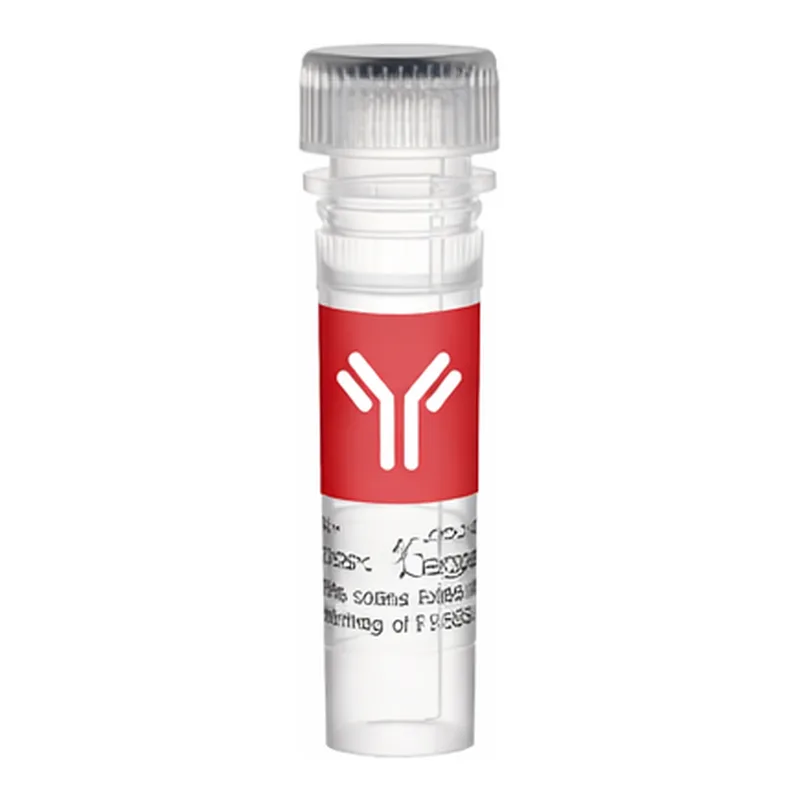
Thermo Fisher Scientific HSPB8 Monoclonal Antibody (3C12-H11)
HSPB8 단백질을 인식하는 Mouse Monoclonal Antibody로, Human, Mouse, Rat 시료에 반응합니다. WB, IHC, ICC/IF, ELISA에 사용 가능하며, 단백질 정제는 Protein G 방식으로 수행되었습니다. 액상 형태로 -20°C에서 보관합니다.
- 판매단위
- pk
카탈로그
1개 옵션 · 카탈로그 번호를 클릭하면 복사됩니다Thermo Fisher Scientific · Thermo Fisher Scientific HSPB8 Monoclonal Antibody (3C12-H11)
Applications and Tested Dilution
| Application | Tested Dilution |
|---|---|
| Western Blot (WB) | 1:2,000 |
| Immunohistochemistry (Paraffin) (IHC (P)) | 1:100 |
| Immunocytochemistry (ICC/IF) | Assay-Dependent |
| ELISA | Assay-Dependent |
Product Specifications
| 항목 | 내용 |
|---|---|
| Species Reactivity | Human, Mouse, Rat |
| Host / Isotype | Mouse / IgG1, kappa |
| Class | Monoclonal |
| Type | Antibody |
| Clone | 3C12-H11 |
| Immunogen | Full-length his-tagged human recombinant HSP22 |
| Conjugate | Unconjugated |
| Form | Liquid |
| Concentration | 1 mg/mL |
| Purification | Protein G |
| Storage Buffer | PBS, pH 7.4, with 50% glycerol |
| Contains | 0.09% sodium azide |
| Storage Conditions | -20°C |
| Shipping Conditions | Wet ice |
| RRID | AB_2735223 |
Additional Formats
- APC (Cat. MA5-45253)
- FITC (Cat. MA5-45254)
- PE (Cat. MA5-45256)
- PerCP (Cat. MA5-45255)
- Custom conjugation available upon request
Product Specific Information
1 µg/mL of MA5-27706 was sufficient for detection of HSP22 in 20 µg of whole rat tissue extract by ECL immunoblot analysis using Goat anti-mouse IgG:HRP as the secondary antibody. Detects approximately 22 kDa. Detects endogenous and exogenous HSP22 in monomeric, dimeric, and tetrameric forms in WB. Does not cross-react with alpha crystallin.
Target Information
The protein encoded by this gene belongs to the superfamily of small heat-shock proteins containing a conserved alpha-crystallin domain at the C-terminal part of the molecule. Expression of this gene is induced by estrogen in estrogen receptor-positive breast cancer cells. This protein functions as a chaperone in association with Bag3, a stimulator of macroautophagy. It is involved in regulation of cell proliferation, apoptosis, and carcinogenesis. Mutations in this gene have been associated with neuromuscular diseases including Charcot-Marie-Tooth disease.
For Research Use Only. Not for use in diagnostic procedures. Not for resale without express authorization.
Thermo Fisher Scientific 상품 둘러보기
전체보기
문의
0개 · 배송·재고 문의는 실시간 상담이 빠릅니다아직 등록된 문의가 없어요.