

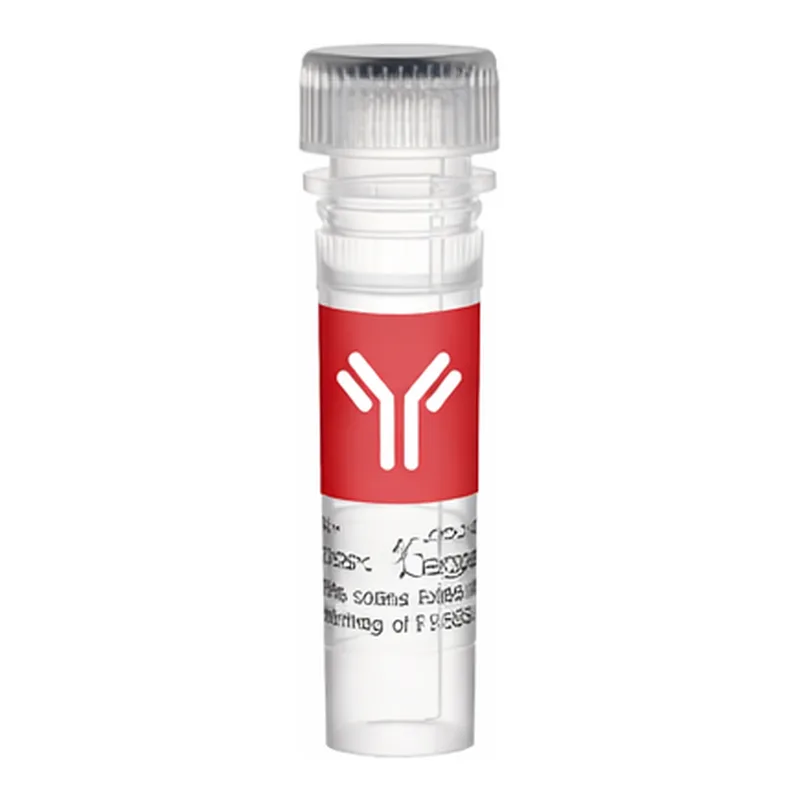
Thermo Fisher Scientific SHH Recombinant Polyclonal Antibody (23HCLC)
Recombinant rabbit polyclonal antibody recognizing human SHH protein. Combines monoclonal specificity with polyclonal sensitivity. Validated for WB and ICC/IF. Provides consistent lot-to-lot performance. For research use only.
- 판매단위
- pk
카탈로그
1개 옵션 · 카탈로그 번호를 클릭하면 복사됩니다Thermo Fisher Scientific · Thermo Fisher Scientific SHH Recombinant Polyclonal Antibody (23HCLC)
Applications and Tested Dilution
| Application | Tested Dilution |
|---|---|
| Western Blot (WB) | 0.5–3 µg/mL |
| Immunocytochemistry (ICC/IF) | 2 µg/mL |
Product Specifications
| Specification | Description |
|---|---|
| Host / Isotype | Rabbit / IgG |
| Class | Recombinant Superclonal |
| Type | Antibody |
| Clone | 23HCLC |
| Immunogen | Peptide corresponding to amino acids 173–184 of human SHH |
| Conjugate | Unconjugated |
| Form | Liquid |
| Concentration | 0.5 mg/mL |
| Storage Conditions | Store at 4°C short term. For long-term storage, store at -20°C, avoiding freeze/thaw cycles. |
| Shipping Conditions | Wet ice |
| RRID | AB_2532713 |
Product Specific Information
Recombinant rabbit polyclonal antibodies are unique offerings from Thermo Fisher Scientific. They consist of multiple different recombinant monoclonal antibodies, combining the sensitivity of polyclonal antibodies with the specificity of monoclonal antibodies, and providing the consistency achievable only with recombinant technology.
These antibodies recognize multiple epitope sites on the target, offering higher detection sensitivity for low-abundance targets. Because the antibody population is defined and reproducible, lot-to-lot variability common in traditional polyclonal production is eliminated.
Target Information
Sonic Hedgehog (SHH) is expressed during embryogenesis and is essential for early developmental patterning. It serves as a key inductive signal in the formation of the ventral neural tube, anterior-posterior limb axis, and ventral somites.
The SHH protein is produced as a precursor that undergoes autocatalytic cleavage. The N-terminal fragment is soluble and mediates signaling activity, while the C-terminal fragment facilitates precursor processing and attaches a cholesterol moiety to the N-terminal fragment. This modification anchors the signaling domain to the cell surface, preventing unrestricted diffusion in the embryo.
Mutations in SHH or its signaling pathway can cause holoprosencephaly (HPE), characterized by abnormal forebrain and facial development, and may contribute to VACTERL syndrome, which involves vertebral, anal, cardiac, tracheoesophageal, renal, and limb anomalies.
For Research Use Only. Not for use in diagnostic procedures. Not for resale without express authorization.
Thermo Fisher Scientific 상품 둘러보기
전체보기
문의
0개 · 배송·재고 문의는 실시간 상담이 빠릅니다아직 등록된 문의가 없어요.