

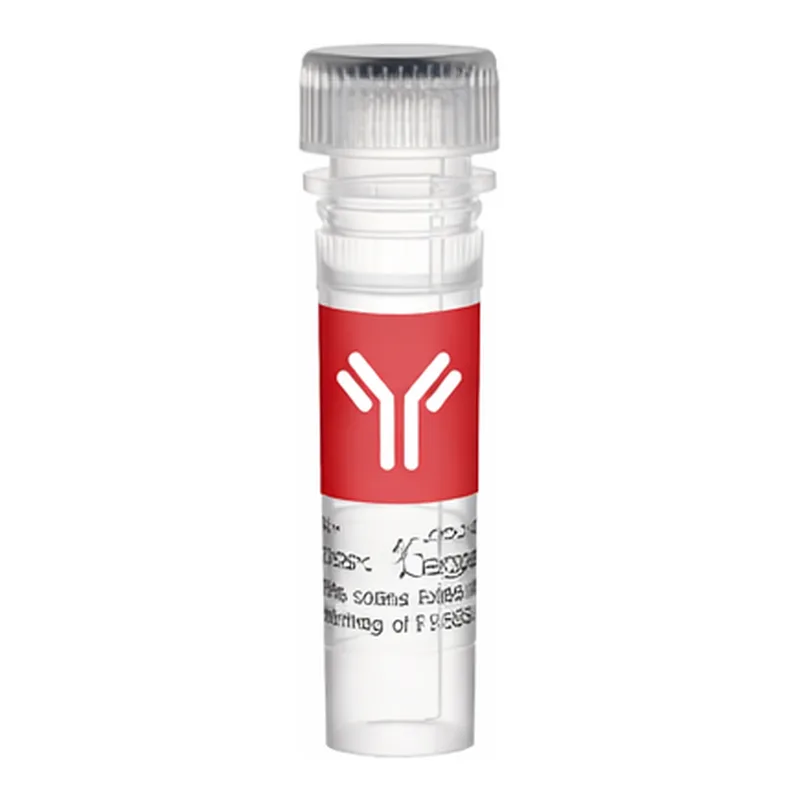
Thermo Fisher Scientific KMT2D Recombinant Superclonal Antibody (9HCLC)
KMT2D 단백질을 인식하는 Recombinant Superclonal 항체로, 인간에 반응하며 원숭이·고양이·쥐에서도 예측 반응. 높은 특이성과 일관된 재현성을 제공하며, 단기간 4°C 보관 가능. 연구용으로 적합.
- 카테고리
- Antibodies
- 판매단위
- pk
카탈로그
1개 옵션 · 카탈로그 번호를 클릭하면 복사됩니다Thermo Fisher Scientific · Thermo Fisher Scientific KMT2D Recombinant Superclonal Antibody (9HCLC)
Applications
Immunocytochemistry (ICC/IF)
- Tested Dilution: 2 µg/mL
Product Specifications
| 항목 | 내용 |
|---|---|
| Species Reactivity | Human |
| Host / Isotype | Rabbit / IgG |
| Expression System | Expi293 |
| Class | Recombinant Superclonal |
| Type | Antibody |
| Clone | 9HCLC |
| Immunogen | Peptides corresponding to Human KMT2D (aa 2–15, 1071–1082) |
| Conjugate | Unconjugated |
| Form | Liquid |
| Concentration | 0.5 mg/mL |
| Purification | Protein A |
| Storage Buffer | PBS, pH 7.2 |
| Contains | 0.09% sodium azide |
| Storage Conditions | Store at 4°C short term. For long term storage, store at -20°C, avoiding freeze/thaw cycles. |
| Shipping Conditions | Wet ice |
| RRID | AB_2610443 |
Product Specific Information
This antibody is predicted to react with Monkey, Cat, and Rat.
Recombinant rabbit Superclonal™ antibodies are unique offerings from Thermo Fisher Scientific. They consist of multiple recombinant monoclonal antibodies, combining the sensitivity of polyclonal antibodies with the specificity of monoclonal antibodies, while maintaining lot-to-lot consistency. Functionally similar to polyclonal antibodies, they recognize multiple epitope sites and provide higher detection sensitivity for low-abundance targets. Each lot contains a defined mixture of light and heavy chains, eliminating biological variability.
Note: Formerly called “Recombinant polyclonal antibody”, now rebranded as “Recombinant Superclonal™ antibody”. Product and performance remain unchanged.
Target Information
KMT2D is a histone methyltransferase that methylates Lys-4 of histone H3 (H3K4me), a key marker for epigenetic transcriptional activation. It acts as a coactivator for estrogen receptors, being recruited by ESR1 to activate transcription. KMT2D is involved in chromatin organization, silencing, oocyte growth, oogenesis, and positive regulation of cell proliferation. Mutations in the KMT2D gene are associated with Kabuki syndrome (KABUK1), a congenital mental retardation syndrome.
For Research Use Only. Not for use in diagnostic procedures. Not for resale without express authorization.
Thermo Fisher Scientific 상품 둘러보기
전체보기
문의
0개 · 배송·재고 문의는 실시간 상담이 빠릅니다아직 등록된 문의가 없어요.