

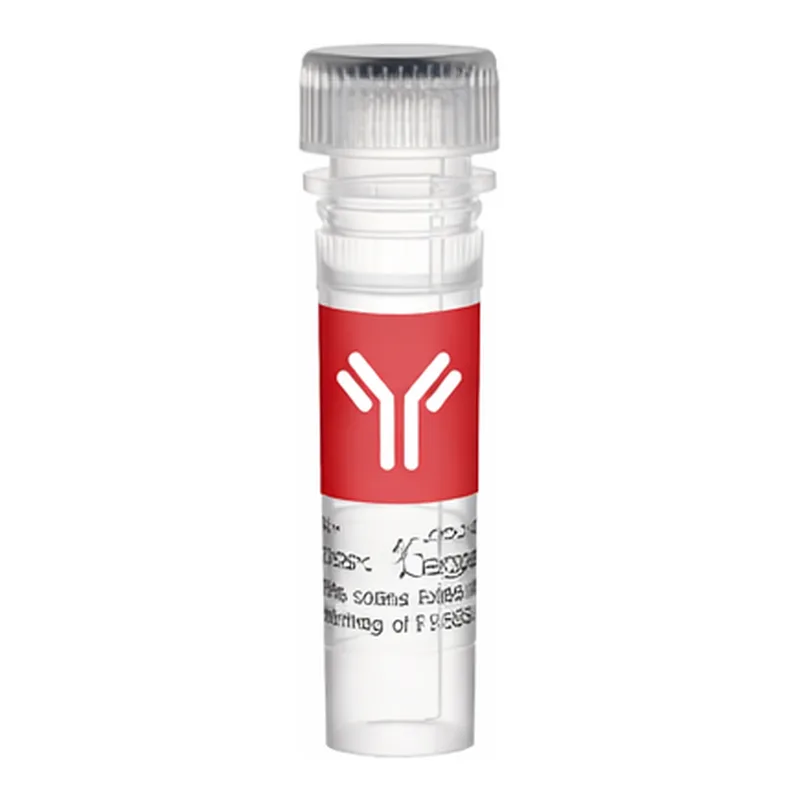
Thermo Fisher Scientific ARPP21 Polyclonal Antibody
ARPP21 단백질을 검출하기 위한 Thermo Fisher Scientific의 Rabbit Polyclonal Antibody. Western blot, IHC, ICC/IF에 적합하며 인간, 마우스, 랫트 시료에 반응. 고순도 친화 크로마토그래피 정제, 1 mg/mL 농도, -20°C 보관.
- 판매단위
- pk
카탈로그
1개 옵션 · 카탈로그 번호를 클릭하면 복사됩니다Thermo Fisher Scientific · Thermo Fisher Scientific ARPP21 Polyclonal Antibody
Thermo Fisher Scientific ARPP21 Polyclonal Antibody
Applications and Tested Dilution
| Application | Tested Dilution | Publications |
|---|---|---|
| Western Blot (WB) | 1:500–1:1,000 | - |
| Immunohistochemistry (Paraffin) (IHC (P)) | 1:50–1:200 | - |
| Immunocytochemistry (ICC/IF) | 1:100–1:500 | View 1 publication |
Product Specifications
| Specification | Description |
|---|---|
| Species Reactivity | Human, Mouse, Rat |
| Published Species | Mouse |
| Host / Isotype | Rabbit / IgG |
| Class | Polyclonal |
| Type | Antibody |
| Immunogen | A synthesized peptide derived from human ARPP21 (Accession Q9UBL0), corresponding to amino acid residues S218–R268 |
| Conjugate | Unconjugated |
| Form | Liquid |
| Concentration | 1 mg/mL |
| Purification | Affinity chromatography |
| Storage Buffer | PBS, pH 7.4, with 50% glycerol |
| Contains | 0.02% sodium azide |
| Storage Conditions | -20°C |
| Shipping Conditions | Wet ice |
| RRID | AB_2850916 |
Product Specific Information
Antibody detects endogenous levels of total ARPP21.
Target Information
The autosomal dominant cerebellar ataxias (ADCA) are a heterogeneous group of neurodegenerative disorders characterized by progressive degeneration of the cerebellum, brain stem, and spinal cord. Clinically, ADCA has been divided into three groups: ADCA types I–III.
ADCAI is genetically heterogeneous, with five genetic loci designated spinocerebellar ataxia (SCA) 1, 2, 3, 4, and 6, assigned to five different chromosomes.
ADCAII, which always presents with retinal degeneration (SCA7), and ADCAIII, often referred to as the ‘pure’ cerebellar syndrome (SCA5), are most likely homogeneous disorders.
Several SCA genes have been cloned and shown to contain CAG repeats in their coding regions. ADCA is caused by expansion of the CAG repeats, producing an elongated polyglutamine tract in the corresponding protein.
The expanded repeats are variable and unstable, usually increasing in size when transmitted to successive generations. The function of the ataxins is not known.
This locus has been mapped to chromosome 6, and the diseased allele contains 41–81 CAG repeats compared to 6–39 in the normal allele, associated with spinocerebellar ataxia type 1 (SCA1).
At least two transcript variants encoding the same protein have been found for this gene.
For Research Use Only. Not for use in diagnostic procedures. Not for resale without express authorization.
제품 이미지
(원본 이미지가 있을 경우 이 섹션에 배치)
Thermo Fisher Scientific 상품 둘러보기
전체보기
문의
0개 · 배송·재고 문의는 실시간 상담이 빠릅니다아직 등록된 문의가 없어요.