

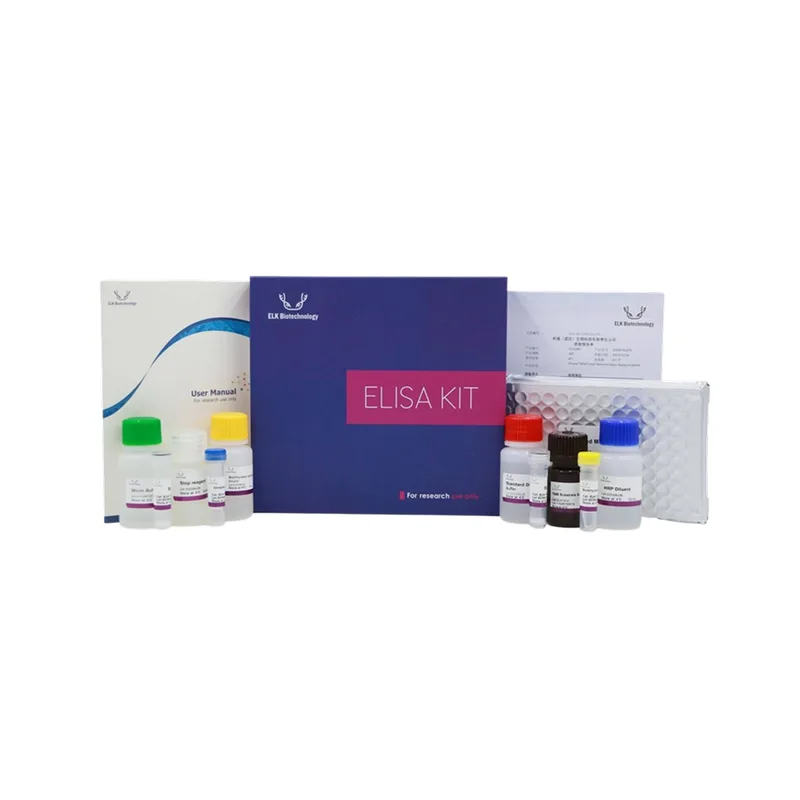
ELK Biotechnology CKAP5 rabbit pAb
CKAP5 단백질을 인식하는 토끼 다클론 항체로, WB에 적합하며 인간 및 생쥐 시료에 반응합니다. 세포골격 및 미세소관 관련 연구에 활용되며, 안정적인 IgG 형으로 -20°C에서 1년 보관 가능합니다.
- 판매단위
- pk
카탈로그
1개 옵션 · 카탈로그 번호를 클릭하면 복사됩니다ELK Biotechnology · ELK Biotechnology CKAP5 rabbit pAb
CKAP5 rabbit pAb
제품 정보
| 항목 | 내용 |
|---|---|
| Product name | CKAP5 rabbit pAb |
| Applications | WB |
| Recommended Dilutions | WB 1:500–2000 |
| Immunogen | Synthesized peptide derived from human CKAP5 (AA range: 1446–1496) |
| Host | Rabbit |
| Storage | -20°C / 1 year |
| Clonality | Polyclonal |
| Isotype | IgG |
| Concentration | 1 mg/ml |
| GeneID (Human) | 9793 |
| Human Swiss-Prot No | Q14008 |
| Species Reactivity | Human, Mouse |
세포 내 위치 (Cellular Localization)
Cytoplasm, cytoskeleton, microtubule organizing center, centrosome.
Detected on centrosomes and kinetochores during interphase and mitosis independently from TACC3 and clathrin.
Located to spindle poles and microtubules during mitosis.
In complex with TACC3 localized to microtubule plus-ends in mitosis and interphase.
In complex with TACC3 and clathrin localized to inter-microtubule bridges in mitotic spindles.
Accumulation sites at microtubule plus ends protruded approximately 100 nm from MAPRE1/EB1 sites in interphase cells.
Background
This gene encodes a cytoskeleton-associated protein belonging to the TOG/XMAP215 family.
The N-terminal half contains a microtubule-binding domain, and the C-terminal half contains a KXGS motif for tubulin dimer binding.
It plays two distinct roles in spindle formation: protecting kinetochore microtubules from depolymerization and supporting centrosomal microtubule assembly.
It may also be essential for microtubule–cell cortex interactions during directional cell movement.
Additionally, it is involved in translation of myelin basic protein (MBP) mRNA through interaction with hnRNP A2.
Alternatively spliced transcript variants encoding different isoforms have been identified. (RefSeq, Aug 2011)
ELK Biotechnology 상품 둘러보기
전체보기
문의
0개 · 배송·재고 문의는 실시간 상담이 빠릅니다아직 등록된 문의가 없어요.