

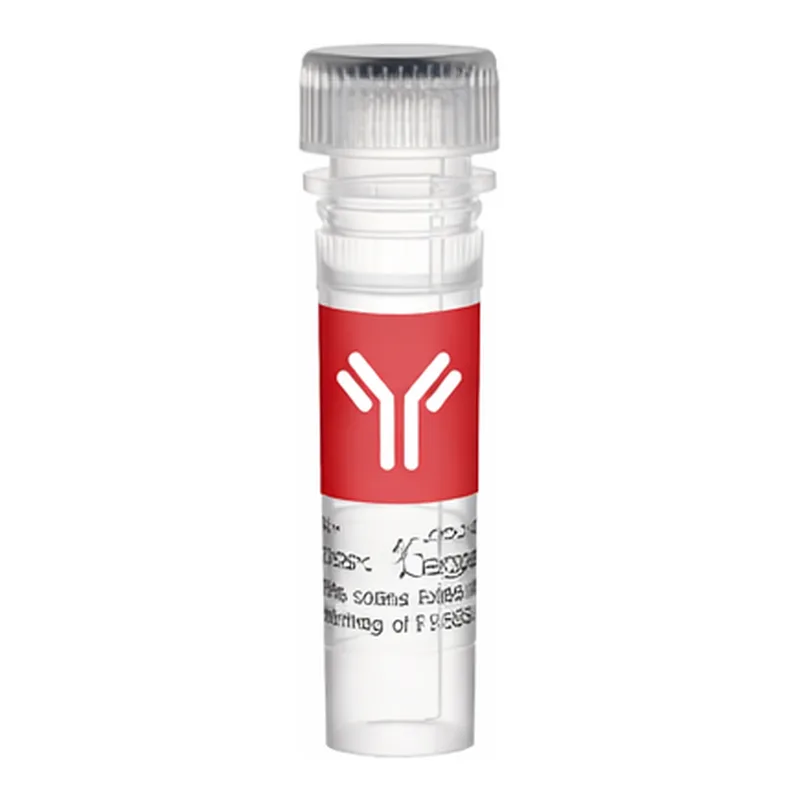
Thermo Fisher Scientific EAAC1 Recombinant Rabbit Monoclonal Antibody (JU39-69)
EAAC1 단백질을 표적으로 하는 Thermo Fisher Scientific의 재조합 토끼 단클론 항체입니다. Western blot, IHC, ICC/IF 등에 사용 가능하며 높은 특이성과 재현성을 제공합니다. HEK293 세포에서 발현되었으며 Protein A로 정제된 액상 형태로 제공됩니다.
- 판매단위
- pk
카탈로그
1개 옵션 · 카탈로그 번호를 클릭하면 복사됩니다Thermo Fisher Scientific · Thermo Fisher Scientific EAAC1 Recombinant Rabbit Monoclonal Antibody (JU39-69)
Applications and Tested Dilutions
| Application | Tested Dilution |
|---|---|
| Western Blot (WB) | 1:2000 |
| Immunohistochemistry (Paraffin) (IHC (P)) | 1:50–1:200 |
| Immunocytochemistry (ICC/IF) | 1:50–1:200 |
Product Specifications
| Specification | Description |
|---|---|
| Species Reactivity | Human |
| Host / Isotype | Rabbit / IgG |
| Expression System | HEK293 cells |
| Class | Recombinant Monoclonal |
| Type | Antibody |
| Clone | JU39-69 |
| Immunogen | Recombinant protein within Human EAAT3 aa 80–209 |
| Conjugate | Unconjugated |
| Form | Liquid |
| Concentration | 1 mg/mL |
| Purification | Protein A |
| Storage Buffer | TBS, pH 7.4, with 40% glycerol, 0.05% BSA |
| Contains | 0.05% sodium azide |
| Storage Conditions | -20°C, avoid freeze/thaw cycles, store in dark |
| Shipping Conditions | Wet ice |
| RRID | AB_2848522 |
Product Specific Information
Positive Control: Mouse liver tissue lysate, HUVEC, LOVO, SH-SY5Y, rat brain tissue, human tonsil tissue, human colon cancer tissue, human kidney tissue.
Localization: Cell membrane.
Target Information
L-glutamate is the major excitatory neurotransmitter in mammalian central nervous systems. To maintain glutamate levels below excitotoxic levels, excess glutamate at excitatory synaptic clefts is removed by ion-coupled glutamate transporters. Four glutamate transporters have been identified: the sodium-dependent GLAST-1, GLT-1, EAAC-1, and the chloride-dependent EAAT-4.
EAAC-1 is expressed in the CNS and also found in kidney and small intestine. Structural features of glutamate transporters include eight membrane-spanning alpha-helices and a loop-pore structure unique among secondary transporters but resembling loop-pores found in ion channels. A second distinctive feature is a highly amphipathic membrane-spanning helix that provides a hydrophilic path through the membrane.
Mice with homozygous deletions of the EAAC-1 transporter gene develop dicarboxylic aminoaciduria and display reduced spontaneous locomotor activity, although no neurodegeneration was observed over a period of 12 months.
For Research Use Only. Not for use in diagnostic procedures. Not for resale without express authorization.
Thermo Fisher Scientific 상품 둘러보기
전체보기
문의
0개 · 배송·재고 문의는 실시간 상담이 빠릅니다아직 등록된 문의가 없어요.