

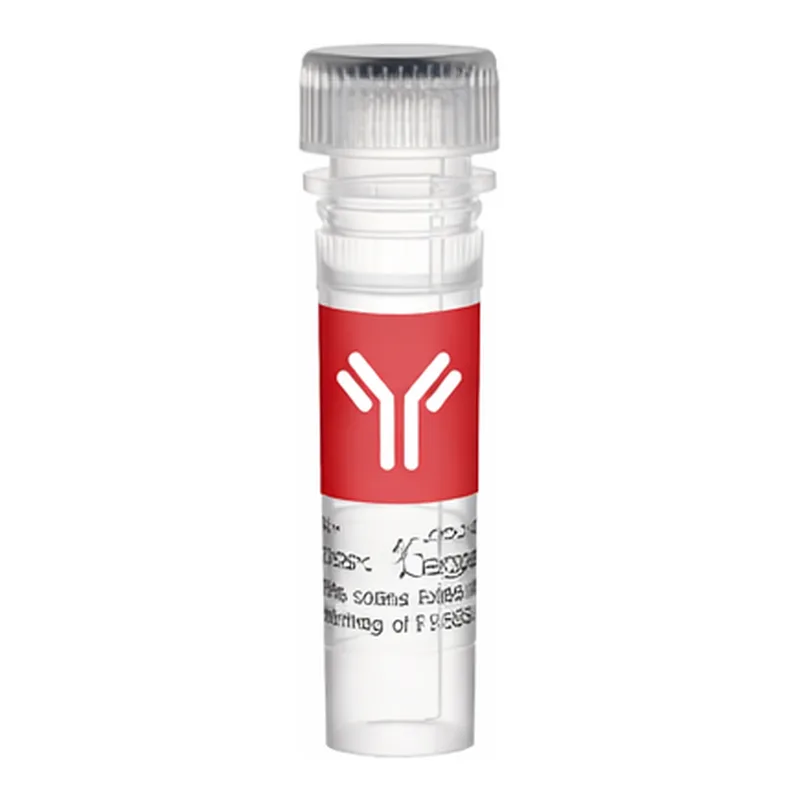
Thermo Fisher Scientific SPAM1 Polyclonal Antibody
Thermo Fisher Scientific의 SPAM1 Polyclonal Antibody는 인간 및 생쥐 시료에서 SPAM1 단백질을 검출하는 고품질 항체입니다. Western blot과 IHC(P) 실험에 적합하며, 고순도 친화 크로마토그래피로 정제되었습니다. 액상 형태로 안정적이며 -20°C에서 보관 가능합니다.
- 판매단위
- pk
카탈로그
1개 옵션 · 카탈로그 번호를 클릭하면 복사됩니다Thermo Fisher Scientific · Thermo Fisher Scientific SPAM1 Polyclonal Antibody
Applications
Western Blot (WB)
- Tested Dilution: 1:500–1:2,000
- Publications: -
Immunohistochemistry (Paraffin) (IHC (P))
- Tested Dilution: 1:50–1:200
- Publications: -
Product Specifications
| 항목 | 내용 |
|---|---|
| Species Reactivity | Human, Mouse |
| Host / Isotype | Rabbit / IgG |
| Class | Polyclonal |
| Type | Antibody |
| Immunogen | A synthesized peptide derived from human SPAM1 (Accession P38567), corresponding to amino acid residues L206–S256 |
| Conjugate | Unconjugated |
| Form | Liquid |
| Concentration | 1 mg/mL |
| Purification | Affinity chromatography |
| Storage buffer | PBS, pH 7.4, with 50% glycerol |
| Contains | 0.02% sodium azide |
| Storage conditions | -20°C |
| Shipping conditions | Wet ice |
| RRID | AB_2851984 |
Product Specific Information
Antibody detects endogenous levels of total SPAM1. In mouse samples, this antibody also recognizes HYAL5 and HYAL2.
Target Information
Hyaluronidase degrades hyaluronic acid, a major structural proteoglycan found in extracellular matrices and basement membranes. Six members of the hyaluronidase family are clustered into two tightly linked groups on chromosome 3p21.3 and 7q31.3.
This gene was previously referred to as HYAL1 and HYA1 and has since been assigned the official symbol SPAM1. Another family member on chromosome 3p21.3 has been assigned HYAL1.
This gene encodes a GPI-anchored enzyme located on the human sperm surface and inner acrosomal membrane. This multifunctional protein is a hyaluronidase that enables sperm to penetrate through the hyaluronic acid-rich cumulus cell layer surrounding the oocyte, acts as a receptor in hyaluronic acid-induced cell signaling, and is involved in sperm-zona pellucida adhesion.
Abnormal expression of this gene in tumors has implicated this protein in degradation of basement membranes leading to tumor invasion and metastasis. Multiple transcript variants encoding different isoforms have been found for this gene.
For Research Use Only. Not for use in diagnostic procedures. Not for resale without express authorization.
Thermo Fisher Scientific 상품 둘러보기
전체보기
문의
0개 · 배송·재고 문의는 실시간 상담이 빠릅니다아직 등록된 문의가 없어요.