

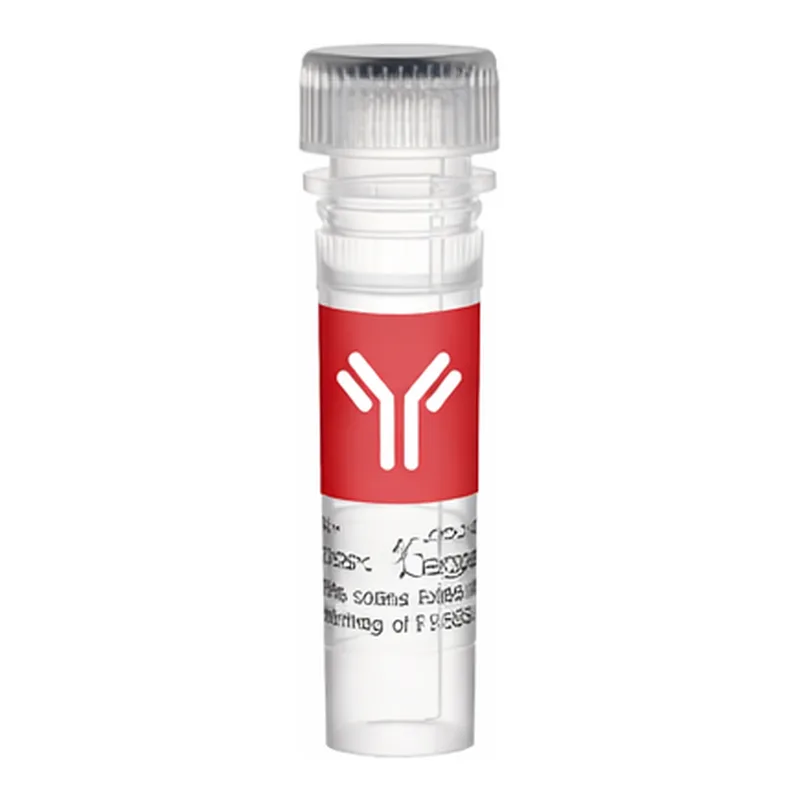
Thermo Fisher Scientific ATM Monoclonal Antibody (2C10)
ATM 단백질을 표적으로 하는 Mouse IgG2a 단일클론 항체로, 인간 시료에 반응합니다. ICC/IF 및 ELISA에 사용 가능하며, DNA 손상 복구 및 세포 주기 조절 연구에 적합합니다. Affinity chromatography로 정제된 액상 형태 제품입니다.
- 판매단위
- pk
카탈로그
1개 옵션 · 카탈로그 번호를 클릭하면 복사됩니다Thermo Fisher Scientific · Thermo Fisher Scientific ATM Monoclonal Antibody (2C10)
Applications
| Application | Tested Dilution |
|---|---|
| Immunocytochemistry (ICC/IF) | 10 µg/mL |
| ELISA | 1 ng/mL |
Product Specifications
| 항목 | 내용 |
|---|---|
| Species Reactivity | Human |
| Host / Isotype | Mouse / IgG2a, kappa |
| Class | Monoclonal |
| Type | Antibody |
| Clone | 2C10 |
| Immunogen | ATM (AAH07023.1, 1–138 a.a) full-length recombinant protein with GST tag (MW of GST tag: 26 kDa) |
| Conjugate | Unconjugated |
| Form | Liquid |
| Concentration | See Label |
| Purification | Affinity chromatography |
| Storage Buffer | PBS, pH 7.4 |
| Contains | No preservative |
| Storage Conditions | -20°C, Avoid Freeze/Thaw Cycles |
| Shipping Conditions | Ambient (domestic); Wet ice (international) |
Product Specific Information
Sequence of this protein is as follows:
MTLHEPANSS ASQSTDLCDF SGDLDPAPNP PHFPSHVVKA TFAYISNCHK TKLKSILEIL SKSPDSYQKI LLAICEQAAE TNNVYKKHRI LKIYHLFVSL LLKDIKSGLG GAWAFVLRDV IYTLIHYINQ RKLTIFSQ
Target Information
Ataxia-telangiectasia Mutated (ATM) is a protein belonging to the PI3/PI4 kinase family.
Ataxia-telangiectasia is a rare autosomal recessive disorder characterized by progressive neurologic degeneration, immunologic deficiency, and an increased risk of lymphoid cancer.
The ATM gene encodes a protein in the phosphoinositide 3-kinase (PI3K) superfamily. ATM phosphorylates proteins instead of lipids and has many downstream targets that act as cell-cycle regulators, including P53, Mdm2, BRCA1, and SMC1.
ATM is responsible for repairing double-stranded DNA breaks caused by ionizing radiation and other mutagens. The C-terminal region of ATM shows extensive homology to catalytic domains of PI3 kinases. Studies indicate that ATM becomes autophosphorylated and upregulated upon ionizing radiation exposure.
AT cells are hypersensitive to ionizing radiation, show impaired inhibition of DNA synthesis, and display delays in p53 induction. DNA damage activates ATM kinase, triggering a cascade of kinase reactions regulating cell cycle, apoptosis, and DNA damage repair.
ATM has also been linked to apoptosis along with Nbs1 and Chk2 in the E2F1 pathway.
For Research Use Only. Not for use in diagnostic procedures. Not for resale without express authorization.
Thermo Fisher Scientific 상품 둘러보기
전체보기
문의
0개 · 배송·재고 문의는 실시간 상담이 빠릅니다아직 등록된 문의가 없어요.