

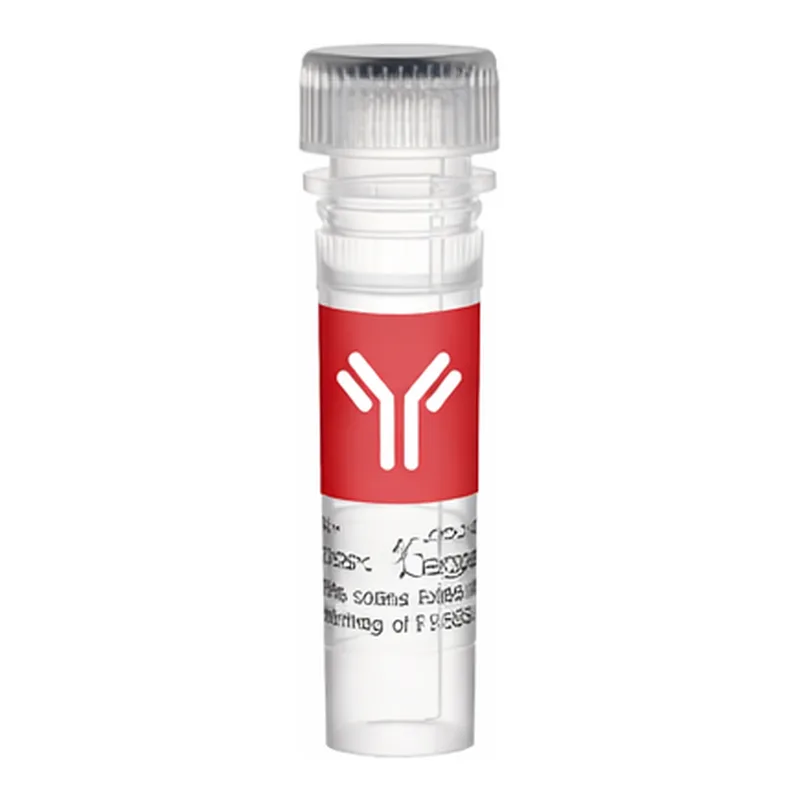
Thermo Fisher Scientific HSF1 Polyclonal Antibody
HSF1 단백질을 인식하는 Thermo Fisher Scientific의 Rabbit Polyclonal Antibody로, WB, IHC, IP 등 다양한 응용에 적합합니다. 항원 친화 크로마토그래피로 정제되었으며, 1 mg/mL 농도의 액상 형태로 제공됩니다. 연구용으로만 사용 가능합니다.
- 판매단위
- pk
카탈로그
2개 옵션 · 카탈로그 번호를 클릭하면 복사됩니다Thermo Fisher Scientific · Thermo Fisher Scientific HSF1 Polyclonal Antibody
Thermo Fisher Scientific HSF1 Polyclonal Antibody
Applications and Tested Dilution
| Application | Tested Dilution |
|---|---|
| Western Blot (WB) | Assay-dependent |
| Immunohistochemistry (IHC) | 1:500–1:5,000 |
| Immunohistochemistry (Paraffin) (IHC (P)) | 1:500–1:5,000 |
| Immunoprecipitation (IP) | 2–10 µg/mg lysate |
Product Specifications
| Specification | Description |
|---|---|
| Species Reactivity | Human |
| Host / Isotype | Rabbit / IgG |
| Class | Polyclonal |
| Type | Antibody |
| Immunogen | Region between residue 225 and 275 of human Heat Shock Transcription Factor 1 (HSF1, UniProt ID: Q00613-1) |
| Conjugate | Unconjugated |
| Form | Liquid |
| Concentration | 1 mg/mL |
| Purification | Antigen affinity chromatography |
| Storage Buffer | Tris citrate/phosphate, pH 7–8 |
| Contains | 0.09% sodium azide |
| Storage Conditions | 4°C |
| Shipping Conditions | Wet ice |
Product Specific Information
- Recommended shelf life: 1 year from date of receipt
- Application Note: For IHC, epitope retrieval with citrate buffer pH 6.0 is recommended for FFPE tissue sections.
Target Information
All organisms respond to elevated temperatures and various environmental stresses by rapid synthesis of heat shock RNAs and proteins. The regulation of heat shock gene transcription is mediated by the transcriptional activator, Heat Shock Factor (HSF), which binds to Heat Shock Response Elements (HSEs).
These HSEs consist of three repeats of a 5-nucleotide {nGAAn} module, arranged in alternating orientation upstream of heat shock genes. Although HSEs are highly conserved, HSFs from yeast, Drosophila, and human differ in molecular weight and do not show significant immunological cross-reactivity.
In human cells, two HSFs have been identified: HSF1 and HSF2. They bind to the same HSEs and share 38% sequence identity. HSF1 responds to classical stress signals such as heat, heavy metals, and oxidative reagents, while HSF2 is activated during hemin-mediated differentiation of human erythroleukemia cells.
HSF1 exists constitutively in the cytoplasm and nucleus of unstressed cells as a monomer without DNA binding activity. Upon stress, HSF1 becomes activated to a nuclear-localized trimeric form that binds DNA. Phosphorylation of HSF1 is necessary for maximal transcription of heat shock genes.
For Research Use Only. Not for use in diagnostic procedures. Not for resale without express authorization.
Thermo Fisher Scientific 상품 둘러보기
전체보기
문의
0개 · 배송·재고 문의는 실시간 상담이 빠릅니다아직 등록된 문의가 없어요.