

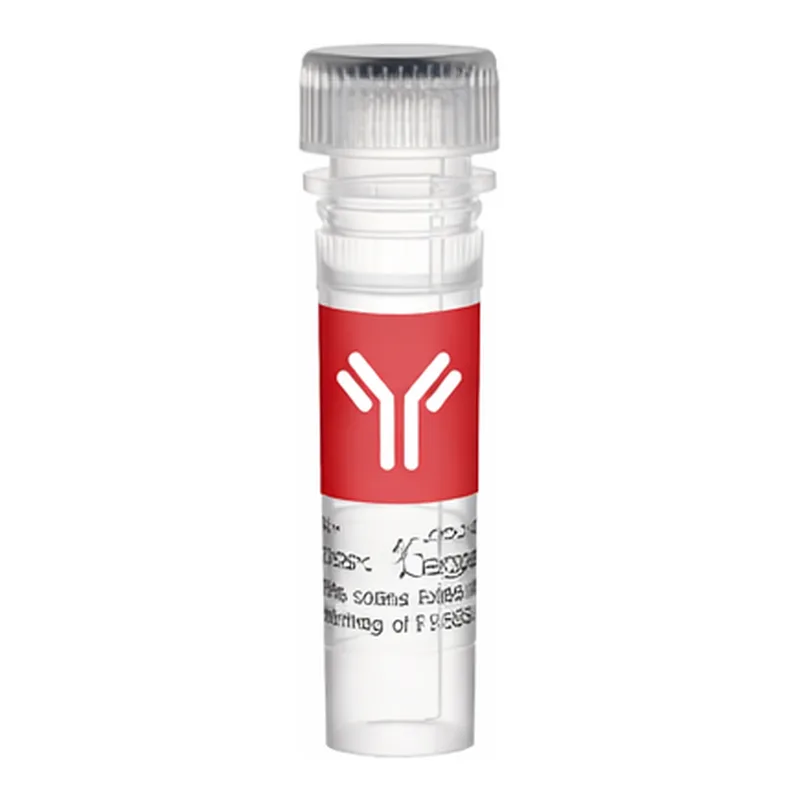
원본
Thermo Fisher Scientific MAPT Monoclonal Antibody (OTI13E11), TrueMAB
상품 한눈에 보기
MAPT 단백질을 인식하는 OTI13E11 클론의 마우스 단일클론 항체로, Western blot 및 IHC(P) 검증 완료. 인간, 생쥐, 랫트 반응성. 동결건조 형태, PBS 버퍼 및 trehalose 함유. 알츠하이머병 연구 등 신경퇴행성 질환 연구용.
- 판매단위
- pk
카탈로그
1개 옵션 · 카탈로그 번호를 클릭하면 복사됩니다회원가입 없이 바로 구매하세요
가입하지 않아도 비회원가로 구매하실 수 있습니다.
마지막 업데이트 2025. 08. 04. 오전 04:01
카탈로그 번호 · 상품 설명출고판매가담기
Thermo Fisher Scientific CF809192 MAPT Monoclonal Antibody (OTI13E11), TrueMAB 100 ug pk판매 단위 pk ·
재고 확인 필요
784,000원VAT 포함 862,400원
Thermo Fisher Scientific · Thermo Fisher Scientific MAPT Monoclonal Antibody (OTI13E11), TrueMAB
Applications
Western Blot (WB)
- Tested Dilution: 1:2,000
Immunohistochemistry (Paraffin) (IHC (P))
- Tested Dilution: 1:500
Product Specifications
| 항목 | 내용 |
|---|---|
| Species Reactivity | Human, Mouse, Rat |
| Host / Isotype | Mouse / IgG1 |
| Class | Monoclonal |
| Type | Antibody |
| Clone | OTI13E11 |
| Immunogen | Human recombinant protein fragment corresponding to amino acids 623–758 of human MAPT produced in E. coli |
| Conjugate | Unconjugated |
| Form | Lyophilized |
| Concentration | 1 mg/mL |
| Purification | Affinity chromatography |
| Storage Buffer | PBS, pH 7.3, with 8% trehalose |
| Contains | No preservative |
| Storage Conditions | -20°C, Avoid Freeze/Thaw Cycles |
| Shipping Conditions | Ambient (domestic); Wet ice (international) |
Product Specific Information
For reconstitution, add 100 µL of distilled water to achieve a final antibody concentration of approximately 1 mg/mL.
For conjugation experiments using this carrier-free antibody, perform an additional desalting step (recommended: Zeba Spin Desalting Columns, 7K MWCO, 0.5 mL, Product #89882).
Target Information
Tau (MAPT) is a neuronal microtubule-associated protein primarily located on axons. It promotes tubulin polymerization and stabilizes microtubules.
- The C-terminus binds axonal microtubules, while the N-terminus associates with neural plasma membrane components, functioning as a linker between both.
- Tau localization determines axonal polarity in neurons.
- Short isoforms contribute to cytoskeletal plasticity, while longer isoforms aid stabilization.
- Hyperphosphorylated Tau forms paired helical filaments (PHF), the major component of neurofibrillary lesions in Alzheimer’s disease brain.
- Hyperphosphorylation disrupts microtubule binding, leading to neuronal degeneration.
- Kinases involved include GSK-3β, PKA, CDK5, and casein kinase II.
- Abnormal Tau phosphorylation is also observed in Pick’s disease, frontotemporal dementia, corticobasal degeneration, and progressive supranuclear palsy.
For Research Use Only. Not for use in diagnostic procedures. Not for resale without express authorization.
Thermo Fisher Scientific 상품 둘러보기
전체보기
Thermo Fisher ScientificThermo Fisher Scientific TSN Monoclonal Antibody (OTI4C6), TrueMAB784,000원VAT별도
Thermo Fisher ScientificThermo Fisher Scientific SSU72 Monoclonal Antibody (OTI5A1), TrueMAB784,000원VAT별도
Thermo Fisher ScientificThermo Fisher Scientific NCF4 Monoclonal Antibody (OTI3E3), TrueMAB784,000원VAT별도
Thermo Fisher ScientificThermo Fisher Scientific TSN Monoclonal Antibody (OTI8F9), TrueMAB784,000원VAT별도
문의
0개 · 배송·재고 문의는 실시간 상담이 빠릅니다아직 등록된 문의가 없어요.