

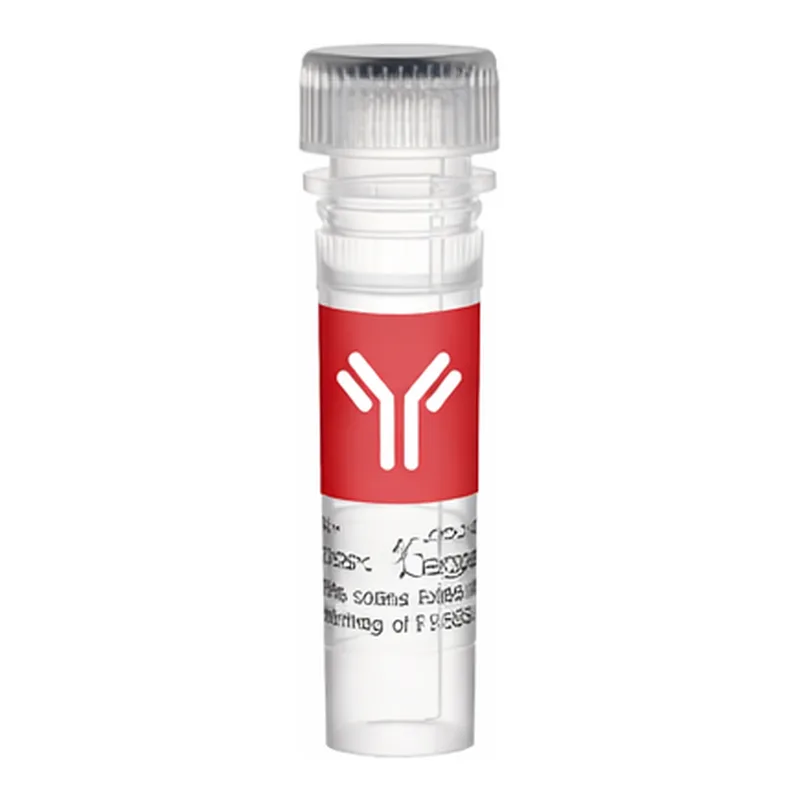
Thermo Fisher Scientific CD30 Monoclonal Antibody (mCD30.1), Functional Grade, eBioscience
마우스 CD30 인식 단일클론 항체로, Flow Cytometry 및 기능적 분석에 적합. 높은 순도(>90%)와 낮은 엔도톡신 수준을 보유하며, 4°C에서 보관. T세포 활성화 및 사이토카인 조절 연구에 활용 가능.
- 판매단위
- pk
카탈로그
4개 옵션 · 카탈로그 번호를 클릭하면 복사됩니다Thermo Fisher Scientific · Thermo Fisher Scientific CD30 Monoclonal Antibody (mCD30.1), Functional Grade, eBioscience
Applications
Flow Cytometry (Flow)
- Tested Dilution: 0.5 µg/test
Functional Assay (Functional)
- Tested Dilution: Assay-Dependent
Product Specifications
| 항목 | 내용 |
|---|---|
| Host / Isotype | Armenian hamster / IgG |
| Recommended Isotype Control | Armenian Hamster IgG Isotype Control (eBio299Arm), Functional Grade, eBioscience™ |
| Class | Monoclonal |
| Type | Antibody |
| Clone | mCD30.1 |
| Conjugate | Functional Grade |
| Form | Liquid |
| Concentration | 1 mg/mL |
| Storage Conditions | 4°C |
| Shipping Conditions | Wet ice |
| RRID | AB_2865690 |
Additional Formats
Product Specific Information
Description:
The mCD30.1 monoclonal antibody reacts with mouse CD30, a 105–120 kDa member of the TNFR superfamily. CD30 is not detectable on splenocytes but can be upregulated on T cells stimulated in vitro through TCR, peaking around day 4–5 post-activation. CD30 is expressed by both CD8⁺ and CD4⁺ activated cells and is suggested to regulate cytokine secretion and T cell development.
Applications Reported:
- Flow cytometric analysis
- In vitro functional studies
Applications Tested:
Tested by flow cytometric analysis of resting and activated mouse splenocytes. Can be used at ≤0.5 µg/test (100 µL final volume). Cell number should be empirically determined (10⁵–10⁸ cells/test). Antibody titration is recommended for optimal assay performance.
Storage and Handling:
Use in a sterile environment.
Filtration:
0.2 µm post-manufacturing filtered.
Purity:
90%, determined by SDS-PAGE.
Endotoxin Level:
<0.001 ng/µg antibody (LAL assay).
Aggregation:
<10%, determined by HPLC.
Target Information
CD30 (Ki-1, TNF Receptor Superfamily Member 8) is a type I transmembrane glycoprotein of the TNF receptor superfamily. Originally identified as a cell surface antigen of Hodgkin’s and Reed-Sternberg cells, its ligand CD30L (CD153) mediates effects such as proliferation, activation, differentiation, and apoptosis. CD30 plays a critical role in Hodgkin’s disease and other CD30⁺ lymphomas, acting as a costimulatory molecule in thymic negative selection.
It is expressed on Hodgkin’s/Reed-Sternberg cells, some non-Hodgkin’s lymphomas, virus-infected T/B cells, and activated normal T/B cells. CD30⁺ T cells are associated with Th2 cytokine production. Soluble CD30 (sCD30) serves as a marker for Th2 immune response. TRAF2 and TRAF5 interact with CD30 to activate NF-κB signaling. CD30 positively regulates apoptosis and limits autoreactive CD8 effector T cell proliferation. Two splice variants encoding distinct isoforms are known.
CD30 is expressed by mononuclear cells in Hodgkin’s lymphoma, Reed-Sternberg cells, and most Anaplastic Large Cell Lymphomas (ALCL), as well as embryonal carcinomas.
For Research Use Only. Not for use in diagnostic procedures. Not for resale without express authorization.
Thermo Fisher Scientific 상품 둘러보기
전체보기
문의
0개 · 배송·재고 문의는 실시간 상담이 빠릅니다아직 등록된 문의가 없어요.