

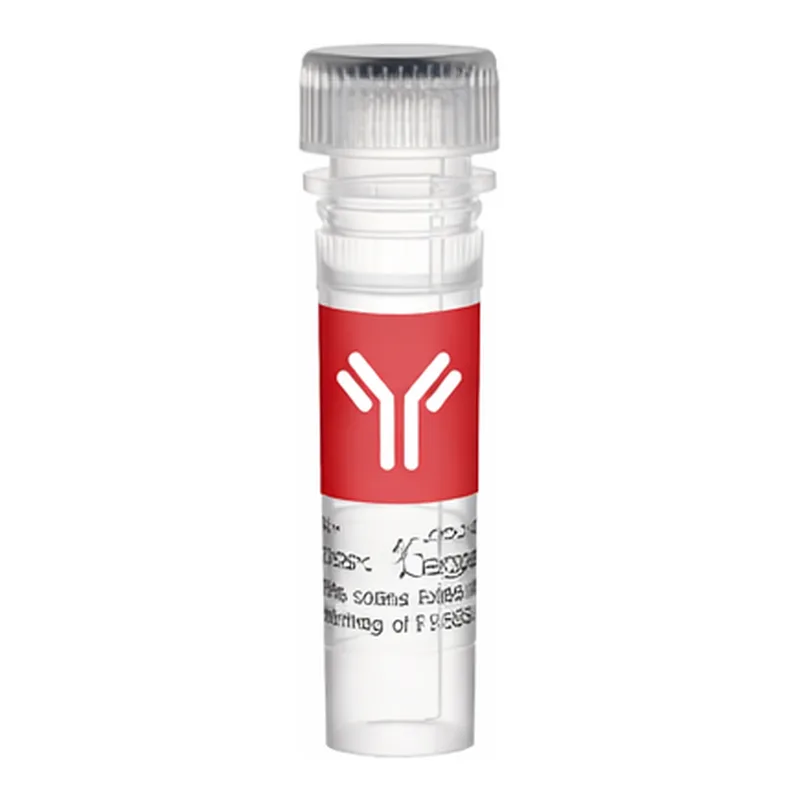
Thermo Fisher Scientific UFD1L Monoclonal Antibody (OTI7C9), TrueMAB
UFD1L 단백질을 인식하는 Mouse monoclonal antibody로 Western blot과 IHC(Paraffin)에 적합합니다. E.coli에서 생산된 full-length human recombinant protein을 면역원으로 사용하였으며, carrier-free 형태로 제공됩니다. 연구용으로만 사용 가능합니다.
- 판매단위
- pk
카탈로그
1개 옵션 · 카탈로그 번호를 클릭하면 복사됩니다Thermo Fisher Scientific · Thermo Fisher Scientific UFD1L Monoclonal Antibody (OTI7C9), TrueMAB
Applications and Tested Dilution
| Application | Tested Dilution |
|---|---|
| Western Blot (WB) | 1:2,000 |
| Immunohistochemistry (Paraffin) (IHC (P)) | 1:150 |
Product Specifications
| 항목 | 내용 |
|---|---|
| Species Reactivity | Human |
| Host / Isotype | Mouse / IgG2b |
| Class | Monoclonal |
| Type | Antibody |
| Clone | OTI7C9 |
| Immunogen | Full length human recombinant protein of human UFD1L produced in E.coli |
| Conjugate | Unconjugated |
| Form | Lyophilized |
| Concentration | 1 mg/mL |
| Purification | Affinity chromatography |
| Storage Buffer | PBS, pH 7.3, with 8% trehalose |
| Contains | No preservative |
| Storage Conditions | -20°C, Avoid Freeze/Thaw Cycles |
| Shipping Conditions | Ambient (domestic); Wet ice (international) |
Product Specific Information
For reconstitution, add 100 µL distilled water to achieve a final antibody concentration of approximately 1 mg/mL.
For conjugation experiments using the carrier-free antibody, perform an additional desalting step (e.g., Zeba Spin Desalting Columns, 7K MWCO, 0.5 mL, Product #89882).
Target Information
Ubiquitin-mediated proteolysis involves the transfer of ubiquitin (Ub) to lysine residues on specific cellular proteins, leading to their degradation by the 26S proteasome. Ub-fusions are cleaved by Ub-specific proteases (UBps) or through the Ub-fusion degradation (UFD) pathway.
UFD proteins preferentially cleave Ub-conjugated proteins with an amino acid substitution at the C-terminal glycine residue of Ub. The UFD1 protein, first identified in yeast (S. cerevisiae), has a human homolog known as UFD1L. In vitro, UFD1 attenuates degradation of Ub-fusions containing a proline or valine substitution at Gly76 by promoting selective multiubiquitination.
Mutations in the UFD1 gene are associated with CATCH22 syndrome, which includes cardiac defects, cleft palate, and hypocalcemia, suggesting a role for this pathway in developmental processes.
For Research Use Only. Not for use in diagnostic procedures. Not for resale without express authorization.
Thermo Fisher Scientific 상품 둘러보기
전체보기
문의
0개 · 배송·재고 문의는 실시간 상담이 빠릅니다아직 등록된 문의가 없어요.