

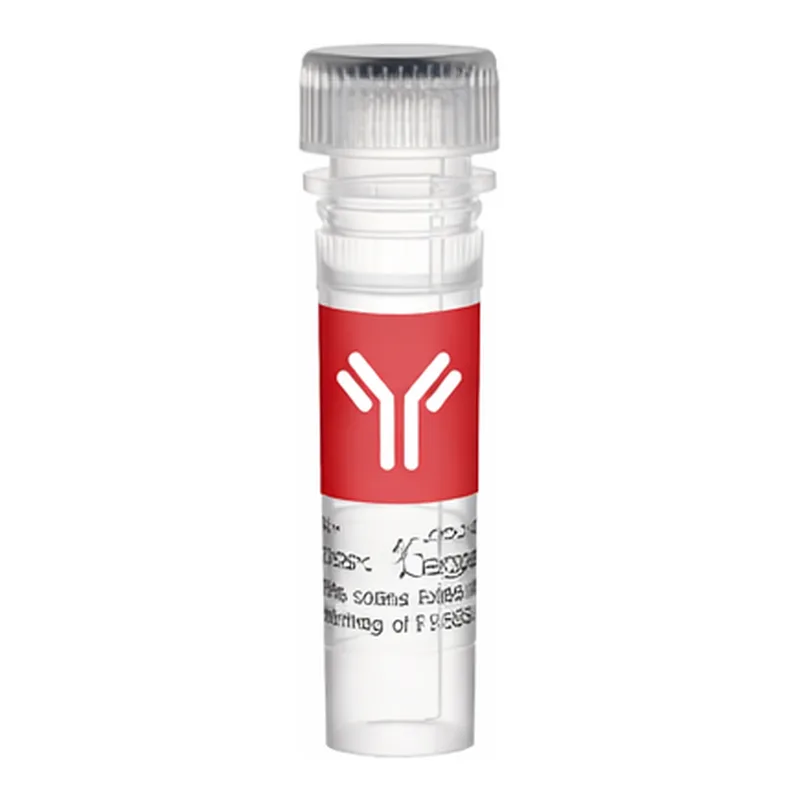
Thermo Fisher Scientific p27 Kip1 Polyclonal Antibody
Rabbit polyclonal antibody against human p27 Kip1 for IHC (paraffin) applications. Predicted to react with canine, mouse, and rat. Suitable for cell cycle and TGF-β pathway research. Supplied as liquid, store at 4°C short term or -20°C long term.
- 판매단위
- pk
카탈로그
2개 옵션 · 카탈로그 번호를 클릭하면 복사됩니다Thermo Fisher Scientific · Thermo Fisher Scientific p27 Kip1 Polyclonal Antibody
Applications
Immunohistochemistry (Paraffin) (IHC (P))
- Tested dilution: 1:100
Product Specifications
| 항목 | 내용 |
|---|---|
| Host / Isotype | Rabbit / IgG |
| Class | Polyclonal |
| Type | Antibody |
| Immunogen | Synthetic peptide derived from C-terminus of human p27 |
| Conjugate | Unconjugated |
| Form | Liquid |
| Storage conditions | Store at 4°C short term. For long term storage, store at -20°C, avoiding freeze/thaw cycles. |
| Shipping conditions | Ambient (domestic); Wet ice (international) |
| RRID | AB_2077824 |
Product Specific Information
This antibody is predicted to react with canine, mouse, and rat based on sequence homology.
Heat-mediated antigen retrieval is recommended prior to staining, using a 10 mM citrate buffer (pH 6.0) for 10 minutes, followed by cooling at room temperature for 20 minutes.
After antigen retrieval, incubate samples with primary antibody for 10 minutes at room temperature.
A suggested positive control is prostate or colon tissue.
Target Information
p27 Kip1 functions as a negative regulator of G1 phase progression and may mediate TGF-β–induced G1 arrest.
It is a key regulator of cell cycle progression and a potent inhibitor of cyclin E- and cyclin A-CDK2 complexes.
p27 Kip1 forms complexes with cyclin D-CDK4 and is involved in assembly, stability, and modulation of CCND1-CDK4 complex activation.
Its activity as an inhibitor or activator depends on phosphorylation state and stoichiometry.
The protein has an approximate molecular weight of 27 kDa, and its degradation—triggered by CDK-dependent phosphorylation and ubiquitination by SCF complexes—is required for the transition from quiescence to proliferation.
For Research Use Only. Not for use in diagnostic procedures. Not for resale without express authorization.
Thermo Fisher Scientific 상품 둘러보기
전체보기
문의
0개 · 배송·재고 문의는 실시간 상담이 빠릅니다아직 등록된 문의가 없어요.