

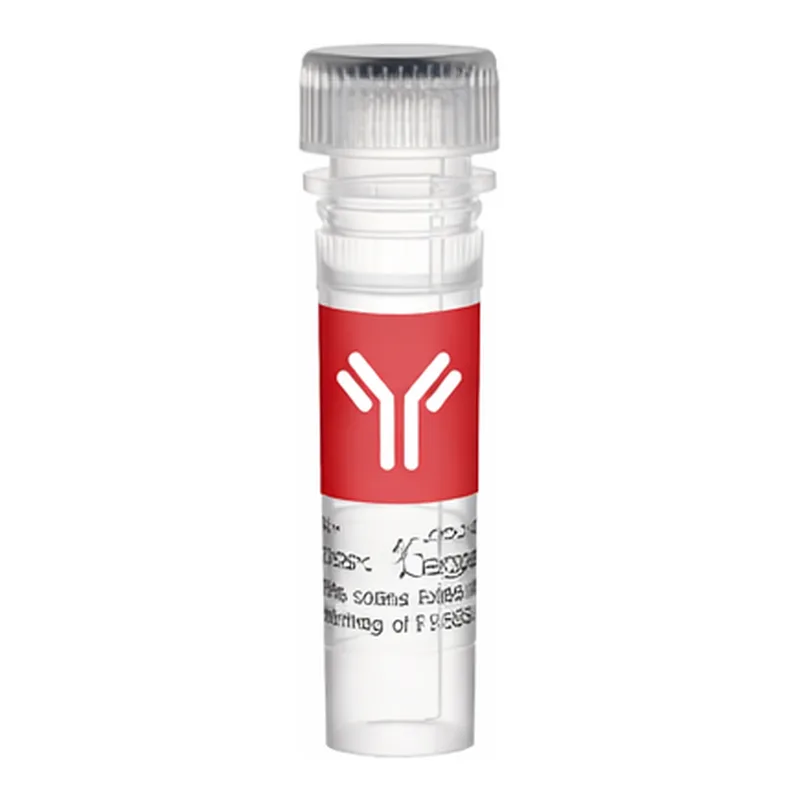
Thermo Fisher Scientific Urokinase Recombinant Rabbit Monoclonal Antibody (JM106-09)
Recombinant rabbit monoclonal antibody recognizing human, mouse, and rat Urokinase. Suitable for WB and IHC applications. Offers high specificity, sensitivity, and lot-to-lot consistency. Supplied as liquid, 1 mg/mL, Protein A purified, stored at 4°C o...
- 카탈로그번호
- MA532586
- 판매단위
- pk
카탈로그
1개 옵션 · 카탈로그 번호를 클릭하면 복사됩니다Thermo Fisher Scientific · Thermo Fisher Scientific Urokinase Recombinant Rabbit Monoclonal Antibody (JM106-09)
Applications and Tested Dilution
| Application | Tested Dilution |
|---|---|
| Western Blot (WB) | 1:500–1:2,000 |
| Immunohistochemistry (Paraffin) (IHC (P)) | 1:5,000 |
Product Specifications
| Property | Description |
|---|---|
| Species Reactivity | Human, Mouse, Rat |
| Host / Isotype | Rabbit / IgG |
| Expression System | HEK293 cells |
| Class | Recombinant Monoclonal |
| Type | Antibody |
| Clone | JM106-09 |
| Immunogen | Synthetic peptide within Human Urokinase aa 50–99 |
| Conjugate | Unconjugated |
| Form | Liquid |
| Concentration | 1 mg/mL |
| Purification | Protein A |
| Storage Buffer | TBS, pH 7.4, with 40% Glycerol, 0.05% BSA |
| Contains | 0.05% sodium azide |
| Storage Conditions | Store at 4°C short term. For long-term storage, store at -20°C, avoiding freeze/thaw cycles. |
| Shipping Conditions | Wet ice |
| RRID | AB_2809863 |
Product Specific Information
Recombinant rabbit monoclonal antibodies are produced using in vitro expression systems. Antibody DNA sequences from immunoreactive rabbits are cloned, and individual clones are screened to select optimal candidates for production.
Advantages include:
- Improved specificity and sensitivity
- Lot-to-lot consistency
- Animal origin-free formulations
- Broad immunoreactivity due to the large rabbit immune repertoire
Target Information
This gene encodes a serine protease involved in extracellular matrix degradation and may play a role in tumor cell migration and proliferation.
A specific polymorphism in this gene may be associated with late-onset Alzheimer’s disease and decreased fibrin-binding affinity.
The protein converts plasminogen to plasmin by cleavage of an Arg-Val bond. Plasmin then cleaves this protein at a Lys-Ile bond, forming a two-chain derivative (HMW-uPA) connected by a disulfide bond.
HMW-uPA can be further processed into LMW-uPA, which remains proteolytically active but does not bind to the uPA receptor.
Alternatively spliced transcript variants encoding different isoforms have been identified.
For Research Use Only. Not for use in diagnostic procedures. Not for resale without express authorization.
Thermo Fisher Scientific 상품 둘러보기
전체보기
문의
0개 · 배송·재고 문의는 실시간 상담이 빠릅니다아직 등록된 문의가 없어요.