

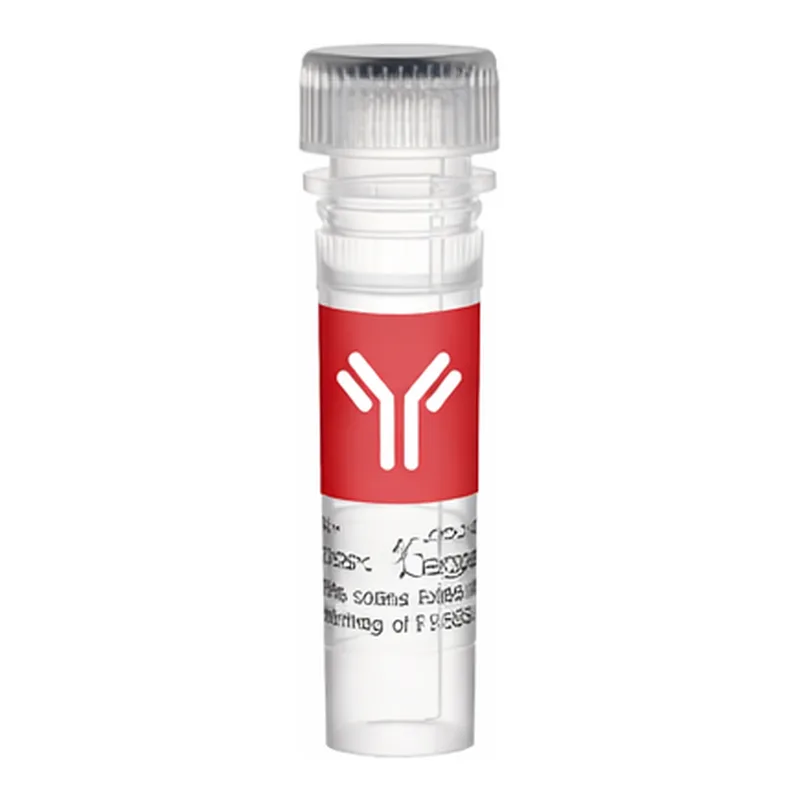
Thermo Fisher Scientific Bai1 Polyclonal Antibody
Bai1 단백질을 인식하는 Rabbit Polyclonal 항체로, WB 및 IHC에 적합합니다. Mouse에 반응하며, Lyophilized 형태로 제공됩니다. 뇌 내 혈관신생 억제 및 세포 신호전달 연구에 활용 가능합니다. 연구용으로만 사용됩니다.
- 판매단위
- pk
카탈로그
1개 옵션 · 카탈로그 번호를 클릭하면 복사됩니다Thermo Fisher Scientific · Thermo Fisher Scientific Bai1 Polyclonal Antibody
Applications
| Application | Tested Dilution | Publications |
|---|---|---|
| Western Blot (WB) | 1:300–1:2,000 | - |
| Immunohistochemistry (IHC) | 1:300–1:2,000 | - |
| Miscellaneous PubMed (Misc) | - | View 1 publication |
Product Specifications
| Specification | Description |
|---|---|
| Species Reactivity | Mouse |
| Published Species | Not Applicable |
| Host / Isotype | Rabbit / Ig |
| Class | Polyclonal |
| Type | Antibody |
| Immunogen | Synthetic peptide corresponding to aa region 1500–1570 of mouse Bai1 conjugated to an immunogenic carrier protein |
| Conjugate | Unconjugated |
| Form | Lyophilized |
| Concentration | Not Determined |
| Storage Buffer | Whole serum |
| Contains | No preservative |
| Storage Conditions | Store at 4°C short term. For long-term storage, store at -20°C, avoiding freeze/thaw cycles. Glycerol (1:1) may be added for stability. |
| Shipping Conditions | Ambient (domestic); Wet ice (international) |
Product Specific Information
- Reconstitute in 100 µL of sterile water.
- Centrifuge to remove any insoluble material.
- Specificity: Bai1.
Target Information
Adgrb1 (BAI1) is a phosphatidylserine receptor that enhances the engulfment of apoptotic cells and acts as a potent inhibitor of angiogenesis in the brain. It may play a significant role in mediating the p53 signal in glioblastoma suppression, and functions in cell adhesion and signal transduction.
Angiogenesis is regulated by a balance between stimulators and inhibitors of new vessel growth and is suppressed under normal physiological conditions. Tumor growth and metastasis depend on angiogenesis, which is stimulated by increased secretion of inducers and decreased production of endogenous inhibitors.
Adgrb1 contains a functional p53-binding site within an intron, and its expression is induced by wild-type p53. Among the brain-specific angiogenesis inhibitor genes (Adgrb1, BAI2, BAI3), only Adgrb1 is transcriptionally regulated by p53. It belongs to the secretin receptor family and acts as an angiogenesis inhibitor and growth suppressor in glioblastomas.
Diseases associated with ADGRB1 include glioblastoma.
For Research Use Only. Not for use in diagnostic procedures. Not for resale without express authorization.
제품 이미지
Thermo Fisher Scientific 상품 둘러보기
전체보기
문의
0개 · 배송·재고 문의는 실시간 상담이 빠릅니다아직 등록된 문의가 없어요.