

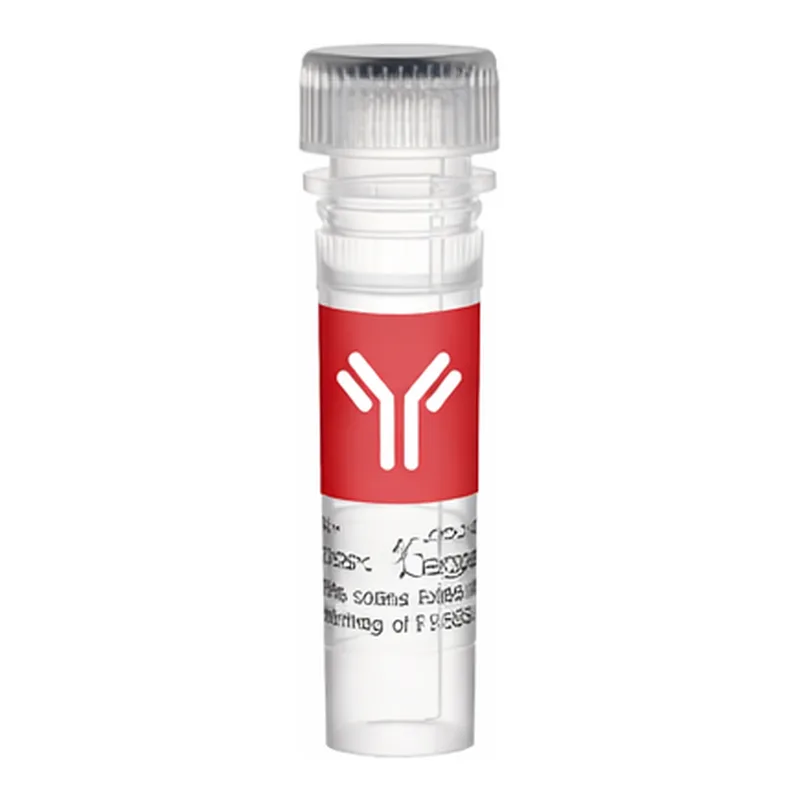
Thermo Fisher Scientific ATPIF1 Monoclonal Antibody (1F3B8)
ATPIF1 단백질을 인식하는 Thermo Fisher Scientific의 Mouse Monoclonal Antibody (Clone 1F3B8). WB, IHC, ICC/IF, Flow, ELISA 등 다양한 응용 가능. 인간 시료 반응성, Protein G 정제, 1 mg/mL 농도. 연구용으로만 사용.
- 판매단위
- pk
카탈로그
1개 옵션 · 카탈로그 번호를 클릭하면 복사됩니다Thermo Fisher Scientific · Thermo Fisher Scientific ATPIF1 Monoclonal Antibody (1F3B8)
Applications and Tested Dilutions
| Application | Tested Dilution |
|---|---|
| Western Blot (WB) | 1:500–1:2,000 |
| Immunohistochemistry (Paraffin) (IHC (P)) | 1:200–1:1,000 |
| Immunocytochemistry (ICC/IF) | 1:100–1:500 |
| Flow Cytometry (Flow) | 1:200–1:400 |
| ELISA | 1:10,000 |
Product Specifications
| Specification | Description |
|---|---|
| Species Reactivity | Human |
| Host / Isotype | Mouse / IgG2b |
| Class | Monoclonal |
| Type | Antibody |
| Clone | 1F3B8 |
| Immunogen | Purified recombinant fragment of human ATPIF1 (AA: 1–106) expressed in E. coli |
| Conjugate | Unconjugated |
| Form | Liquid |
| Concentration | 1 mg/mL |
| Purification | Protein G |
| Storage Buffer | PBS |
| Contains | 0.05% sodium azide |
| Storage Conditions | Store at 4°C short term. For long term, store at -20°C. Avoid freeze/thaw cycles. |
| Shipping Conditions | Ambient (domestic); Wet ice (international) |
| RRID | AB_2787266 |
Product Specific Information
MA5-31642 has been tested in indirect ELISA.
Target Information
Complex V (F1F0 ATPase or ATP synthase) is a transmembrane enzyme conserved across plants, fungi, bacteria, and animals. It catalyzes the reversible conversion of ADP and phosphate to ATP during oxidative phosphorylation, driven by proton flux across membranes.
Originally thought to be localized only in mitochondria, ATP synthase has also been found on plasma membranes of various cell types, including hepatocytes (HDL receptor), endothelial cells (angiostatin receptor), and cancer cells.
The enzyme comprises two main sections:
- F1 ATP-ase (soluble): α, β, γ, δ, ε subunits
- F0 ATP-ase (membrane embedded): a, b, c subunits
In mammals, ATP synthase consists of 17 subunits—5 forming the F1 domain and the rest constituting stalk and F0 components. Two F0 subunits are mitochondrial-encoded, while others are nuclear-encoded.
Mutations in mitochondrial-encoded subunits of ATP synthase (Complex V) can lead to OXPHOS disease.
For Research Use Only. Not for use in diagnostic procedures. Not for resale without express authorization.
제품 이미지
(이미지 없음)
Thermo Fisher Scientific 상품 둘러보기
전체보기
문의
0개 · 배송·재고 문의는 실시간 상담이 빠릅니다아직 등록된 문의가 없어요.