

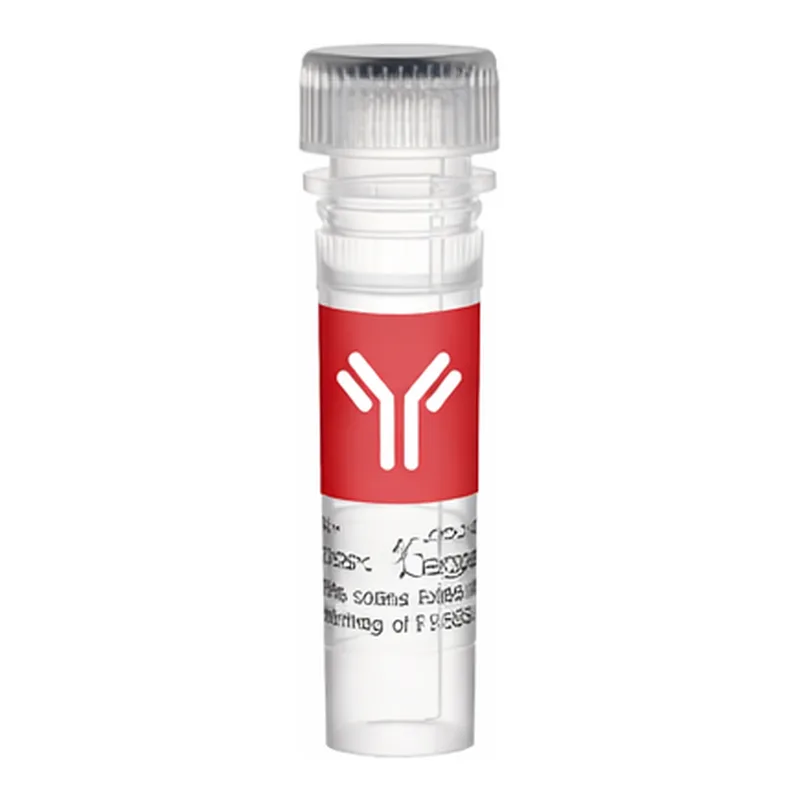
Thermo Fisher Scientific TCR V alpha 24 J alpha 18 Monoclonal Antibody (6B11), Biotin, eBioscience
인간 iNKT 세포의 불변 TCR(Vα24Jα18)을 인식하는 6B11 단클론 항체로, Biotin 결합형입니다. Flow cytometry에 최적화되어 있으며, 0.5 mg/mL 농도로 제공됩니다. 4°C 암소 보관, 인간 반응성 확인, 연구용으로 사용됩니다.
- 판매단위
- pk
카탈로그
1개 옵션 · 카탈로그 번호를 클릭하면 복사됩니다Thermo Fisher Scientific · Thermo Fisher Scientific TCR V alpha 24 J alpha 18 Monoclonal Antibody (6B11), Biotin, eBioscience
Thermo Fisher Scientific TCR V alpha 24 J alpha 18 Monoclonal Antibody (6B11), Biotin, eBioscience™
Applications and Tested Dilution
| Application | Tested Dilution | Publications |
|---|---|---|
| Immunocytochemistry (ICC/IF) | - | View 1 publication |
| Flow Cytometry (Flow) | 1 µg/test | View 3 publications |
Product Specifications
| 항목 | 내용 |
|---|---|
| Species Reactivity | Human |
| Published Species | Human, Mouse |
| Host / Isotype | Mouse / IgG1, kappa |
| Recommended Isotype Control | Mouse IgG1 kappa Isotype Control (P3.6.2.8.1), Biotin, eBioscience™ |
| Class | Monoclonal |
| Type | Antibody |
| Clone | 6B11 |
| Conjugate | Biotin |
| Form | Liquid |
| Concentration | 0.5 mg/mL |
| Purification | Affinity chromatography |
| Storage Buffer | PBS, pH 7.2 |
| Contains | 0.09% sodium azide |
| Storage Conditions | 4°C, store in dark, DO NOT FREEZE! |
| Shipping Conditions | Ambient (domestic); Wet ice (international) |
| RRID | AB_10549112 |
| Filtration | 0.2 µm post-manufacturing filtered |
Available Formats
Product Specific Information
The 6B11 monoclonal antibody reacts with an epitope of the CDR3 formed by the germ-line configuration of the Vα24 and Jα18 regions of the TCR α locus, resulting in expression of an invariant T-cell receptor (TCR) found in invariant NK T cells (iNKT).
This receptor is homologous to murine Vα14Jα18 and pairs with restricted TCR β chains, most prominently Vβ11 in humans.
iNKT cells, restricted by CD1d molecules, are activated by CD1d-presented glycolipid ligands, producing IL-4, IL-13, and IFN-γ rapidly.
Though iNKT cells exhibit NK-like cytolytic activity, they serve as regulators of immune responses, producing both Th1 and Th2 cytokines in autoimmune, infectious, and cancer contexts.
Peripheral blood iNKT cell frequency in normal humans varies from 0.01–1% of total T cells.
Applications Reported: Flow cytometric analysis.
Applications Tested: Flow cytometric analysis of human peripheral blood cells; ≤1 µg/test (100 µL final volume). Cell number should be empirically determined (10⁵–10⁸ cells/test). Titrate for optimal performance.
Target Information
T cell receptors (TCRs) enable discrimination between foreign and self-peptides presented by MHC class II molecules, critical for adaptive immunity.
Self-peptide recognition is linked to autoimmune diseases, while mutant self-peptides are associated with tumors.
Superantigen engagement of TCRs causes toxic shock syndrome.
Autoantibodies to Vβ segments have been found in rheumatoid arthritis and SLE patients, blocking TH1-mediated inflammation.
Most human T cells express TCR αβ with CD4 or CD8 (single positive), while a small subset lacks both (double negative).
Elevated αβ DN T cells are observed in autoimmune and immunodeficiency disorders.
γδ T cells, mainly epithelial, exhibit limited diversity and distinct antigen recognition, contributing to antitumor and immunoregulatory activity.
For Research Use Only. Not for use in diagnostic procedures or resale without authorization.
Thermo Fisher Scientific 상품 둘러보기
전체보기
문의
0개 · 배송·재고 문의는 실시간 상담이 빠릅니다아직 등록된 문의가 없어요.