

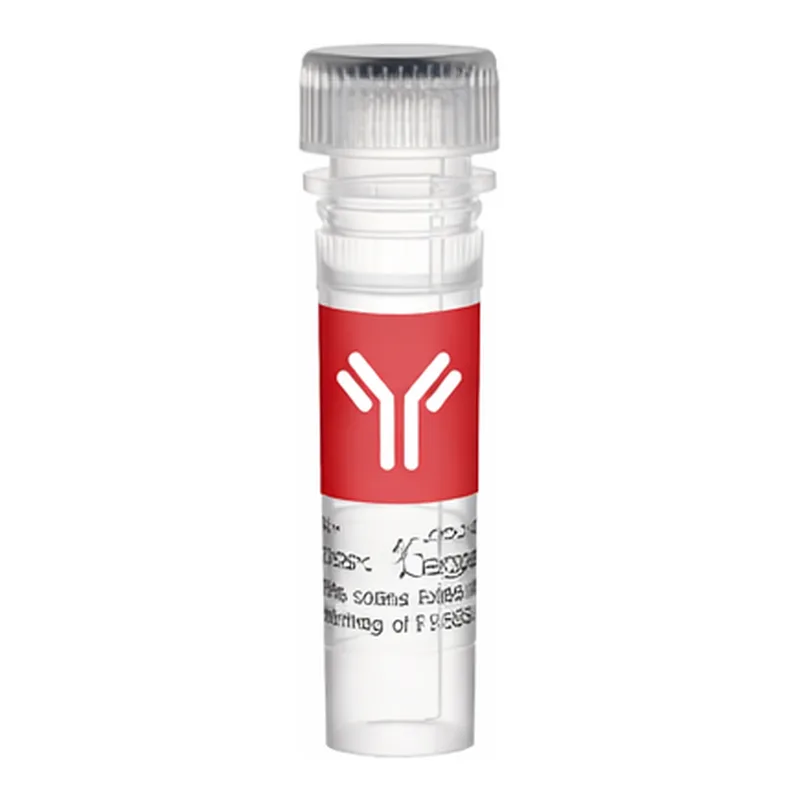
Thermo Fisher Scientific Human JPH4 Synthetic Peptide
인간 JPH4 단백질의 중심부 17개 아미노산 서열에 해당하는 합성 펩타이드. 항체 PA5-20646의 블로킹 펩타이드로 사용 가능. 순도 높은 액상 형태로 제공되며 PBS(pH 7.2)와 0.1% BSA, 0.02% sodium azide를 함유. 연구용으로만 사용.
- 판매단위
- pk
카탈로그
1개 옵션 · 카탈로그 번호를 클릭하면 복사됩니다Thermo Fisher Scientific · Thermo Fisher Scientific Human JPH4 Synthetic Peptide
Applications
Control (Ctrl)
- Assay-dependent
Blocking Assay (BLOCK)
- Assay-dependent
Product Specifications
| 항목 | 내용 |
|---|---|
| Species Reactivity | Human |
| Class | Synthetic |
| Type | Peptide |
| Conjugate | Unconjugated |
| Form | Liquid |
| Concentration | 200 µg/mL |
| Purification | Purified |
| Storage Buffer | PBS, pH 7.2, with 0.1% BSA |
| Contains | 0.02% sodium azide |
| Storage Conditions | -20°C |
Product Specific Information
This peptide corresponds to 17 amino acids near the center of human JPH4.
PEP-0766 can be used as a blocking peptide with polyclonal antibody PA5-20646.
Target Information
Junctional complexes between the plasma membrane (PM) and endoplasmic/sarcoplasmic reticulum (ER/SR) are a common feature of all excitable cell types and mediate cross talk between cell surface and intracellular ion channels.
Junctophilins (JPs) are important components of these junctional complexes. JPs consist of a carboxy-terminal hydrophobic segment spanning the ER/SR membrane and a cytoplasmic domain that binds specifically to the PM.
Four JPs have been identified as tissue-specific subtypes:
- JPH1: Expressed in skeletal muscle
- JPH2: Detected throughout all muscle cell types
- JPH3, JPH4: Predominantly expressed in the brain
In the CNS, both JPH3 and JPH4 are expressed throughout neural sites and contribute to subsurface cistern formation in neurons.
Mice lacking both JPH3 and JPH4 exhibit impaired learning and memory and abnormal nervous functions.
For Research Use Only. Not for use in diagnostic procedures. Not for resale without express authorization.
Thermo Fisher Scientific 상품 둘러보기
전체보기
문의
0개 · 배송·재고 문의는 실시간 상담이 빠릅니다아직 등록된 문의가 없어요.