

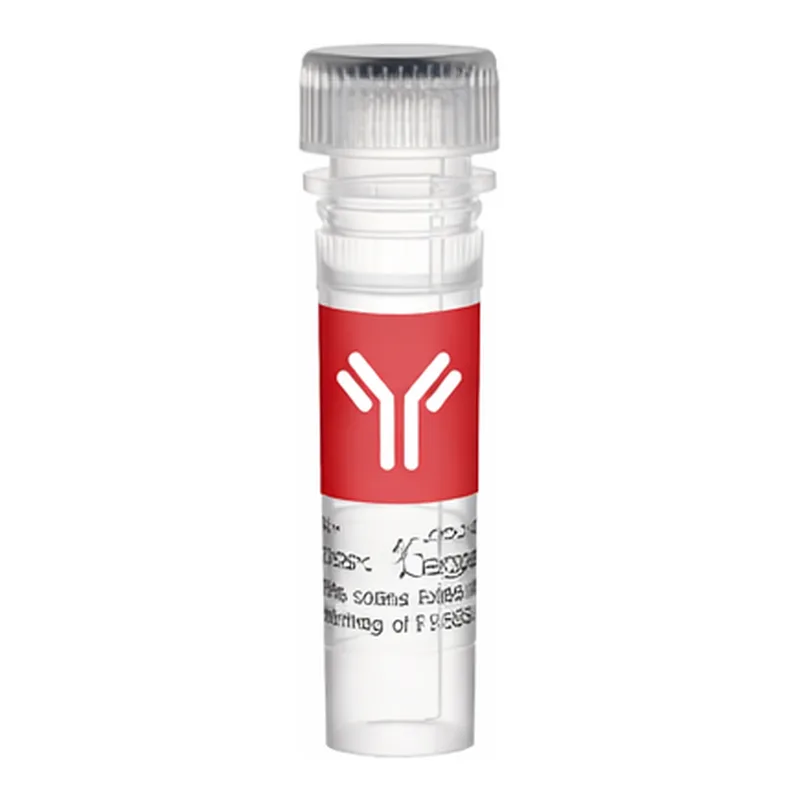
Thermo Fisher Scientific beta Amyloid (N-terminal) Polyclonal Antibody
인간 베타 아밀로이드 단백질의 N-말단 서열(1-14aa)에 특이적인 Rabbit Polyclonal 항체. 면역조직화학(IHC) 및 기능적 분석에 사용 가능. 액상 형태로 제공되며 -20°C 보관. 알츠하이머병 관련 연구용으로 적합.
- 판매단위
- pk
카탈로그
1개 옵션 · 카탈로그 번호를 클릭하면 복사됩니다Thermo Fisher Scientific · Thermo Fisher Scientific beta Amyloid (N-terminal) Polyclonal Antibody
Applications
Immunohistochemistry (IHC)
- Tested Dilution: Assay-dependent
Functional Assay
- Tested Dilution: Assay-dependent
Product Specifications
| 항목 | 내용 |
|---|---|
| Host / Isotype | Rabbit / IgG |
| Class | Polyclonal |
| Type | Antibody |
| Immunogen | A synthetic peptide corresponding to amino acid sequence 1–14 (1DAEFRHDSGYEVHH14) of the human amyloid-beta protein |
| Conjugate | Unconjugated |
| Form | Liquid |
| Storage Conditions | -20°C |
| Shipping Conditions | Wet ice (domestic); Wet or Dry ice (international) |
| RRID | AB_2536238 |
Target Information
Amyloid beta peptide (Abeta/Beta-amyloid) is the major constituent of amyloid plaques in the brains of individuals afflicted with Alzheimer’s disease. Abeta peptide is 40–43 amino acids long and generated from the beta-amyloid precursor protein (beta APP) in a two-step process.
The first step involves cleavage of the extracellular, amino-terminal domain of beta APP by the aspartyl protease beta-secretase (BACE), which is synthesized as a propeptide and activated by the prohormone convertase, furin.
Beta APP cleavage by mature BACE results in secretion of a segment of beta APP and a membrane-bound remnant, which is further processed by gamma-secretase. Gamma-secretase cleaves an intra-membrane site in the carboxyl-terminal domain of beta APP, generating the amyloid beta peptide.
Gamma-secretase is a multi-subunit complex containing presenilin-1 and -2 as central components. The transmembrane glycoprotein nicastrin associates with presenilins and binds to the carboxyl-terminus of beta APP, modulating amyloid beta peptide production.
Abeta is an extracellular filamentous protein component of amyloid cores and neuritic plaques, also found in neurofibrillary tangles. Alzheimer’s disease, the most common cause of senile dementia, is characterized by abnormal filamentous protein deposits in the brain. Beta amyloid deposits are also detected in Lewy body dementia, Down’s syndrome, amyloidosis (Dutch type), cerebroarterial amyloidosis (cerebral amyloid angiopathy), and the Guam Parkinson-Dementia complex.
For Research Use Only. Not for use in diagnostic procedures. Not for resale without express authorization.
Thermo Fisher Scientific 상품 둘러보기
전체보기
문의
0개 · 배송·재고 문의는 실시간 상담이 빠릅니다아직 등록된 문의가 없어요.