

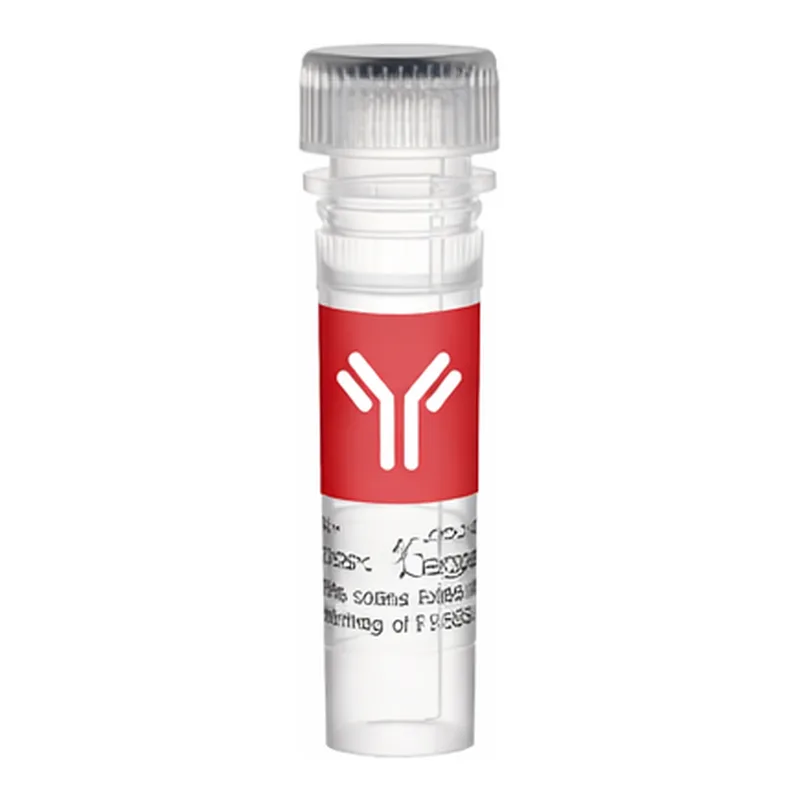
Thermo Fisher Scientific TLR1 Monoclonal Antibody (GD2.F4), FITC
인간 TLR1 단백질을 검출하는 FITC 결합 단클론 항체로, IHC, Flow Cytometry, ELISA 등 다양한 응용에 적합합니다. 마우스 IgG1 형식이며 Protein G로 정제되어 높은 특이성과 재현성을 제공합니다. 연구용으로만 사용 가능합니다.
- 판매단위
- pk
카탈로그
1개 옵션 · 카탈로그 번호를 클릭하면 복사됩니다Thermo Fisher Scientific · Thermo Fisher Scientific TLR1 Monoclonal Antibody (GD2.F4), FITC
Applications and Tested Dilution
| Application | Tested Dilution |
|---|---|
| Immunohistochemistry (Paraffin) (IHC (P)) | 1:50 |
| Immunohistochemistry (Frozen) (IHC (F)) | 1:50 |
| Flow Cytometry (Flow) | 1:50 |
| ELISA | 1:50 |
| Functional Assay | 1:50 |
Product Specifications
| Specification | Description |
|---|---|
| Species Reactivity | Human |
| Host / Isotype | Mouse / IgG1 |
| Class | Monoclonal |
| Type | Antibody |
| Clone | GD2.F4 |
| Immunogen | Human TLR1 |
| Conjugate | FITC |
| Excitation / Emission Max | 498 / 517 nm |
| Form | Liquid |
| Concentration | 0.1 mg/mL |
| Purification | Protein G |
| Storage Buffer | PBS with 1% BSA |
| Contains | 0.02% sodium azide |
| Storage Conditions | 4°C, store in dark |
| Shipping Conditions | Ambient (domestic); Wet ice (international) |
| RRID | AB_1087873 |
Product Specific Information
MA1-40168 detects TLR1 from human samples.
The MA1-40168 immunogen is human TLR1.
Positive control: HeLa cells transfected with TLR1 mRNA
Negative control: Mock transfected HeLa cells.
Target Information
TLR1 protein is a member of the Toll-like receptor (TLR) family which plays a fundamental role in pathogen recognition and activation of innate immunity.
TLRs are highly conserved from Drosophila to humans and share structural and functional similarities.
They recognize pathogen-associated molecular patterns (PAMPs) expressed on infectious agents and mediate cytokine production necessary for effective immunity.
The Toll-like receptor family in mammals consists of transmembrane proteins characterized by multiple leucine-rich repeats in the extracellular domain and an IL-1 receptor motif in the cytoplasmic domain.
TLR1 interacts with TLR2 in mice, and co-expression enhances NF-kappaB activation in response to synthetic lipopeptides.
They recognize lipid configurations of native mycobacterial lipoproteins and several tri-acylated lipopeptides.
Alternative polyadenylation and splicing may result in different transcript lengths for the TLR1 gene.
For Research Use Only. Not for use in diagnostic procedures. Not for resale without express authorization.
제품 이미지

Thermo Fisher Scientific 상품 둘러보기
전체보기
문의
0개 · 배송·재고 문의는 실시간 상담이 빠릅니다아직 등록된 문의가 없어요.