

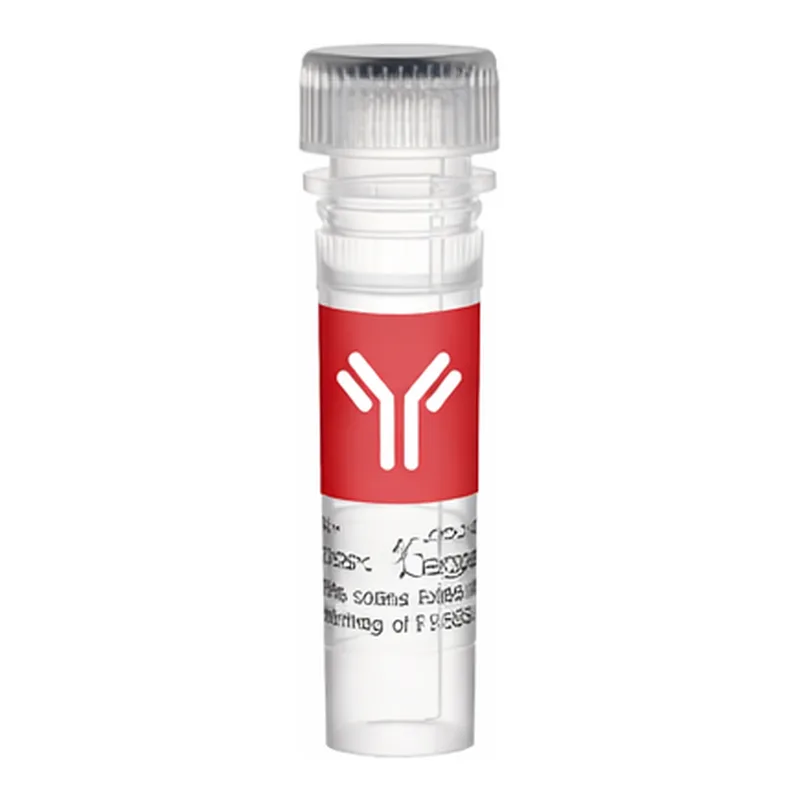
Thermo Fisher Scientific AHR Monoclonal Antibody (FF3399), PE-Cyanine7, eBioscience
인간 AHR 단백질을 인식하는 FF3399 단클론 항체로, PE-Cyanine7 형광체가 결합되어 있습니다. Flow cytometry용으로 최적화되어 있으며, 세포 내 염색에 사용 가능합니다. 고순도 친화 크로마토그래피 정제, 빛에 민감하며 4°C 암소 보관이 필요합니다.
- 판매단위
- pk
카탈로그
1개 옵션 · 카탈로그 번호를 클릭하면 복사됩니다Thermo Fisher Scientific · Thermo Fisher Scientific AHR Monoclonal Antibody (FF3399), PE-Cyanine7, eBioscience
Thermo Fisher Scientific AHR Monoclonal Antibody (FF3399), PE-Cyanine7, eBioscience™
Applications and Tested Dilution
- Flow Cytometry (Flow): 5 µL (0.5 µg)/test
- Publications: View 1 publication
Product Specifications
| 항목 | 내용 |
|---|---|
| Species Reactivity | Human |
| Published Species | Human |
| Host / Isotype | Mouse / IgG2b, kappa |
| Recommended Isotype Control | Mouse IgG2b kappa Isotype Control (eBMG2b), PE-Cyanine7, eBioscience™ |
| Class | Monoclonal |
| Type | Antibody |
| Clone | FF3399 |
| Immunogen | 21H2-AHR (aa 449–848) |
| Conjugate | PE-Cyanine7 |
| Excitation / Emission Max | 569 / 780 nm |
| Form | Liquid |
| Concentration | 5 µL/test |
| Purification | Affinity chromatography |
| Storage Buffer | PBS, pH 7.2, with 0.2% BSA |
| Contains | 0.09% sodium azide |
| Storage Conditions | 4°C, store in dark, DO NOT FREEZE |
| Shipping Conditions | Ambient (domestic); Wet ice (international) |
| RRID | AB_2573556 |
Available Formats
Product Specific Information
The FF3399 monoclonal antibody recognizes human aryl hydrocarbon receptor (AHR), a ligand-activated transcription factor mediating the toxic effects of environmental contaminants such as PCB and TCDD. AHR also binds naturally occurring compounds from fruits and vegetables and participates in normal cellular metabolism.
AHR is localized in the cytoplasm complexed with HSP90, p23, and XAP2/AIP/ARA9. Upon ligand binding, it translocates to the nucleus, dimerizes with ARNT, and binds to DNA consensus sequences (GCGTG) in promoter regions of genes such as CYP1A1. Highest expression occurs in liver cells and it plays a role in Treg and Th17 cell regulation.
- Reported Applications: Intracellular staining followed by flow cytometry
- Tested Applications: Pre-titrated for Th17-polarized human PBMCs using Intracellular Fixation & Permeabilization Buffer Set (Product #88-8824-00)
- Recommended Protocol: BestProtocols® - Protocol A
Usage: 5 µL (0.5 µg) per test (100 µL final volume, 10⁵–10⁸ cells/test)
Light Sensitivity: Protect from light; tandem dye is sensitive to photo-induced oxidation.
Fixation: Compatible with IC Fixation Buffer (Product #00-8222-49) or 1-step Fix/Lyse Solution (Product #00-5333-54); store up to 3 days at 4°C in dark.
Excitation/Emission: 488–561 nm / 775 nm (Blue, Green, Yellow-Green lasers)
Filtration: 0.2 µm post-manufacturing filtered.
Target Information
AHR (Ah Receptor) forms a complex with ARNT (HIF-1β) and Drosophila PER/SIM proteins. It contains an N-terminal PAS domain (~200 aa) and binds specific DNA enhancer sequences to initiate transcription of CYPIA1. AHR regulates xenobiotic-metabolizing enzymes, including cytochrome P450, and binds various aromatic hydrocarbons such as TCDD.
In non-ligand activated cells, AHR remains cytoplasmic complexed with HSP90. Upon ligand binding, AHR translocates to the nucleus, dissociates from HSP90, and forms a heterodimer with ARNT for DNA binding.
Associated diseases include eosinophilic fasciitis and seborrheic dermatitis.
For Research Use Only. Not for use in diagnostic procedures or resale without authorization.
제품 이미지

Thermo Fisher Scientific 상품 둘러보기
전체보기
문의
0개 · 배송·재고 문의는 실시간 상담이 빠릅니다아직 등록된 문의가 없어요.