

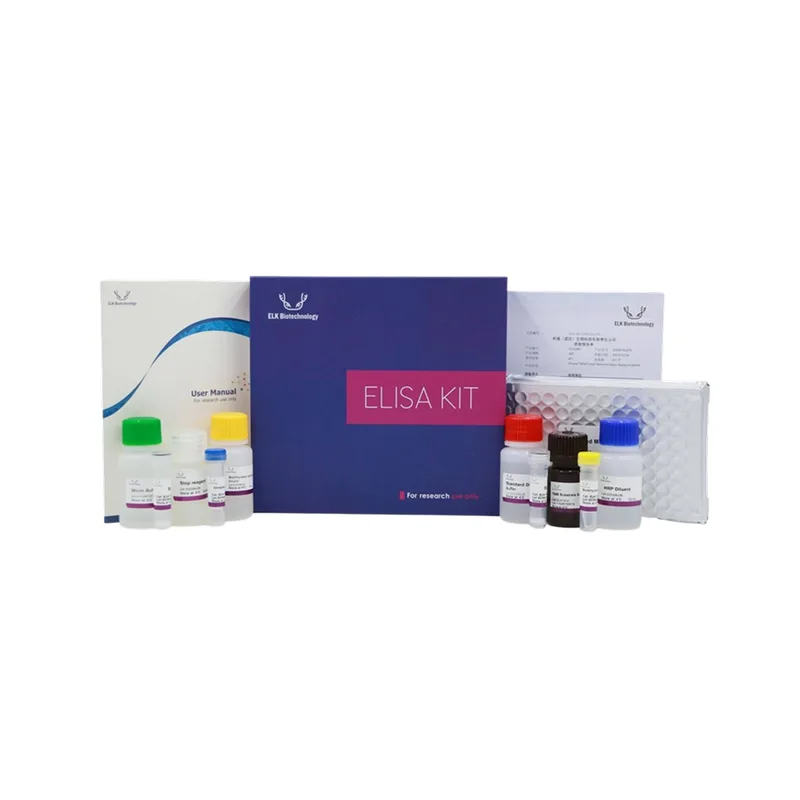
ELK Biotechnology Stat1 (Acetyl Lys410/K413) rabbit pAb
Stat1 (Acetyl Lys410/K413) rabbit polyclonal antibody로, 인간·마우스·랫트 반응성. WB, ELISA, IHC에 적합하며, 세포 내 STAT1 단백질의 아세틸화 상태 분석에 유용. -20°C 보관, 고품질 연구용 항체.
- 판매단위
- pk
카탈로그
2개 옵션 · 카탈로그 번호를 클릭하면 복사됩니다ELK Biotechnology · ELK Biotechnology Stat1 (Acetyl Lys410/K413) rabbit pAb
Stat1 (Acetyl Lys410/K413) rabbit pAb
제품 정보
| 항목 | 내용 |
|---|---|
| Product name | Stat1 (Acetyl Lys410/K413) rabbit pAb |
| Alternative Names | Signal transducer and activator of transcription 1-alpha/beta (Transcription factor ISGF-3 components p91/p84) |
| Applications | WB; ELISA; IHC |
| Recommended Dilutions | WB 1:500–2000; IHC-p 1:50–300; ELISA 1:2000–20000 |
| Immunogen | Synthesized peptide derived from human Stat1 (Acetyl Lys410/K413) |
| Storage | -20°C / 1 year |
| Host | Rabbit |
| Clonality | Polyclonal |
| Isotype | IgG |
| Concentration | 1 mg/ml |
| Observed Band | 85 kDa |
| GeneID (Human) | 6772 |
| Human Swiss-Prot No | P42224 |
| Species Reactivity | Human; Mouse; Rat |
세포 내 위치 (Cellular Localization)
Cytoplasm and nucleus. Translocated into the nucleus upon tyrosine phosphorylation and dimerization in response to IFN-gamma and FGFR signaling. Monomethylation at Lys-525 is required for phosphorylation at Tyr-701 and nuclear translocation. Also translocates to the nucleus upon interferon-beta stimulation.
Background
Defects in STAT1 are associated with Mendelian susceptibility to mycobacterial disease (MSMD) [MIM:209950], also known as familial disseminated atypical mycobacterial infection. This condition predisposes to infections by BCG vaccine strains, environmental mycobacteria, and Mycobacterium tuberculosis. In severe cases, patients may die in early childhood due to overwhelming infection, while others develop later, curable tuberculoid granulomas.
STAT1 defects can also cause STAT1 deficiency [MIM:600555], leading to susceptibility to mycobacterial or viral diseases.
Function
STAT1 mediates signaling by interferons (IFNs). Upon IFN-α/β binding, Jak kinases (TYK2, JAK1) activate STAT1 and STAT2 via tyrosine phosphorylation, forming the ISGF3 complex with IRF-9 that translocates to the nucleus and activates interferon-stimulated genes.
In response to IFN-γ, STAT1 is phosphorylated on tyrosine and serine residues, forming a homodimer (GAF) that binds to the GAS element to induce antiviral gene expression.
Post-Translational Modifications (PTM)
- Phosphorylation: On Tyr-701 and Ser-727 upon IFN-α, IFN-γ, PDGF, EGF stimulation.
- Sumoylation: By SUMO1/2/3, enhanced by IFN-γ-induced phosphorylation on Ser-727 and interaction with PIAS proteins.
- Functional impact: Phosphorylation and sumoylation regulate STAT1 activation, nuclear translocation, and transcriptional activity.
Similarity & Structure
- Belongs to the STAT transcription factor family
- Contains one SH2 domain
Subunit Interaction
- Isoform α forms homodimers upon IFN-γ-induced phosphorylation
- Heterodimerizes with STAT2 upon IFN-α/β stimulation
- Interacts with NMI, viral proteins (Sendai virus, Nipah virus, rabies virus), and HCV core protein
- Interacts with PIAS1, which inhibits STAT1 activation upon Ser-727 phosphorylation
ELK Biotechnology 상품 둘러보기
전체보기
문의
0개 · 배송·재고 문의는 실시간 상담이 빠릅니다아직 등록된 문의가 없어요.