

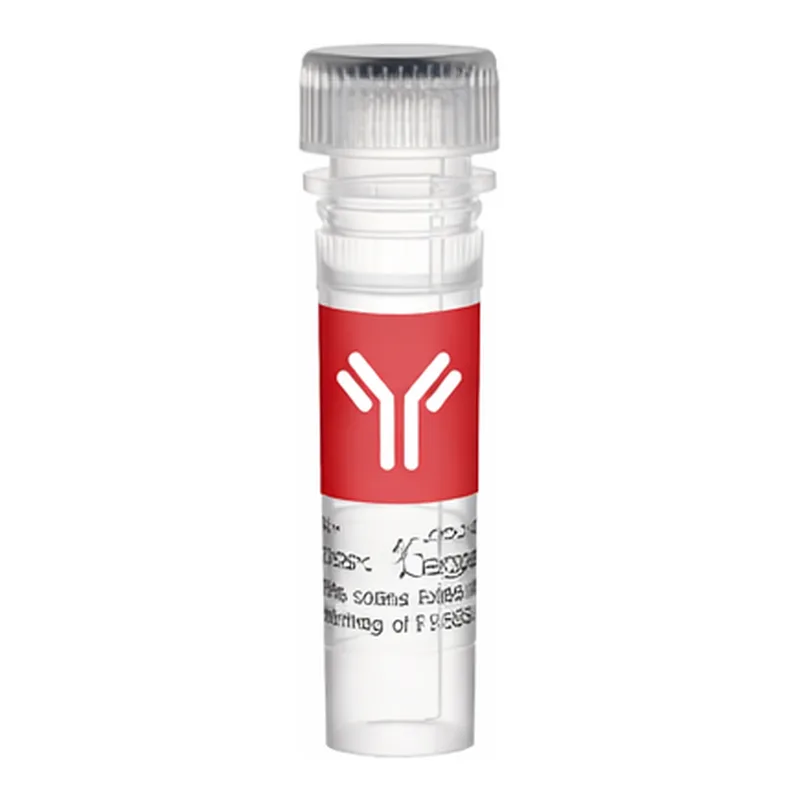
Thermo Fisher Scientific MINT3 Polyclonal Antibody
Rabbit polyclonal antibody recognizing human MINT3 protein. Validated for IHC (paraffin) with 1:50–1:200 dilution. Detects endogenous 61 kDa protein with >95% purity. Suitable for studying membrane transport and APP interaction pathways.
- 판매단위
- pk
카탈로그
1개 옵션 · 카탈로그 번호를 클릭하면 복사됩니다Thermo Fisher Scientific · Thermo Fisher Scientific MINT3 Polyclonal Antibody
Applications
- Immunohistochemistry (Paraffin) (IHC (P)): 1:50–1:200 dilution
Product Specifications
| 항목 | 내용 |
|---|---|
| Species Reactivity | Human |
| Host / Isotype | Rabbit / IgG |
| Class | Polyclonal |
| Type | Antibody |
| Immunogen | Synthetic peptide corresponding to amino acids 371–420 of human X11 gamma (MINT3, UniProt ID: O96018-1) |
| Conjugate | Unconjugated |
| Form | Liquid |
| Concentration | 1 mg/mL |
| Purification | Antigen affinity chromatography |
| Storage buffer | PBS, pH 7.2, with 50% glycerol |
| Contains | 0.02% sodium azide |
| Storage conditions | Store at 4°C short term. For long term, store at -20°C, avoiding freeze/thaw cycles. |
| Shipping conditions | Wet ice |
| RRID | AB_2553593 |
Product Specific Information
- Detects endogenous MINT3 protein at a molecular weight of approximately 61 kDa.
- Purity is >95% by SDS-PAGE.
Target Information
The munc-18 interacting protein (Mint) family consists of evolutionarily conserved adaptor proteins involved in membrane transport and organization. In mammals, three isoforms (Mint1, Mint2, and Mint3) exist. While the amino-terminal regions show little sequence conservation, the carboxy-terminal halves are highly conserved and contain PTB and PDZ domains that function as protein interaction modules.
Mint1 and Mint2 are primarily expressed in the brain and interact with Munc18, a critical component of synaptic vesicle fusion. In contrast, Mint3 is ubiquitously expressed across tissues, with lowest expression in brain and testis, and does not interact with Munc18. Instead, Mint3 binds to the amyloid precursor protein (APP) through its PTB and PDZ domains, potentially linking APP to transport machinery components and regulating its transport, endocytosis, and metabolism. Abnormal APP metabolism is implicated in early-onset Alzheimer’s disease.
For Research Use Only. Not for use in diagnostic procedures. Not for resale without express authorization.
Thermo Fisher Scientific 상품 둘러보기
전체보기
문의
0개 · 배송·재고 문의는 실시간 상담이 빠릅니다아직 등록된 문의가 없어요.