

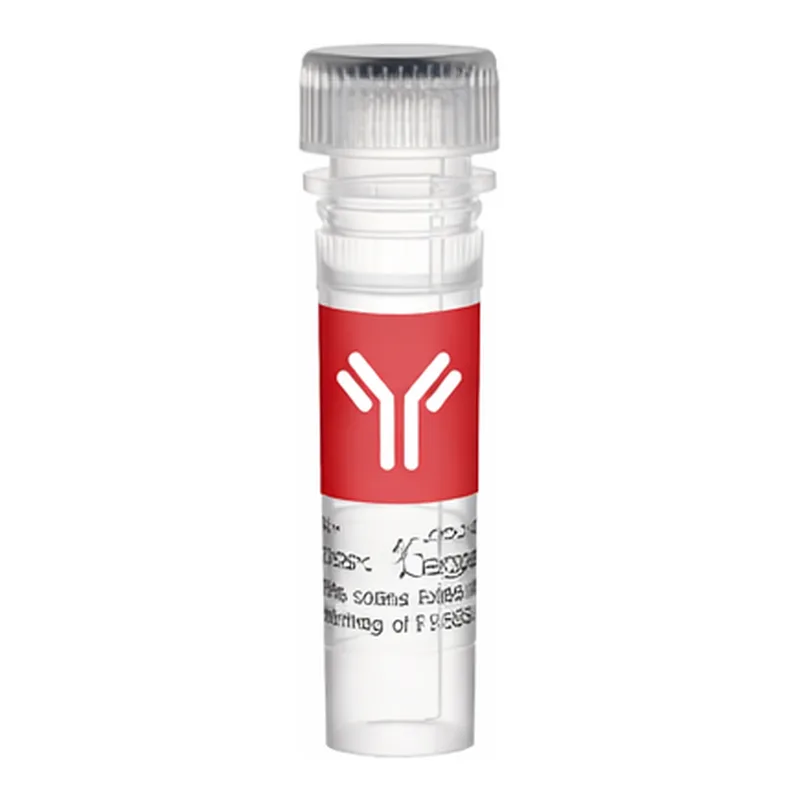
Thermo Fisher Scientific EB1/EB2/EB3 Monoclonal Antibody (KT65)
EB1/EB2/EB3 단백질을 인식하는 Rat monoclonal antibody (Clone KT65). Western blot 및 ICC/IF에 최적화. Human, Mouse, Rat 시료 반응성. Protein G 정제, 1 mg/mL 농도, PBS + 0.05% sodium azide 보존. 연구용 한정.
- 판매단위
- pk
카탈로그
1개 옵션 · 카탈로그 번호를 클릭하면 복사됩니다Thermo Fisher Scientific · Thermo Fisher Scientific EB1/EB2/EB3 Monoclonal Antibody (KT65)
Applications
Western Blot (WB)
- Tested Dilution: 1:500
Immunocytochemistry (ICC/IF)
- Tested Dilution: 1:50
Product Specifications
| 항목 | 내용 |
|---|---|
| Species Reactivity | Human, Mouse, Rat |
| Host / Isotype | Rat / IgG2a |
| Class | Monoclonal |
| Type | Antibody |
| Clone | KT65 |
| Immunogen | Clone KT65 was generated from a GST fusion protein containing amino acids from the C-terminal region of mouse EB1. This sequence is highly conserved in human and rat EB1. |
| Conjugate | Unconjugated |
| Form | Liquid |
| Concentration | 1 mg/mL |
| Purification | Protein G |
| Storage Buffer | PBS |
| Contains | 0.05% sodium azide |
| Storage Conditions | Store at 4°C short term. For long term storage, store at -20°C, avoiding freeze/thaw cycles. |
| Shipping Conditions | Wet ice |
| RRID | AB_2942694 |
Product Specific Information
The antibody detects a 30 kDa protein corresponding to the molecular mass of EB1 on SDS-PAGE immunoblots of human HeLa, mouse brain, and rat PC12 cells.
It also detects EB1 by immunocytochemistry in HeLa and A431 cells.
The antibody may weakly detect endogenous EB2 and EB3 in some cells and tissues.
Target Information
The microtubule (MT) plus-end is a crucial site for the regulation of MT dynamics and interactions by several groups of plus-end tracking proteins (+TIPs).
These +TIPs form comet-like accumulations at the plus ends of MTs to regulate MT dynamics and interactions with organelles and macromolecular complexes.
The +TIPs include diverse groups of proteins, such as motor and nonmotor proteins, MT polymerases and depolymerases, as well as various regulatory and adaptor proteins.
The CLIP-associated protein (CLASP) family includes CLASP1 and CLASP2 proteins, which are expressed as long (alpha) and short (beta) isoforms.
These +TIPs contain an N-terminal TOG domain, multiple TOG-like domains, and a basic and serine-rich motif (SxIP).
The TOG domain facilitates interaction with tubulin dimers, while the SxIP motif promotes interaction with EB1 and MTs.
A C-terminal domain is involved in interaction with CLIPs, as well as several other proteins.
CLASPs are MT-stabilizing factors that localize to mitotic spindles, kinetochores, and the midbody.
CLASPs are important for cell division and may regulate cell migration and neuronal growth cone motility.
For Research Use Only. Not for use in diagnostic procedures. Not for resale without express authorization.
Thermo Fisher Scientific 상품 둘러보기
전체보기
문의
0개 · 배송·재고 문의는 실시간 상담이 빠릅니다아직 등록된 문의가 없어요.