

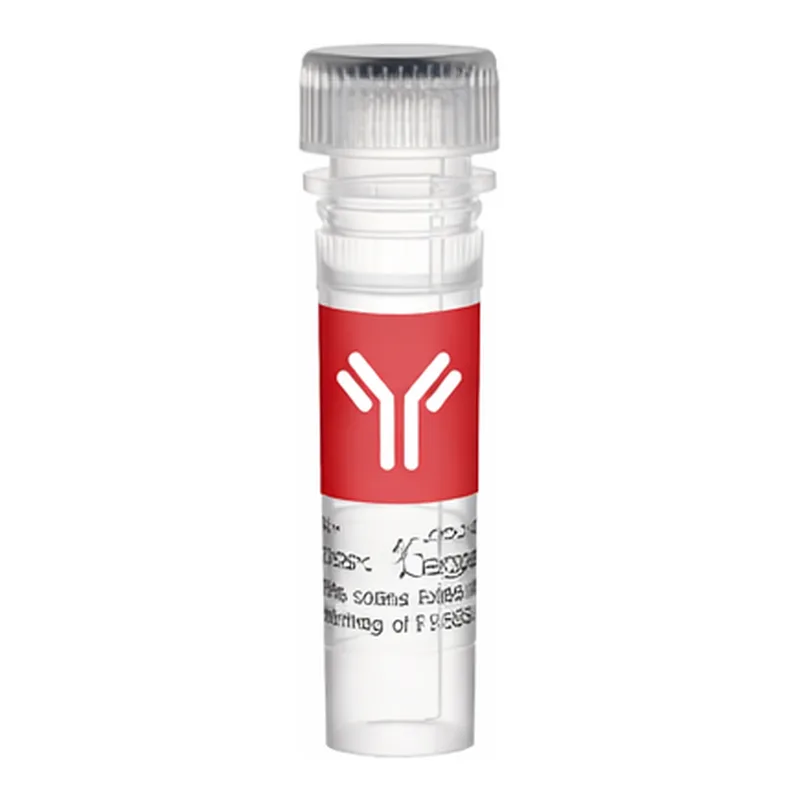
Thermo Fisher Scientific MCP-1 Recombinant Rabbit Monoclonal Antibody (29H86L56)
인간 MCP-1 단백질을 인식하는 재조합 토끼 단클론 항체로, Western blot과 면역세포염색에 적합합니다. 높은 특이성과 민감도를 제공하며, 로트 간 일관성이 우수합니다. 단백질 A로 정제된 액상형 항체로 0.5 mg/mL 농도이며, 연구용으로만 사용됩니다.
- 판매단위
- pk
카탈로그
1개 옵션 · 카탈로그 번호를 클릭하면 복사됩니다Thermo Fisher Scientific · Thermo Fisher Scientific MCP-1 Recombinant Rabbit Monoclonal Antibody (29H86L56)
Applications
Western Blot (WB)
- Tested Dilution: 0.05–0.5 µg/mL
Immunocytochemistry (ICC/IF)
- Tested Dilution: 2–5 µg/mL
Product Specifications
| 항목 | 내용 |
|---|---|
| Species Reactivity | Human |
| Host / Isotype | Rabbit / IgG |
| Expression System | Expi293 |
| Class | Recombinant Monoclonal |
| Type | Antibody |
| Clone | 29H86L56 |
| Immunogen | Proprietary |
| Conjugate | Unconjugated |
| Form | Liquid |
| Concentration | 0.5 mg/mL |
| Purification | Protein A |
| Storage Buffer | PBS |
| Contains | 0.09% sodium azide |
| Storage Conditions | Store at 4°C short term. For long term storage, store at -20°C, avoiding freeze/thaw cycles. |
| Shipping Conditions | Wet ice |
| RRID | AB_2532326 |
Product Specific Information
This antibody is predicted to react with Rhesus monkey and porcine based on sequence homology.
Intact IgG appears on a non-reducing gel as ~150 kDa band and upon reduction generates a ~25 kDa light chain band and a ~50 kDa heavy chain.
Recombinant rabbit monoclonal antibodies are produced using in vitro expression systems developed by cloning specific antibody DNA sequences from immunoreactive rabbits. Individual clones are screened to select the best candidates for production.
The advantages of recombinant rabbit monoclonal antibodies include:
- Better specificity and sensitivity
- Lot-to-lot consistency
- Animal origin-free formulations
- Broader immunoreactivity due to the larger rabbit immune repertoire
Target Information
This gene is part of a cytokine gene cluster on the q-arm of chromosome 17. Cytokines are secreted proteins involved in immunoregulatory and inflammatory processes.
The encoded protein is structurally related to the CXC subfamily of cytokines, characterized by two cysteines separated by a single amino acid.
This cytokine shows chemotactic activity for monocytes and basophils but not for neutrophils or eosinophils.
It is implicated in diseases with monocytic infiltrates such as psoriasis, rheumatoid arthritis, and atherosclerosis.
It binds to chemokine receptors CCR2 and CCR4.
For Research Use Only. Not for use in diagnostic procedures. Not for resale without express authorization.
Thermo Fisher Scientific 상품 둘러보기
전체보기
문의
0개 · 배송·재고 문의는 실시간 상담이 빠릅니다아직 등록된 문의가 없어요.