

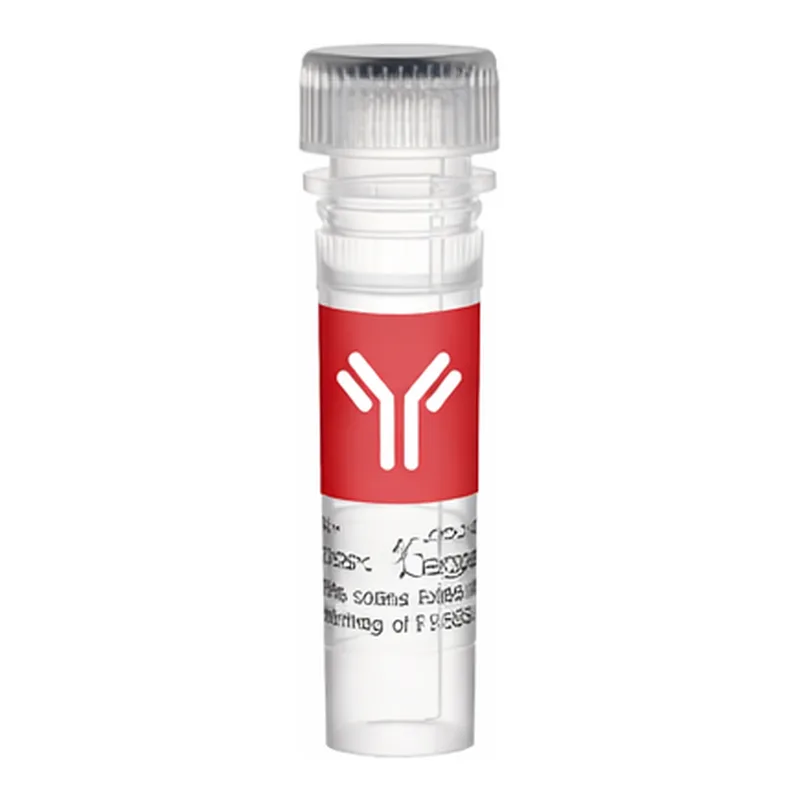
Thermo Fisher Scientific c-Myc Monoclonal Antibody (OTI5G3), TrueMAB
c-Myc 단백질을 인식하는 마우스 단클론 항체로 Western blot, IHC, ICC에 적합합니다. 인간 시료에 반응하며, 동결건조 상태로 제공됩니다. 세포 증식 및 종양 연구용으로 활용 가능하며, 재구성 후 1 mg/mL 농도로 사용 가능합니다.
- 판매단위
- pk
카탈로그
1개 옵션 · 카탈로그 번호를 클릭하면 복사됩니다Thermo Fisher Scientific · Thermo Fisher Scientific c-Myc Monoclonal Antibody (OTI5G3), TrueMAB
Applications and Tested Dilutions
| Application | Tested Dilution |
|---|---|
| Western Blot (WB) | 1:50–1:100 |
| Immunohistochemistry (Paraffin) (IHC-P) | 1:50 |
| Immunocytochemistry (ICC/IF) | 1:100 |
Product Specifications
| 항목 | 내용 |
|---|---|
| Species Reactivity | Human |
| Host / Isotype | Mouse / IgG2b |
| Class | Monoclonal |
| Type | Antibody |
| Clone | OTI5G3 |
| Immunogen | Full-length human recombinant protein of human Myc produced in E. coli |
| Conjugate | Unconjugated |
| Form | Lyophilized |
| Concentration | 1 mg/mL |
| Purification | Affinity chromatography |
| Storage Buffer | PBS, pH 7.3, with 8% trehalose |
| Contains | No preservative |
| Storage Conditions | -20°C, Avoid Freeze/Thaw Cycles |
| Shipping Conditions | Ambient (domestic); Wet ice (international) |
Product Specific Information
For reconstitution, add 100 µL distilled water to achieve a final antibody concentration of approximately 1 mg/mL.
For conjugation experiments, perform an additional desalting step (e.g., Zeba Spin Desalting Columns, 7K MWCO, 0.5 mL, Product #89882).
Target Information
The c-Myc protein is a 62 kDa transcription factor encoded by the c-Myc gene located on human chromosome 8q24. It is frequently activated in various tumor cells and plays a key role in cellular proliferation, differentiation, apoptosis, and cell cycle progression.
Phosphorylation at Thr58/Ser62 by kinases such as GSK3, CDK, ERK2, and JNK is functionally associated with proliferation and cell cycle regulation. c-Myc is essential for vasculogenesis and angiogenesis in tumor development.
Overexpression or amplification of the c-Myc gene is observed in multiple cancers, including lung, breast, and colon carcinomas. Translocations involving the c-Myc locus are implicated in Burkitt’s lymphoma and other B-cell proliferative disorders.
Antibodies against c-Myc epitopes can detect Myc-tagged fusion proteins at either the amino or carboxy termini. The Myc family (c-Myc, N-Myc, L-Myc) is involved in proliferation, differentiation, and oncogenesis.
For Research Use Only. Not for use in diagnostic procedures. Not for resale without express authorization.
Thermo Fisher Scientific 상품 둘러보기
전체보기
문의
0개 · 배송·재고 문의는 실시간 상담이 빠릅니다아직 등록된 문의가 없어요.