

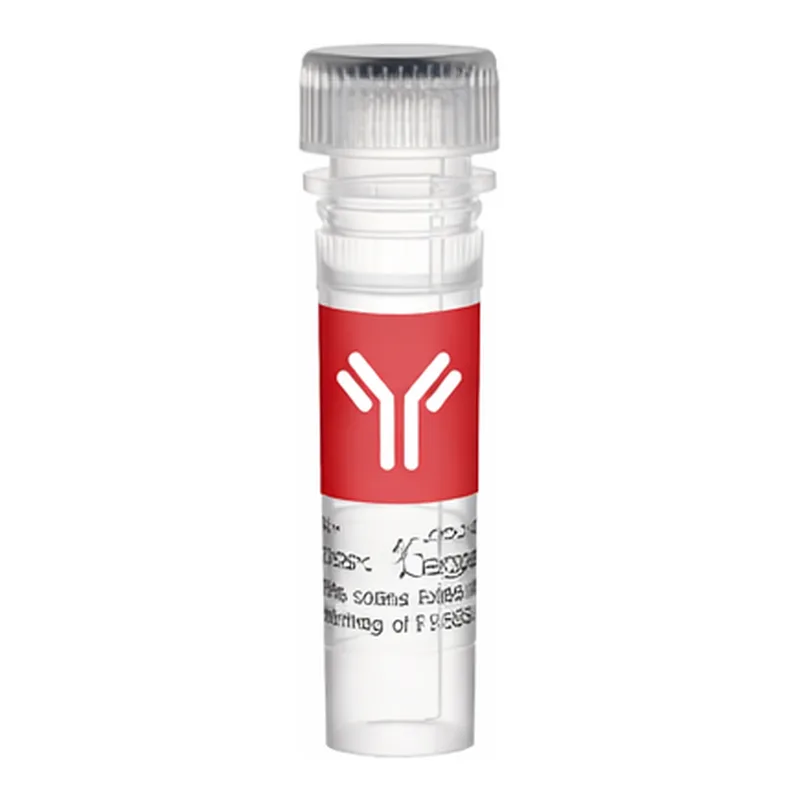
Thermo Fisher Scientific H2BR79me1 Recombinant Rabbit Monoclonal Antibody (ST0430)
H2BR79me1에 특이적인 재조합 토끼 단일클론 항체로, IHC(P) 및 ICC/IF에 사용 가능. 인간과 생쥐 시료에 반응하며, 단백질 A로 정제된 고순도 항체. 단기 4°C, 장기 -20°C 보관 권장. 연구용으로만 사용.
- 판매단위
- pk
카탈로그
1개 옵션 · 카탈로그 번호를 클릭하면 복사됩니다Thermo Fisher Scientific · Thermo Fisher Scientific H2BR79me1 Recombinant Rabbit Monoclonal Antibody (ST0430)
Applications and Tested Dilution
| Application | Tested Dilution |
|---|---|
| Immunohistochemistry (Paraffin) (IHC (P)) | 1:50–1:200 |
| Immunocytochemistry (ICC/IF) | 1:50–1:200 |
Product Specifications
| 항목 | 내용 |
|---|---|
| Species Reactivity | Human, Mouse |
| Host / Isotype | Rabbit / IgG |
| Expression System | HEK293 cells |
| Class | Recombinant Monoclonal |
| Type | Antibody |
| Clone | ST0430 |
| Immunogen | Recombinant protein |
| Conjugate | Unconjugated |
| Form | Liquid |
| Concentration | 1 mg/mL |
| Purification | Protein A |
| Storage Buffer | TBS, pH 7.4, with 0.05% BSA, 40% glycerol |
| Contains | 0.05% sodium azide |
| Storage Conditions | Store at 4°C short term. For long term storage, store at -20°C, avoiding freeze/thaw cycles. |
| Shipping Conditions | Wet ice |
| RRID | AB_2898873 |
Product Specific Information
This antibody is predicted to work in Western Blot at a dilution of 1:1,000.
Target Information
Eukaryotic histones are basic, water-soluble nuclear proteins that form hetero-octameric nucleosome particles by wrapping 146 base pairs of DNA in a left-handed super-helical turn to form chromosomal fiber. Two molecules of each of the four core histones (H2A, H2B, H3, and H4) form the octamer, consisting of two H2A-H2B dimers and two H3-H4 dimers, creating two nearly symmetrical halves by tertiary structure. Over 80% of nucleosomes contain the linker Histone H1, derived from an intronless gene, which interacts with linker DNA between nucleosomes and mediates compaction into higher-order chromatin. Histones undergo posttranslational modifications primarily on their N-terminal tails, including methylation, citrullination, acetylation, phosphorylation, sumoylation, ubiquitination, and ADP-ribosylation.
For Research Use Only. Not for use in diagnostic procedures. Not for resale without express authorization.
Thermo Fisher Scientific 상품 둘러보기
전체보기
문의
0개 · 배송·재고 문의는 실시간 상담이 빠릅니다아직 등록된 문의가 없어요.