

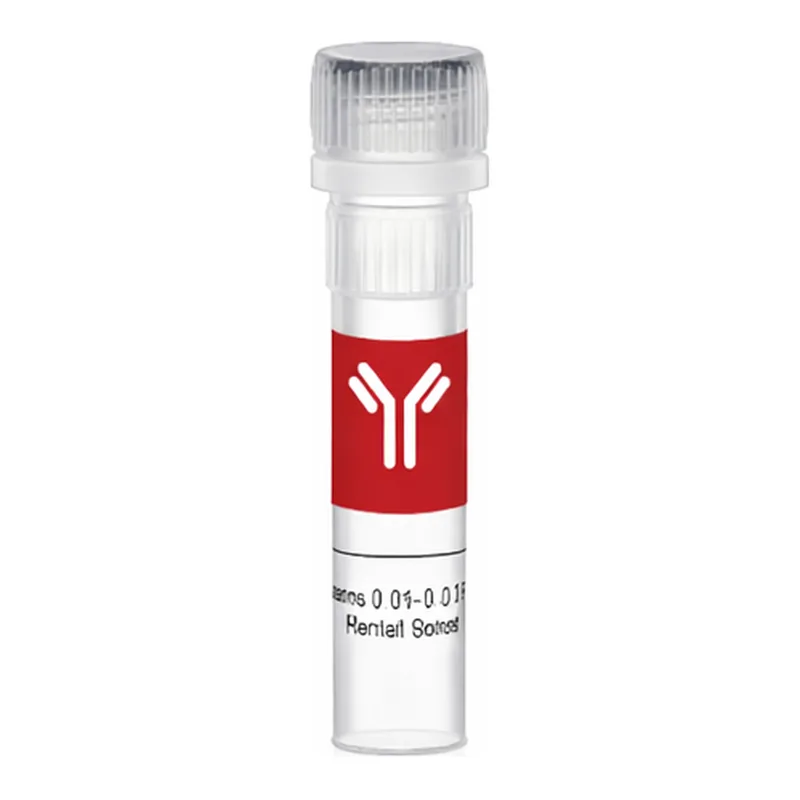
Thermo Fisher Scientific Mouse CCL8 (MCP-2) Recombinant Protein
Recombinant Mouse CCL8 (MCP-2) 단백질로, E. coli 발현 시스템에서 생산된 고순도(>98%) 단백질입니다. 면역세포 화학주성 시험에 적합하며, Western blot, IHC, ELISA 등에 활용 가능합니다. Carrier-free 형태로 제공되며, 장기 보관은 -20°C에서 권장됩니다.
- 카테고리
- Protein
- 판매단위
- pk
카탈로그
1개 옵션 · 카탈로그 번호를 클릭하면 복사됩니다Thermo Fisher Scientific · Thermo Fisher Scientific Mouse CCL8 (MCP-2) Recombinant Protein
Applications
| Application | Tested Dilution | Notes |
|---|---|---|
| Western Blot (WB) | Assay-dependent | |
| Immunohistochemistry (IHC) | Assay-dependent | |
| ELISA | Assay-dependent | |
| Control (Ctrl) | Assay-dependent |
Product Specifications
| 항목 | 내용 |
|---|---|
| Species | Mouse |
| Expression System | E. coli |
| Amino Acid Sequence | Mouse CCL8 recombinant protein contains 74 amino acids |
| Molecular Weight | 8.5 kDa |
| Class | Recombinant |
| Type | Protein |
| Purity | >98% by SDS-PAGE |
| Endotoxin Concentration | <0.1 ng/µg |
| Activity | ED50 = 10–100 ng/mL; determined by the dose-dependent chemotaxis of human PBMCs |
| Conjugate | Unconjugated |
| Form | Lyophilized |
| Purification | Purified |
| Contains | No preservative |
| Storage Conditions | -20°C |
| Shipping Conditions | Wet ice (domestic); Wet or Dry ice (international) |
Product Specific Information
Carrier-Free
Reconstitution:
We recommend briefly centrifuging the vial before opening to bring contents to the bottom. Reconstitute in sterile, distilled water to a concentration of 0.1–1.0 mg/mL. Further dilutions should be made in aqueous buffers supplemented with carrier protein (e.g., 0.1–1.0% BSA).
Storage:
This lyophilized preparation is stable at 2°C to 8°C, but should be stored at -20°C for long-term storage, preferably desiccated.
Upon reconstitution, the preparation is stable for up to one week at 2°C to 8°C. For maximal stability, divide into working aliquots and store at -20°C. Avoid repeated freeze/thaw cycles.
Target Information
This antimicrobial gene is one of several chemokine genes clustered on the q-arm of chromosome 17.
Chemokines form a superfamily of secreted proteins involved in immunoregulatory and inflammatory processes.
The superfamily is divided into four subfamilies based on the arrangement of N-terminal cysteine residues of the mature peptide.
This chemokine belongs to the CC subfamily, characterized by two adjacent cysteine residues.
It exhibits chemotactic activity for monocytes, lymphocytes, basophils, and eosinophils.
By recruiting leukocytes to sites of inflammation, this cytokine may contribute to tumor-associated leukocyte infiltration and to the antiviral state against HIV infection.
For Research Use Only. Not for use in diagnostic procedures. Not for resale without express authorization.
Thermo Fisher Scientific 상품 둘러보기
전체보기
문의
0개 · 배송·재고 문의는 실시간 상담이 빠릅니다아직 등록된 문의가 없어요.