

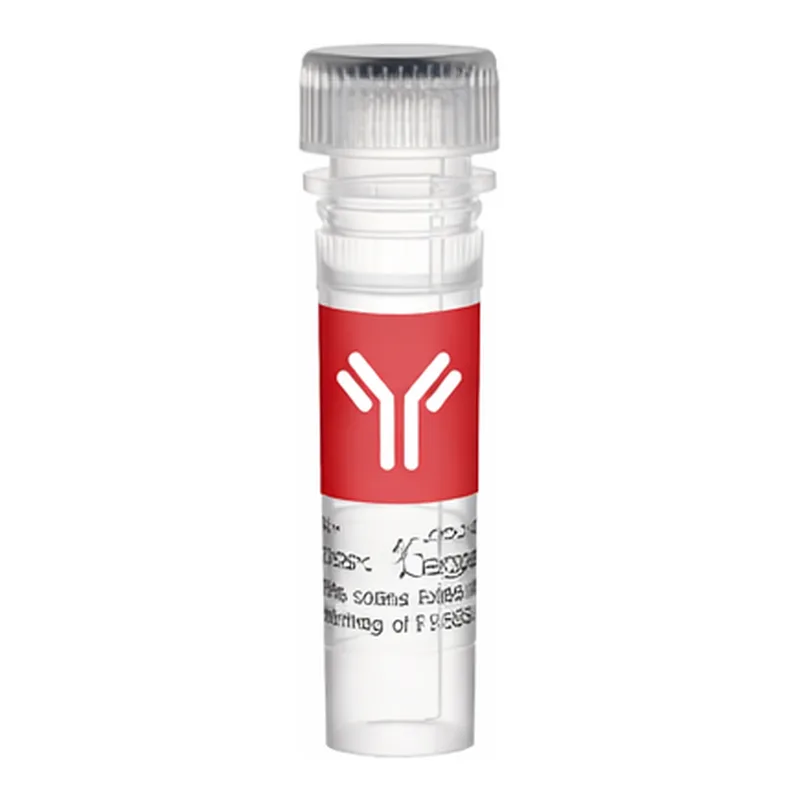
Thermo Fisher Scientific PTPRK Polyclonal Antibody
Rabbit polyclonal antibody against human PTPRK for IHC and ICC applications. Validated for paraffin-embedded tissues and cultured cells. Affinity purified with recombinant antigen. Supplied in PBS with glycerol and sodium azide. For research use only.
- 판매단위
- pk
카탈로그
1개 옵션 · 카탈로그 번호를 클릭하면 복사됩니다Thermo Fisher Scientific · Thermo Fisher Scientific PTPRK Polyclonal Antibody
Applications and Tested Dilutions
| Application | Tested Dilution |
|---|---|
| Immunohistochemistry (Paraffin) (IHC-P) | 1:500–1:1,000 |
| Immunocytochemistry (ICC/IF) | 0.25–2 µg/mL |
Product Specifications
| Property | Description |
|---|---|
| Species Reactivity | Human |
| Host / Isotype | Rabbit / IgG |
| Class | Polyclonal |
| Type | Antibody |
| Immunogen | Recombinant protein corresponding to Human PTPRK (Recombinant protein control fragment: Product #RP-101384) |
| Conjugate | Unconjugated |
| Form | Liquid |
| Concentration | 0.1 mg/mL |
| Purification | Antigen affinity chromatography |
| Storage Buffer | PBS, pH 7.2, with 40% glycerol |
| Contains | 0.02% sodium azide |
| Storage Conditions | Store at 4°C short term. For long term, store at -20°C. Avoid freeze/thaw cycles. |
| Shipping Conditions | Wet ice |
| RRID | AB_2646132 |
Product Specific Information
Immunogen sequence:
MTHMVNAMDR SYADQSTLHA EDPLSITFMD QHNFSPRYEN HSATAESSRL LDVPRYLCE
Antigen sequence identity:
Mouse – 98%, Rat – 98%
Target Information
Protein tyrosine phosphatases (PTPs) are type I transmembrane, membrane-associated, or nuclear proteins. Examples include LAR, PTPα, PTPβ, PTPγ, PTPδ, PTPε, PTPζ, PTPκ, and PTPμ. These enzymes play diverse roles in development and adult tissue function.
LAR regulates insulin receptor phosphorylation, while PTPα activity increases upon phorbol ester stimulation, influencing PKC-mediated phosphorylation. PTPε expression is induced by v-H-ras and Neu in mammary tumors. Alternative splicing of PTPζ produces phosphacan, a nervous tissue-specific proteoglycan. PTPκ and PTPμ share a conserved MAM domain facilitating homophilic binding, and PTPμ localizes at cell contacts, potentially regulating cadherin/catenin complexes.
For Research Use Only. Not for use in diagnostic procedures. Not for resale without express authorization.
Thermo Fisher Scientific 상품 둘러보기
전체보기
문의
0개 · 배송·재고 문의는 실시간 상담이 빠릅니다아직 등록된 문의가 없어요.