

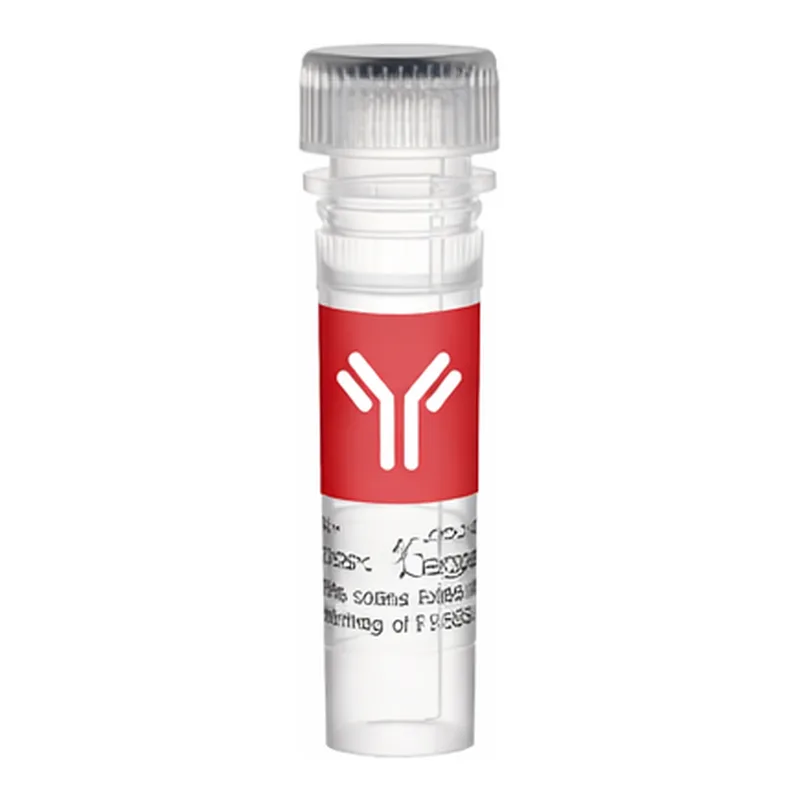
Thermo Fisher Scientific TCRa/b Monoclonal Antibody (IP26)
인간 TCRα/β를 인식하는 마우스 단클론 항체(IP26)로, IHC(P) 및 유세포분석에 적합합니다. 비결합형 액상 형태이며, Protein A로 정제되었습니다. 단기 4°C, 장기 -20°C 보관 권장. 연구용으로만 사용 가능합니다.
- 판매단위
- pk
카탈로그
1개 옵션 · 카탈로그 번호를 클릭하면 복사됩니다Thermo Fisher Scientific · Thermo Fisher Scientific TCRa/b Monoclonal Antibody (IP26)
Applications and Tested Dilution
| Application | Tested Dilution |
|---|---|
| Immunohistochemistry (Paraffin) (IHC (P)) | 2–10 µg/mL |
| Flow Cytometry (Flow) | 0.5–5 µg/10⁶ cells |
Product Specifications
| 항목 | 내용 |
|---|---|
| Species Reactivity | Human |
| Host / Isotype | Mouse / IgG1 |
| Class | Monoclonal |
| Type | Antibody |
| Clone | IP26 |
| Immunogen | A recombinant protein of human TCRα/β |
| Conjugate | Unconjugated |
| Form | Liquid |
| Concentration | 0.5 mg/mL |
| Purification | Protein A |
| Storage Buffer | PBS with proprietary stabilizer |
| Contains | 0.01% sodium azide |
| Storage Conditions | Store at 4°C short term. For long term storage, store at -20°C, avoiding freeze/thaw cycles. |
| Shipping Conditions | Ambient (domestic); Wet ice (international) |
Product Specific Information
- Positive control: Tonsil
- Cellular location: Membrane
Target Information
The T cell antigen receptor (TCR) consists of a ligand-specific alpha/beta heterodimer non-covalently associated with five invariant chains including the CD3 gamma/delta/eta and zeta subunits, all of which are required for efficient surface expression.
T cell activation through the TCR induces cellular differentiation and/or proliferation and the production of lymphokines and cytokines. Both the CD3 and TCR zeta subunits are proposed to be responsible for the intracellular signal transduction events.
The majority of T cells in blood, lymph, and secondary lymphoid organs express TCR alpha/beta heterodimers, whereas T cells expressing TCR gamma/delta heterodimers are mainly localized in epithelial tissues and infection sites.
The subunits of TCR heterodimers are covalently bonded and associate with CD3 subunits in the endoplasmic reticulum to form a functional TCR-CD3 complex. Lack of expression of any chain halts surface expression.
T cell receptors (TCR) discriminate foreign from self-peptides presented by MHC class II molecules, which is essential for effective adaptive immune responses. Recognition of self-peptides by TCRs is linked to autoimmune diseases, and mutant self-peptides have been associated with tumors.
Engagement of TCRs by bacterial superantigens can cause toxic shock syndrome. Autoantibodies to V beta segments of TCRs have been identified in patients with rheumatoid arthritis (RA) and systemic lupus erythematosus (SLE), potentially modulating TH1-mediated inflammatory responses.
Most human T cells express TCR alpha-beta and either CD4 or CD8 (single positive, SP). A smaller subset lacks both CD4 and CD8 (double negative, DN), which may increase in autoimmune or immunodeficiency disorders. Gamma-delta T cells, primarily found in epithelial tissues, show less TCR diversity and distinct antigen recognition, with some subsets exhibiting antitumor and immunoregulatory activity.
For Research Use Only. Not for use in diagnostic procedures. Not for resale without express authorization.
Thermo Fisher Scientific 상품 둘러보기
전체보기
문의
0개 · 배송·재고 문의는 실시간 상담이 빠릅니다아직 등록된 문의가 없어요.