

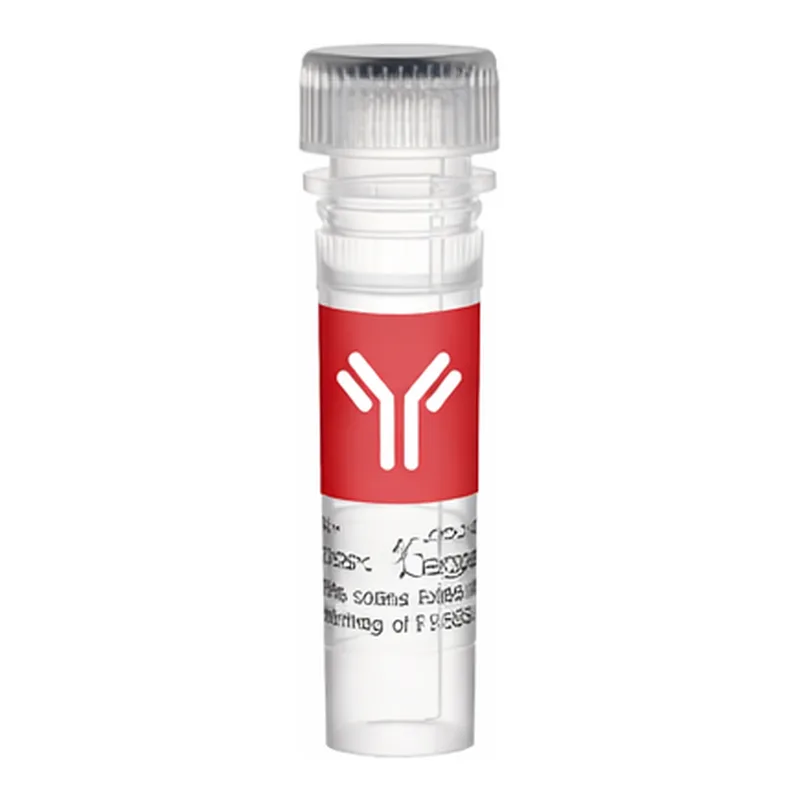
Thermo Fisher Scientific CD86 (B7-2) Monoclonal Antibody (GL1), PerCP-eFluor 710, eBioscience
마우스 CD86(B7-2)을 인식하는 GL1 클론 단일클론 항체로, PerCP-eFluor 710 형광체가 결합되어 있습니다. Flow Cytometry에 최적화되어 있으며, 높은 특이성과 안정성을 제공합니다. 면역반응 연구 및 T세포 활성화 분석에 적합합니다.
- 판매단위
- pk
카탈로그
2개 옵션 · 카탈로그 번호를 클릭하면 복사됩니다Thermo Fisher Scientific · Thermo Fisher Scientific CD86 (B7-2) Monoclonal Antibody (GL1), PerCP-eFluor 710, eBioscience
Applications
Immunocytochemistry (ICC/IF)
- Not tested
View 1 publication
Flow Cytometry (Flow)
- Tested Dilution: 0.25 µg/test
View 100 publications
Product Specifications
| 항목 | 내용 |
|---|---|
| Species Reactivity | Mouse |
| Published Species | Human |
| Host / Isotype | Rat / IgG2a, kappa |
| Recommended Isotype Control | Rat IgG2a kappa Isotype Control (eBR2a), PerCP-eFluor™ 710, eBioscience™ |
| Class | Monoclonal |
| Type | Antibody |
| Clone | GL1 |
| Conjugate | PerCP-eFluor™ 710 |
| Excitation / Emission Max | 482 / 708 nm |
| Form | Liquid |
| Concentration | 0.2 mg/mL |
| Purification | Affinity chromatography |
| Storage Buffer | PBS, pH 7.2 |
| Contains | 0.09% sodium azide |
| Storage Conditions | 4°C, store in dark, DO NOT FREEZE |
| Shipping Conditions | Ambient (domestic); Wet ice (international) |
| RRID | AB_2815139 |
Available Formats
- Unconjugated
- Alexa Fluor 700
- APC
- APC-eFluor 780
- Biotin
- Brilliant UV 395
- Brilliant UV 737
- Brilliant Violet 605
- Brilliant Violet 786
- eFluor 450
- FITC
- PE
- PE-Cyanine5
- PE-Cyanine7
- Super Bright 436
- Super Bright 600
- Super Bright 645
- Super Bright 702
- Request custom conjugation
Product Specific Information
The GL1 monoclonal antibody reacts with mouse CD86 (~80 kDa surface receptor, also known as B7-2). CD86 and CD80 are members of the B7 family of costimulatory molecules. CD86 is expressed at low levels on B cells, macrophages, and dendritic cells, and is upregulated through stimuli such as BCR complex, CD40, and cytokine receptors. It is also expressed by activated mouse T cells and thioglycolate-elicited peritoneal cells.
CD86 interacts with CD28 and CD152 (CTLA-4) on T cells, playing a key role in T-B cell crosstalk, costimulation, autoantibody production, and Th2-mediated Ig production. Its upregulation kinetics support its major role during the primary immune response phase.
- Applications Reported: Flow cytometric analysis
- Applications Tested: Flow cytometric analysis of stimulated mouse splenocytes (≤0.25 µg/test)
- A test is defined as the antibody amount staining a cell sample in 100 µL final volume.
- Cell number: 10⁵–10⁸ cells/test (empirical determination recommended).
- Antibody titration recommended for optimal assay performance.
Fluorochrome Information:
PerCP-eFluor 710 emits at 710 nm and is excited with the blue laser (488 nm). Recommended filter: 710/50 bandpass (695/40 acceptable alternative). Ensure instrument compatibility.
Light Sensitivity:
Sensitive to photo-induced oxidation. Protect vial and samples from light.
Fixation:
Samples can be stored in IC Fixation Buffer (Product #00-8222-49) or 1-step Fix/Lyse Solution (Product #00-5333-57) for up to 3 days at 4°C in the dark with minimal brightness and FRET efficiency impact.
Excitation: 488 nm
Emission: 710 nm
Laser: Blue Laser
Target Information
CD86 is a ligand for CTLA4 and CD28, acting as a costimulatory molecule in T-cell activation during antigen presentation. Insufficient co-stimulation via CD86/CD80 can induce tolerance. CD86 is a type I membrane protein of the immunoglobulin superfamily expressed by antigen-presenting cells.
- Functions:
- Ligand for CD28 and CTLA-4 on T cells
- Costimulatory signal for T-cell activation
- Negative regulation of T-cell activation via CTLA-4 binding
Alternative splicing produces multiple transcript variants of CD86. Diseases associated with CD86 dysfunction include gallbladder squamous cell carcinoma and myocarditis.
For Research Use Only. Not for use in diagnostic procedures. Not for resale without express authorization.
제품 이미지

Thermo Fisher Scientific 상품 둘러보기
전체보기
문의
0개 · 배송·재고 문의는 실시간 상담이 빠릅니다아직 등록된 문의가 없어요.