

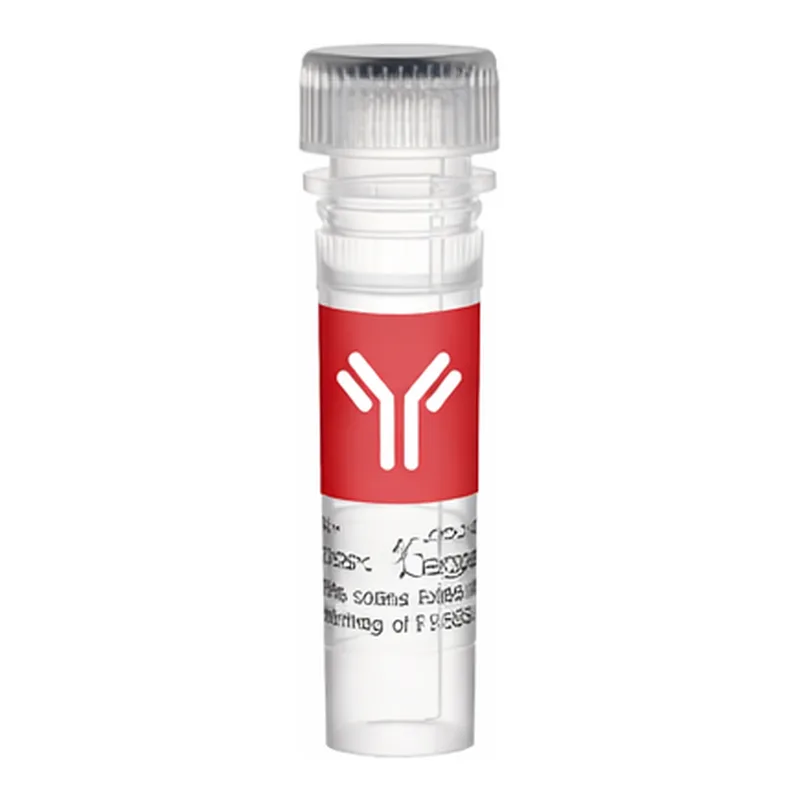
Thermo Fisher Scientific CD366 (TIM3) Monoclonal Antibody (8B.2C12), Super Bright 436, eBioscience
마우스 CD366(TIM3)을 인식하는 8B.2C12 클론의 단일클론 항체로, Super Bright 436 형광체로 결합됨. Th1/Tc1 세포 표면 단백질 분석에 적합하며, Flow Cytometry에 최적화. 405 nm 레이저로 여기, 436 nm에서 방출. 연구용으로만 사용.
- 판매단위
- pk
카탈로그
2개 옵션 · 카탈로그 번호를 클릭하면 복사됩니다Thermo Fisher Scientific · Thermo Fisher Scientific CD366 (TIM3) Monoclonal Antibody (8B.2C12), Super Bright 436, eBioscience
Thermo Fisher Scientific CD366 (TIM3) Monoclonal Antibody (8B.2C12), Super Bright 436, eBioscience
Applications and Tested Dilution
| Application | Tested Dilution | Publications |
|---|---|---|
| Western Blot (WB) | - | View 1 publication |
| Flow Cytometry (Flow) | 0.125 µg/test | View 1 publication |
| Immunoprecipitation (IP) | - | View 1 publication |
Product Specifications
| Specification | Description |
|---|---|
| Published species | Not Applicable |
| Host / Isotype | Rat / IgG1, kappa |
| Recommended Isotype Control | Rat IgG1 kappa Isotype Control (eBRG1), Super Bright™ 436, eBioscience™ |
| Class | Monoclonal |
| Type | Antibody |
| Clone | 8B.2C12 |
| Conjugate | Super Bright™ 436 |
| Excitation / Emission Max | 413 / 431 nm |
| Form | Liquid |
| Concentration | 0.2 mg/mL |
| Storage Conditions | 4°C, store in dark, DO NOT FREEZE |
| Shipping Conditions | Wet ice |
| RRID | AB_2734974 |
Additional Formats Available:
- Unconjugated
- Alexa Fluor 488
- APC
- APC-eFluor 780
- Biotin
- eFluor 450
- Functional Grade
- PE
- PerCP-eFluor 710
- Super Bright 600
- Super Bright 645
- Request custom conjugation
Product Specific Information
The 8B.2C12 monoclonal antibody reacts with mouse CD366 (TIM3), a Th1-specific cell surface protein. CD366 is a type I transmembrane protein containing immunoglobulin and mucin-like domains extracellularly and a tyrosine phosphorylation motif intracellularly. It is expressed selectively by differentiated CD4⁺ Th1 and CD8⁺ Tc1 cells but absent on Th2 and Tc2. Other hematopoietic cells, including naive T cells, B cells, macrophages, and dendritic cells, do not express CD366 at the protein level.
Expression of CD366 increases at a late stage of T cell differentiation, suggesting a role in Th1 effector function rather than differentiation. In EAE models, CD366 is expressed on most CD4⁺ and CD8⁺ T cells in the CNS during disease onset. Administration of 8B.2C12 in vivo resulted in a hyperacute disease phenotype, indicating CD366 engagement may enhance macrophage activation and autoimmune severity. The Tim gene family is implicated in autoimmunity and allergy regulation.
The 8B.2C12 antibody binds strongly to the BALB/c allele of CD366 and weakly to the C57Bl/6 allele.
Applications Reported: Flow cytometric analysis
Applications Tested: Tested on mouse splenocytes; ≤0.125 µg/test (100 µL final volume). Optimize titration for best performance.
Super Bright 436 is excited with a 405 nm violet laser and emits at 436 nm. Recommended filter: 450/50 bandpass or equivalent. Ensure instrument compatibility.
When using multiple Super Bright dye-conjugated antibodies, use Super Bright Complete Staining Buffer (Product # SB-4401) to minimize non-specific polymer interactions.
Excitation: 405 nm
Emission: 436 nm
Laser: Violet
Super Bright Polymer Dyes are sold under license from Becton, Dickinson and Company.
Target Information
TIM3 (HAVCR2) is a 281 amino acid, type I Th1-specific surface glycoprotein expressed on terminally differentiated CD4⁺ Th1 and CD8⁺ Tc1 cells. It includes an IgV-like domain, mucin-like domain, and a conserved tyrosine phosphorylation motif. TIM3 participates in macrophage activation and autoimmune disease induction, down-regulating aggressive Th1 responses and promoting immune tolerance. Its pathological relevance is observed in experimental autoimmune encephalomyelitis (EAE), enhancing disease severity in mice.
For Research Use Only. Not for use in diagnostic procedures. Not for resale without express authorization.
제품 이미지

Thermo Fisher Scientific 상품 둘러보기
전체보기
문의
0개 · 배송·재고 문의는 실시간 상담이 빠릅니다아직 등록된 문의가 없어요.