

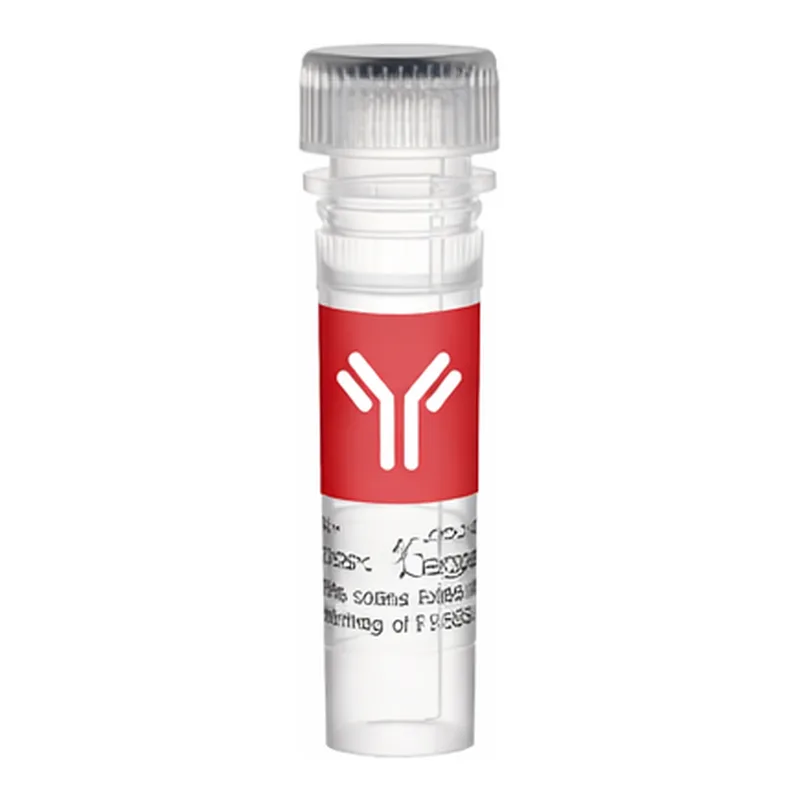
Thermo Fisher Scientific Progesterone Receptor Monoclonal Antibody (KMC912), Biotin, eBioscience
인간 프로게스테론 수용체(PR)를 인식하는 단클론 항체로, Biotin으로 표지된 KMC912 클론입니다. IHC 및 ICC/IF에 사용 가능하며, 0.5 mg/mL 농도의 액상 제품입니다. Affinity chromatography로 정제되었으며, 4°C 암소 보관이 권장됩니다.
- 판매단위
- pk
카탈로그
1개 옵션 · 카탈로그 번호를 클릭하면 복사됩니다Thermo Fisher Scientific · Thermo Fisher Scientific Progesterone Receptor Monoclonal Antibody (KMC912), Biotin, eBioscience
Thermo Fisher Scientific Progesterone Receptor Monoclonal Antibody (KMC912), Biotin, eBioscience™
Applications and Tested Dilution
| Application | Tested Dilution |
|---|---|
| Immunohistochemistry (Paraffin) (IHC (P)) | 2.5 µg/mL |
| Immunocytochemistry (ICC/IF) | Assay-Dependent |
Product Specifications
| 항목 | 내용 |
|---|---|
| Species Reactivity | Human |
| Host / Isotype | Mouse / IgG1, kappa |
| Recommended Isotype Control | Mouse IgG1 kappa Isotype Control (P3.6.2.8.1), Biotin, eBioscience™ |
| Class | Monoclonal |
| Type | Antibody |
| Clone | KMC912 |
| Conjugate | Biotin |
| Form | Liquid |
| Concentration | 0.5 mg/mL |
| Purification | Affinity chromatography |
| Storage Buffer | PBS, pH 7.2 |
| Contains | 0.09% sodium azide |
| Storage Conditions | 4°C, store in dark, DO NOT FREEZE |
| Shipping Conditions | Ambient (domestic); Wet ice (international) |
| RRID | AB_2572831 |
| Filtration | 0.2 µm post-manufacturing filtered |
Additional Formats
Product Specific Information
This KMC912 monoclonal antibody reacts with human progesterone receptor (PgR, PR), a member of a superfamily of nuclear receptors that are ligand-dependent transcriptional regulators. The human PgR exists in alpha and beta forms (94 kDa and 120 kDa respectively). In most human cells, both forms are expressed at similar levels and primarily form heterodimers.
Progestin binding to PgR causes a conformational change, leading to dissociation of chaperone proteins and subsequent dimerization with PgRa or PgRb. Activated PgR binds to DNA through progestin response elements (PRE), resulting in chromatin remodeling and transcriptional regulation of target genes.
PgR plays a key role in gene expression regulation in breast, uterine, brain, and cardiovascular tissues. Its presence in breast tissue is associated with better survival and endocrine therapy response. Altered PgRa:PgRb ratio is considered an early event in cancer progression, with alpha form predominance in ductal carcinoma and loss of forms in uterine cancer.
Applications Reported: Suitable for immunohistochemical staining of formalin-fixed paraffin-embedded tissue sections, microscopy, and immunocytochemistry.
Applications Tested: Tested by IHC on formalin-fixed paraffin-embedded tissue using high or low pH antigen retrieval; recommended ≤ 2.5 µg/mL, titrate for optimal performance.
Target Information
The progesterone receptor (PR) is a member of the steroid family of nuclear receptors. PR mediates physiological effects of progesterone, crucial for reproductive events such as pregnancy establishment and maintenance. PR exists as 94 kDa (Form A) and 120 kDa (Form B) proteins due to alternative translation initiation.
PR-B is transcriptionally active, responsible for gene activation related to endometrium maintenance and ovulation inhibition. PR-A lacks 165 amino acids at the N-terminus, exposing an inhibitory domain that represses steroid hormone transcriptional activity. Upon progesterone binding, PR undergoes conformational change, dimerizes, and binds to PRE sequences to activate transcription. Null mutations in PGR gene cause reproductive abnormalities.
For Research Use Only. Not for use in diagnostic procedures. Not for resale without express authorization.
Thermo Fisher Scientific 상품 둘러보기
전체보기
문의
0개 · 배송·재고 문의는 실시간 상담이 빠릅니다아직 등록된 문의가 없어요.