

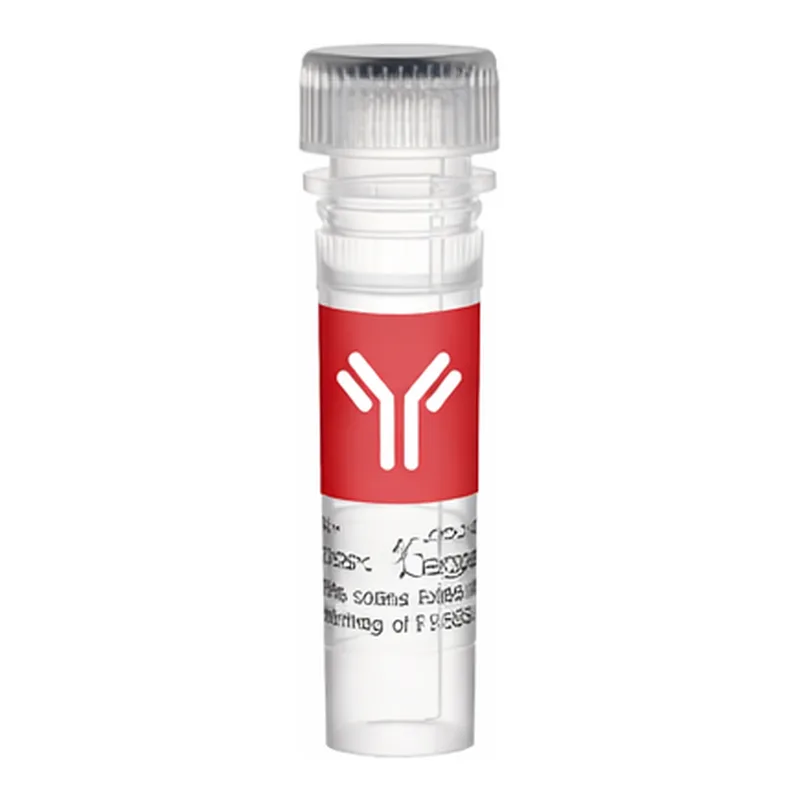
Thermo Fisher Scientific KDELR3 Polyclonal Antibody
Human, Mouse, Rat에 반응하는 Rabbit Polyclonal 항체로, IHC(P)에서 1:50–1:200 희석으로 사용 가능. KDELR3 단백질(aa 71–120)에 특이적이며, 항원 친화 크로마토그래피로 정제됨. PBS/glycerol buffer에 보관하며 연구용으로만 사용.
- 판매단위
- pk
카탈로그
1개 옵션 · 카탈로그 번호를 클릭하면 복사됩니다Thermo Fisher Scientific · Thermo Fisher Scientific KDELR3 Polyclonal Antibody
Thermo Fisher Scientific KDELR3 Polyclonal Antibody
Applications
- Immunohistochemistry (Paraffin) (IHC (P)): 1:50–1:200
Product Specifications
| 항목 | 내용 |
|---|---|
| Species Reactivity | Human, Mouse, Rat |
| Host / Isotype | Rabbit / IgG |
| Class | Polyclonal |
| Type | Antibody |
| Immunogen | Synthetic peptide corresponding to amino acids 71–120 of Human KDELR3 |
| Conjugate | Unconjugated |
| Form | Liquid |
| Concentration | 1 mg/mL |
| Purification | Antigen affinity chromatography |
| Storage Buffer | PBS, pH 7.2, with 50% glycerol |
| Contains | 0.02% sodium azide |
| Storage Conditions | Store at 4°C short term. For long term storage, store at −20°C, avoiding freeze/thaw cycles. |
| Shipping Conditions | Wet ice |
| RRID | AB_2719126 |
Product Specific Information
The antibody was affinity-purified from rabbit antiserum by affinity chromatography using an epitope-specific immunogen. The purity is greater than 95% (by SDS-PAGE).
Target Information
This gene encodes a member of the KDEL endoplasmic reticulum protein retention receptor family. Retention of resident soluble proteins in the lumen of the endoplasmic reticulum (ER) is achieved in both yeast and animal cells by their continual retrieval from the cis-Golgi or a pre-Golgi compartment. Sorting of these proteins depends on a C-terminal tetrapeptide signal, usually lys-asp-glu-leu (KDEL) in animal cells and his-asp-glu-leu (HDEL) in S. cerevisiae. This process is mediated by a receptor that recognizes and binds the tetrapeptide-containing protein and returns it to the ER. In yeast, the sorting receptor encoded by a single gene, ERD2, is a seven-transmembrane protein. Unlike yeast, several human homologs of the ERD2 gene, constituting the KDEL receptor gene family, have been described. KDELR3 was the third member of the family to be identified. Alternate splicing results in multiple transcript variants.
For Research Use Only. Not for use in diagnostic procedures. Not for resale without express authorization.
Thermo Fisher Scientific 상품 둘러보기
전체보기
문의
0개 · 배송·재고 문의는 실시간 상담이 빠릅니다아직 등록된 문의가 없어요.