

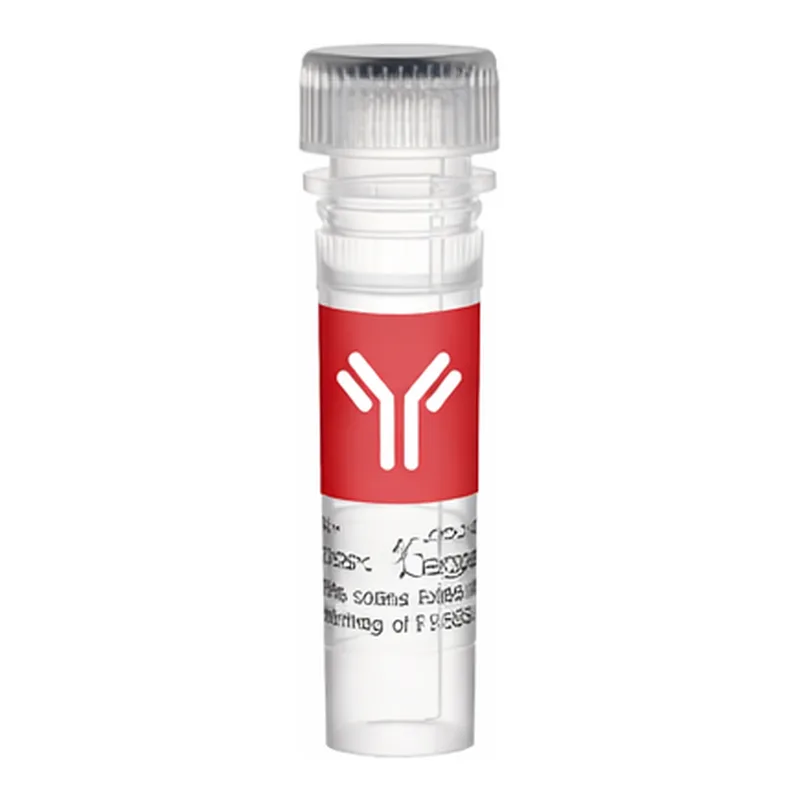
Thermo Fisher Scientific CD27 (Tumor Necrosis Factor Receptor Superfamily 7) Monoclonal Antibody (LPFS2, 4177)
CD27 단백질을 인식하는 Mouse monoclonal antibody로, Human 시료에 반응합니다. IHC(P) 및 Peptide Array에 사용 가능하며, Protein A/G로 정제된 액상 형태입니다. 4°C 보관, 연구용으로 적합합니다.
- 판매단위
- pk
카탈로그
1개 옵션 · 카탈로그 번호를 클릭하면 복사됩니다Thermo Fisher Scientific · Thermo Fisher Scientific CD27 (Tumor Necrosis Factor Receptor Superfamily 7) Monoclonal Antibody (LPFS2, 4177)
Applications
Immunohistochemistry (Paraffin) (IHC (P))
- Tested Dilution: 1–2 µg/mL
Peptide Array (Array)
- Tested Dilution: Assay-dependent
Product Specifications
| 항목 | 내용 |
|---|---|
| Species Reactivity | Human |
| Host / Isotype | Mouse / IgG1, kappa |
| Class | Monoclonal |
| Type | Antibody |
| Clone | LPFS2, 4177 |
| Immunogen | Recombinant human CD27 protein fragment (aa 28–170) |
| Conjugate | Unconjugated |
| Form | Liquid |
| Concentration | 200 µg/mL |
| Purification | Protein A/G |
| Storage Buffer | PBS, pH 7.4, with 0.05% BSA |
| Contains | 0.05% sodium azide |
| Storage Conditions | 4°C |
| Shipping Conditions | Ambient (domestic); Wet ice (international) |
Product Specific Information
- Immunohistochemistry (PFA fixed): Incubate antibody for 30 minutes at room temperature.
- Staining of formalin-fixed tissues requires heating tissue sections in 10 mM Tris with 1 mM EDTA (pH 9.0) for 45 minutes at 95°C, followed by cooling at room temperature for 20 minutes.
Target Information
CD27 is a 50 kDa member of the tumor necrosis factor (TNF) receptor superfamily that includes CD40 and CD30. Members of this family regulate cell proliferation and death.
Unlike other TNFR/TNF family members, CD27 and its ligand CD70 are predominantly expressed in lymphocytes. High CD27 expression depends on proper antigen receptor ligation, while CD70 expression requires additional co-stimulatory or pro-inflammatory signals.
CD27 is expressed as a disulfide-linked homodimer on mature thymocytes, peripheral blood T cells, and a subpopulation of B cells. Activation of T cells via the TCR-CD3 complex leads to upregulation of CD27 and release of soluble CD27 (sCD27, 28–32 kDa), which can be detected in plasma, urine, or spinal fluid. Soluble CD27 serves as a prognostic marker for acute and chronic B cell malignancies.
RgpA, a cysteine proteinase, activates T cells through protease-activated receptors (PARs) but degrades CD27, counteracting CD27/CD70-mediated activation. CD27-binding protein (SIVA), a proapoptotic protein, binds to this receptor and is thought to play a role in CD27-induced apoptosis.
Diseases associated with CD27 dysfunction include Lymphoproliferative Syndrome 2 and Autosomal Recessive Lymphoproliferative Syndrome.
For Research Use Only. Not for use in diagnostic procedures. Not for resale without express authorization.
Thermo Fisher Scientific 상품 둘러보기
전체보기
문의
0개 · 배송·재고 문의는 실시간 상담이 빠릅니다아직 등록된 문의가 없어요.