

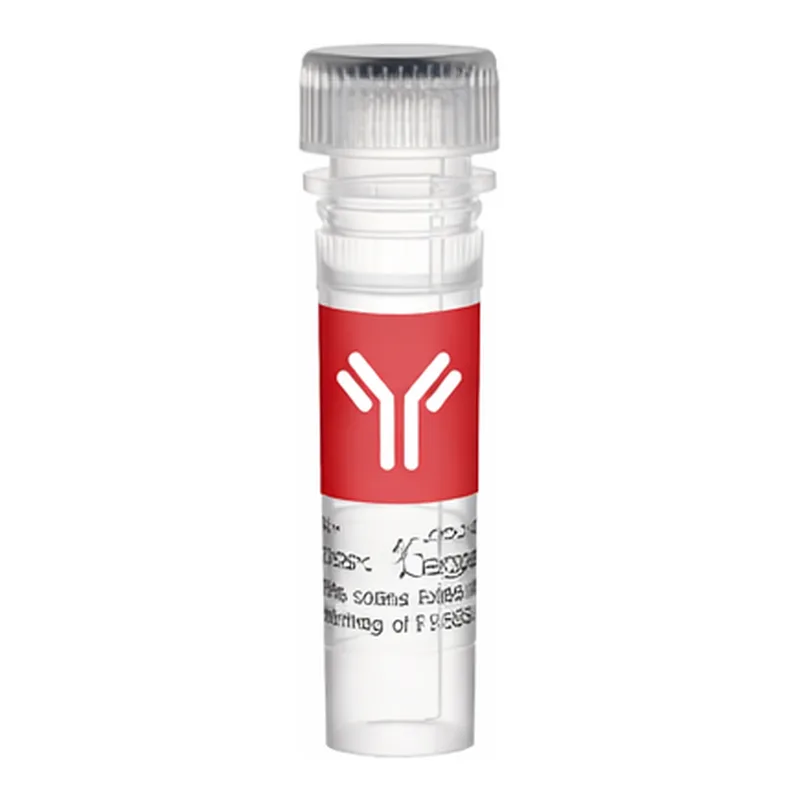
Thermo Fisher Scientific CD227 (Mucin 1) Monoclonal Antibody (SM3), eFluor 615, eBioscience
인간 MUC1(CD227) 저당화형을 인식하는 SM3 단일클론 항체로, eFluor 615 형광 표지. IHC-P 및 ICC에 적합하며, 암세포에서의 MUC1 발현 연구에 활용. 595/614 nm 형광 특성, 4°C 암조건 보관.
- 판매단위
- pk
카탈로그
2개 옵션 · 카탈로그 번호를 클릭하면 복사됩니다Thermo Fisher Scientific · Thermo Fisher Scientific CD227 (Mucin 1) Monoclonal Antibody (SM3), eFluor 615, eBioscience
Thermo Fisher Scientific CD227 (Mucin 1) Monoclonal Antibody (SM3), eFluor 615, eBioscience
Applications and Tested Dilution
| Application | Tested Dilution | Publications |
|---|---|---|
| Immunohistochemistry (IHC) | - | View 1 publication |
| Immunohistochemistry (Paraffin) (IHC-P) | 20 µg/mL | - |
| Immunocytochemistry (ICC/IF) | 20 µg/mL | - |
Product Specifications
| Item | Description |
|---|---|
| Species Reactivity | Human |
| Published Species | Human |
| Host / Isotype | Mouse / IgG1 |
| Class | Monoclonal |
| Type | Antibody |
| Clone | SM3 |
| Conjugate | eFluor™ 615 |
| Excitation / Emission Max | 595 / 614 nm |
| Form | Liquid |
| Concentration | 0.2 mg/mL |
| Purification | Affinity chromatography |
| Storage Buffer | PBS, pH 7.2 |
| Contains | 0.09% sodium azide |
| Storage Conditions | 4°C, store in dark, DO NOT FREEZE |
| Shipping Conditions | Ambient (domestic); Wet ice (international) |
| RRID | AB_10804488 |
Product Specific Information
This SM3 monoclonal antibody reacts with the under-glycosylated form of human Mucin 1 (MUC1, CD227), a large glycoprotein of the mucin family. Mucin 1 is expressed in ductal or glandular epithelial cells and localized to the apical membrane. In cancerous cells, Mucin 1 expression increases and loses membrane-specific localization, appearing throughout the membrane and cytoplasm.
High levels of under-glycosylated MUC1 are associated with altered cell behavior, invasion, metastasis, and immune recognition. It can also be detected in circulation due to shedding from epithelial surfaces. Altered glycosylation of MUC1 is common in adenocarcinomas of the breast, lung, pancreas, prostate, and ovary.
MUC1 interacts with erbB receptor kinase family members, upregulated in aggressive breast cancers. This antibody recognizes a distinct epitope from other MUC1 antibodies.
Applications Reported:
- Immunohistochemical staining of formalin-fixed paraffin-embedded sections (IHC-P)
- Immunocytochemistry (ICC)
Applications Tested:
- Tested on human breast carcinoma tissue and MCF7 cells at ≤20 µg/mL.
- Not validated for flow cytometry.
- Optimize dilution per assay.
Filter Recommendation:
Use filters capturing 615 nm emission (e.g., Excitation 560/55, 585LP, Emission 645/75). Alexa Fluor® 594 filter acceptable.
Excitation/Emission: 595 nm / 615 nm
Filtration: 0.2 µm post-manufacturing filtered
Target Information
MUC1 (Mucin 1, Episialin, MAM-6, CA 15-3, PEM, EMA) is a large transmembrane mucin glycoprotein expressed by most glandular and ductal epithelial cells and some hematopoietic lineages. It has a mucin-like extracellular domain with multiple tandem repeats (30–90), leading to high polymorphism and molecular weight variability.
MUC1 is abundantly expressed in >90% of breast carcinomas and metastases. It associates with erbB receptors (including EGFR) in lactating glands.
Altered expression, localization, and glycosylation of MUC1 are linked to carcinomas. Multiple alternatively spliced variants exist, with only some full-length forms determined.
For Research Use Only. Not for use in diagnostic procedures. Not for resale without express authorization.
제품 이미지

Thermo Fisher Scientific 상품 둘러보기
전체보기
문의
0개 · 배송·재고 문의는 실시간 상담이 빠릅니다아직 등록된 문의가 없어요.