

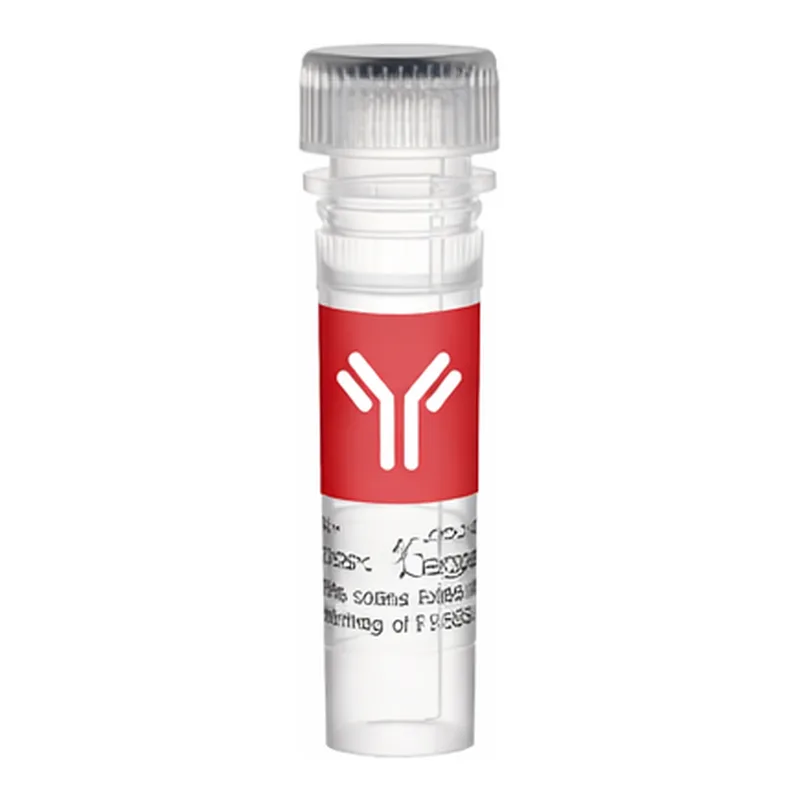
Thermo Fisher Scientific ABCD1 Recombinant Rabbit Monoclonal Antibody (9R4O8)
ABCD1 단백질을 인식하는 재조합 토끼 단클론 항체로, Western blot과 ELISA에 적합. 인간, 생쥐, 랫트 반응성. HEK293 세포 발현, Protein A 정제, 액상 형태. 연구용으로만 사용 가능.
- 판매단위
- pk
카탈로그
1개 옵션 · 카탈로그 번호를 클릭하면 복사됩니다Thermo Fisher Scientific · Thermo Fisher Scientific ABCD1 Recombinant Rabbit Monoclonal Antibody (9R4O8)
Applications
Western Blot (WB)
- Tested Dilution: 1:500–1:1,000
ELISA
- Tested Dilution: 1 µg/mL
Product Specifications
| 항목 | 내용 |
|---|---|
| Species Reactivity | Human, Mouse, Rat |
| Host / Isotype | Rabbit / IgG |
| Expression System | HEK293 cells |
| Class | Recombinant Monoclonal |
| Type | Antibody |
| Clone | 9R4O8 |
| Immunogen | Recombinant fusion protein containing a sequence corresponding to amino acids 650–745 of human ABCD1 ALD |
| Conjugate | Unconjugated |
| Form | Liquid |
| Concentration | 1.05 mg/mL |
| Purification | Protein A |
| Storage Buffer | PBS, pH 7.3, with 0.05% BSA, 50% glycerol |
| Contains | 0.02% sodium azide |
| Storage Conditions | -20°C, Avoid Freeze/Thaw Cycles |
Product Specific Information
Immunogen Sequence:
AGIALLSITH RPSLWKYHTH LLQFDGEGGW KFEKLDSAAR LSLTEEKQRL EQQLAGIPKM QRRLQELCQI LGEAVAPAHV PAPSPQGPGG LQGAST
Target Information
This gene is a member of the UBA domain family, whose members are associated with ubiquitin and the ubiquitination pathway. The ubiquitin-associated domain is a non-covalent ubiquitin binding domain composed of a compact three-helix bundle. This protein originates from a gene locus on chromosome 9 that undergoes loss of heterozygosity in nasopharyngeal carcinoma (NPC). Considering its cytogenetic location, this UBA domain family member is studied as a potential mutation target in NPC. Multiple alternatively spliced transcript variants encoding different isoforms have been identified for this gene.
For Research Use Only. Not for use in diagnostic procedures. Not for resale without express authorization.
Thermo Fisher Scientific 상품 둘러보기
전체보기
문의
0개 · 배송·재고 문의는 실시간 상담이 빠릅니다아직 등록된 문의가 없어요.