

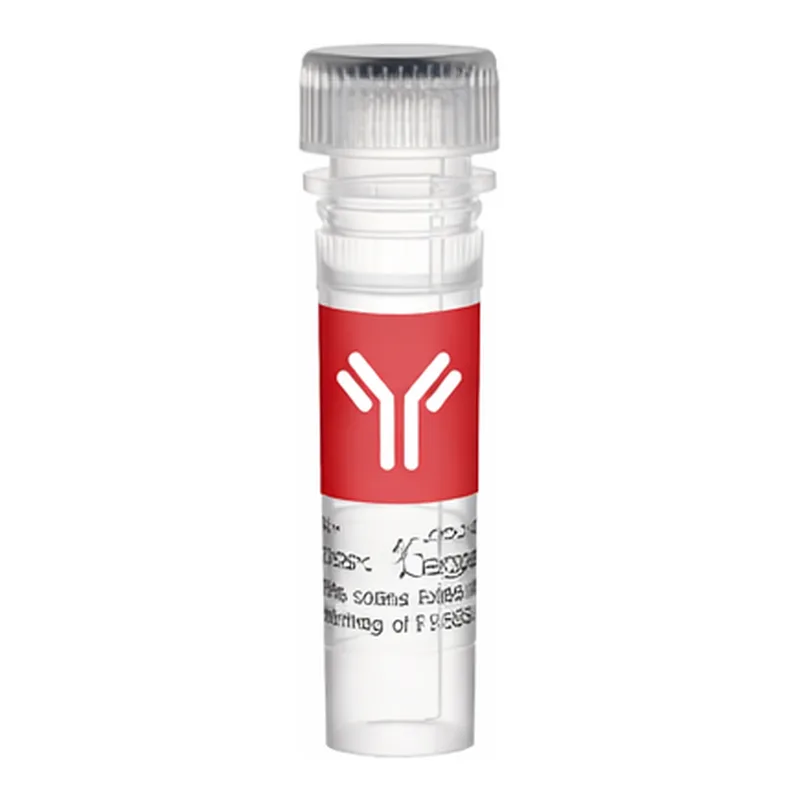
Thermo Fisher Scientific Phospho-POLR2A (Ser1616) Polyclonal Antibody
POLR2A의 Ser1616 인산화 형태를 특이적으로 인식하는 Rabbit Polyclonal Antibody. Western blot, IHC, ICC/IF 등 다양한 응용에 사용 가능. Human, Mouse, Rat에 반응하며, 고순도의 액상 형태로 제공. 연구용으로만 사용.
- 판매단위
- pk
카탈로그
1개 옵션 · 카탈로그 번호를 클릭하면 복사됩니다Thermo Fisher Scientific · Thermo Fisher Scientific Phospho-POLR2A (Ser1616) Polyclonal Antibody
Applications and Tested Dilution
| Application | Tested Dilution |
|---|---|
| Western Blot (WB) | 1:1,000–1:3,000 |
| Immunohistochemistry (Paraffin) (IHC-P) | 1:50–1:200 |
| Immunocytochemistry (ICC/IF) | 1:100–1:500 |
Product Specifications
| 항목 | 내용 |
|---|---|
| Species Reactivity | Human, Mouse, Rat |
| Host / Isotype | Rabbit / IgG |
| Class | Polyclonal |
| Type | Antibody |
| Immunogen | A synthesized peptide derived from human POLR2A (Accession P24928), corresponding to amino acid residues around phosphorylated Ser1616 |
| Conjugate | Unconjugated |
| Form | Liquid |
| Concentration | 1 mg/mL |
| Purification | Sequential chromatography |
| Storage Buffer | PBS, pH 7.4, with 50% glycerol |
| Contains | 0.02% sodium azide |
| Storage Conditions | -20°C |
| Shipping Conditions | Wet ice |
| RRID | AB_2817466 |
Product Specific Information
This antibody detects endogenous levels of POLR2A only when phosphorylated at Ser1616.
Target Information
DNA-directed RNA polymerase II subunit RPB1 (POLR2A) is a DNA-dependent RNA polymerase that catalyzes transcription of DNA into RNA using ribonucleoside triphosphates as substrates.
POLR2A is the largest subunit and a catalytic component of RNA polymerase II, which synthesizes mRNA precursors and many functional non-coding RNAs. It forms the polymerase active center together with the second largest subunit.
RNA polymerase II (Pol II) is the central component of the basal transcription machinery, composed of mobile structural elements that move relative to each other. RPB1 contributes to the core element with the central cleft, the clamp element that opens and closes the cleft, and the jaws that engage the DNA template.
During transcription initiation, the single-stranded DNA template is positioned within the active site cleft of Pol II. The RPB1 bridging helix promotes translocation of Pol II by acting as a ratchet that moves the RNA-DNA hybrid through the active site.
Transcription elongation by Pol II is regulated by the phosphorylation status of the C-terminal domain (CTD) of RPB1, which serves as a platform for assembly of factors controlling initiation, elongation, termination, and mRNA processing.
Regulation of gene expression depends on the balance between methylation and acetylation levels of CTD lysines.
For Research Use Only.
Not for use in diagnostic procedures.
Not for resale without express authorization.
Thermo Fisher Scientific 상품 둘러보기
전체보기
문의
0개 · 배송·재고 문의는 실시간 상담이 빠릅니다아직 등록된 문의가 없어요.