

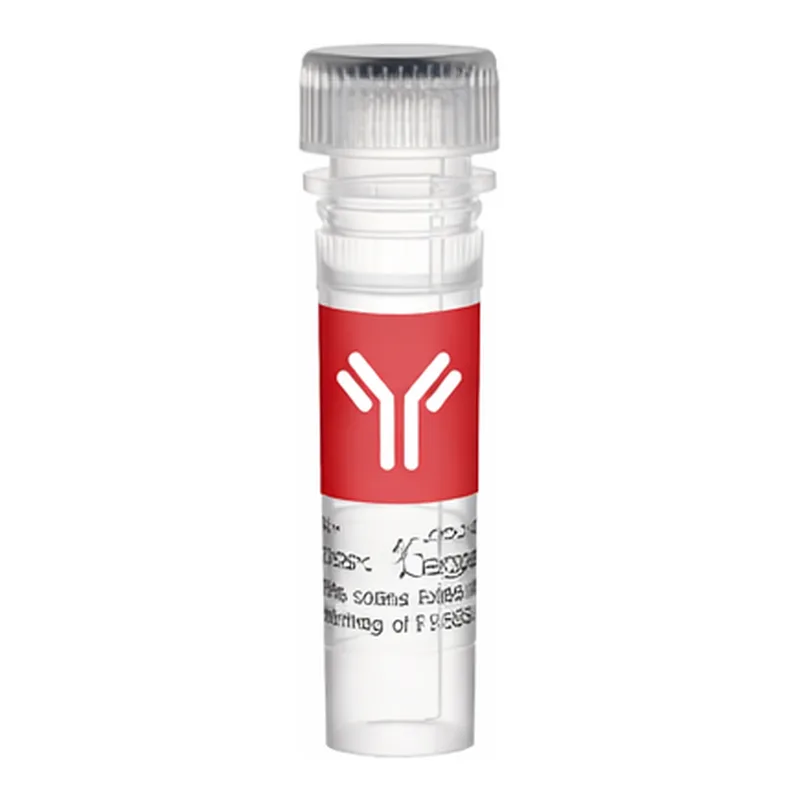
Thermo Fisher Scientific PDCD1LG2 Monoclonal Antibody (3C9)
PDCD1LG2 (PD-L2/B7-DC) 단백질을 인식하는 Mouse monoclonal antibody (clone 3C9). Western blot 및 ELISA에 적합하며, 인간 시료 반응성. 비결합형 액상 형태로, PBS buffer에 보존제 없이 제공. 면역조절 연구 및 PD-1 경로 분석에 활용 가능.
- 카탈로그번호
- H00080380-M44
- 판매단위
- pk
카탈로그
1개 옵션 · 카탈로그 번호를 클릭하면 복사됩니다Thermo Fisher Scientific · Thermo Fisher Scientific PDCD1LG2 Monoclonal Antibody (3C9)
Applications and Tested Dilution
| Application | Tested Dilution |
|---|---|
| Western Blot (WB) | 1–5 µg/mL |
| ELISA | 10 µg/mL |
Product Specifications
| 항목 | 내용 |
|---|---|
| Species Reactivity | Human |
| Host / Isotype | Mouse / IgG1, kappa |
| Class | Monoclonal |
| Type | Antibody |
| Clone | 3C9 |
| Immunogen | PDCD1LG2 (AAH74766.1, 19 a.a. – approximately 121 a.a.) partial recombinant protein |
| Conjugate | Unconjugated |
| Form | Liquid |
| Concentration | See Label |
| Purification | Affinity chromatography |
| Storage Buffer | PBS, pH 7.4 |
| Contains | No preservative |
| Storage Conditions | -20°C, Avoid Freeze/Thaw Cycles |
| Shipping Conditions | Ambient (domestic); Wet ice (international) |
Product Specific Information
Protein sequence:
ALFTVTVPKE LYIIEHGSNV TLECNFDTGS HVNLGAITAS LQKVENDTSP HRERATLLEE QLPLGKASFH IPQVQVRDEG QYQCIIIYGV AWDYKYLTLK VKA
Target Information
Programmed death-ligand 2 (PD-L2), also known as B7-DC, is a member of the B7 ligand family within the immunoglobulin superfamily. Along with PD-L1, it acts as a ligand for PD-1. PD-L2 is primarily expressed in dendritic cells but can be induced on various immune and non-immune cells depending on the microenvironment. Expression is upregulated by Th2 cytokine IL-4 and, to a lesser degree, by Th1 cytokines TNF-α and IFN-γ.
Although PD-L2 is generally expressed at lower levels than PD-L1, it shows a 2–6 times higher affinity for PD-1. PD-1 and its ligands serve as inhibitory immune checkpoint molecules, providing negative feedback to regulate immune homeostasis. Ligation of PD-L2 or PD-L1 inhibits T-cell activation, proliferation, and cytokine secretion (e.g., IFN-γ, IL-10), thereby dampening immune responses. Interestingly, PD-L2 can also stimulate T-cell proliferation and cytokine production even in PD-1-deficient T cells, suggesting additional receptors.
Recent studies have identified repulsive guidance molecule b (RGMb) as a second receptor for PD-L2. RGMb, initially known as a receptor for bone morphogenetic proteins (BMPs), is expressed in the central nervous system and macrophages. Interaction between PD-L2 and RGMb regulates respiratory tolerance development in the lung through BMP and/or neogenin signaling pathways.
The naturally occurring human PD-L2 monomer consists of:
- 201-amino-acid extracellular domain
- 21-amino-acid transmembrane domain
- 32-amino-acid cytoplasmic domain
For Research Use Only. Not for use in diagnostic procedures. Not for resale without express authorization.
Thermo Fisher Scientific 상품 둘러보기
전체보기
문의
0개 · 배송·재고 문의는 실시간 상담이 빠릅니다아직 등록된 문의가 없어요.