

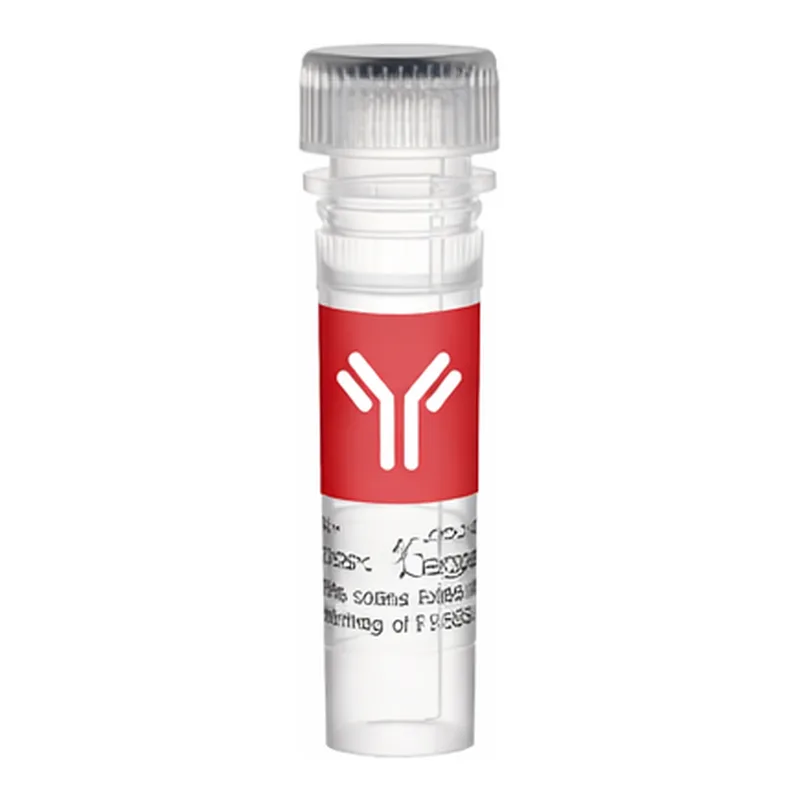
Thermo Fisher Scientific NCAM1 Monoclonal Antibody (UMAB194), UltraMAB
Thermo Fisher Scientific의 NCAM1 Monoclonal Antibody (UMAB194)는 인간 NCAM1(CD56)을 타깃으로 하는 Mouse IgG1 단일클론 항체입니다. Western Blot, IHC, ChIP, Peptide Array 등 다양한 응용에 적합하며, 동결건조 형태로 제공되어 안정적인 보관이 가능합니다.
- 판매단위
- pk
카탈로그
1개 옵션 · 카탈로그 번호를 클릭하면 복사됩니다Thermo Fisher Scientific · Thermo Fisher Scientific NCAM1 Monoclonal Antibody (UMAB194), UltraMAB
Applications
| Application | Tested Dilution |
|---|---|
| Western Blot (WB) | Assay-dependent |
| Immunohistochemistry (Paraffin) (IHC (P)) | 1:100–1:400 |
| ChIP assay (ChIP) | Assay-dependent |
| Peptide Array (Array) | 1:100 |
Product Specifications
| Specification | Description |
|---|---|
| Species Reactivity | Human |
| Host/Isotype | Mouse / IgG1 |
| Class | Monoclonal |
| Type | Antibody |
| Clone | UMAB194 |
| Immunogen | Human recombinant protein fragment corresponding to amino acids 20–718 of human NCAM1 produced in HEK293T cells |
| Conjugate | Unconjugated |
| Form | Lyophilized |
| Concentration | 1 mg/mL |
| Purification | Affinity chromatography |
| Storage Buffer | PBS, pH 7.3, with 8% trehalose |
| Contains | No preservative |
| Storage Conditions | -20°C, Avoid Freeze/Thaw Cycles |
| Shipping Conditions | Ambient (domestic); Wet ice (international) |
Product Specific Information
For reconstitution, add 100 µL distilled water to obtain a final antibody concentration of approximately 1 mg/mL.
For conjugation experiments using this carrier-free antibody, it is recommended to perform an additional desalting step (e.g., Zeba Spin Desalting Columns, 7K MWCO, 0.5 mL, Product #89882).
Target Information
CD56 (NCAM, neural cell adhesion molecule) is a transmembrane glycoprotein of the immunoglobulin family that functions as an adhesive molecule and is widely expressed in the nervous system in isoforms ranging from 120–180 kDa.
It is found on T cells and NK cells and plays roles in cell migration, axonal growth, pathfinding, and synaptic plasticity.
Polysialic modification reduces CD56-mediated adhesion. Through its extracellular domain, CD56 mediates homophilic and heterophilic interactions with extracellular matrix components such as laminin and integrins.
CD56 is expressed on most neuroectodermal-derived cell lines, tissues, and neoplasms including retinoblastoma, medulloblastoma, astrocytomas, and neuroblastoma.
It serves as a sensitive neuroendocrine marker for neuroendocrine tumors and ovarian granulosa cell tumors.
Diseases associated with CD56 dysfunction include rabies and blastic plasmacytoid dendritic cell neoplasms.
For Research Use Only. Not for use in diagnostic procedures. Not for resale without express authorization.
Thermo Fisher Scientific 상품 둘러보기
전체보기
문의
0개 · 배송·재고 문의는 실시간 상담이 빠릅니다아직 등록된 문의가 없어요.