

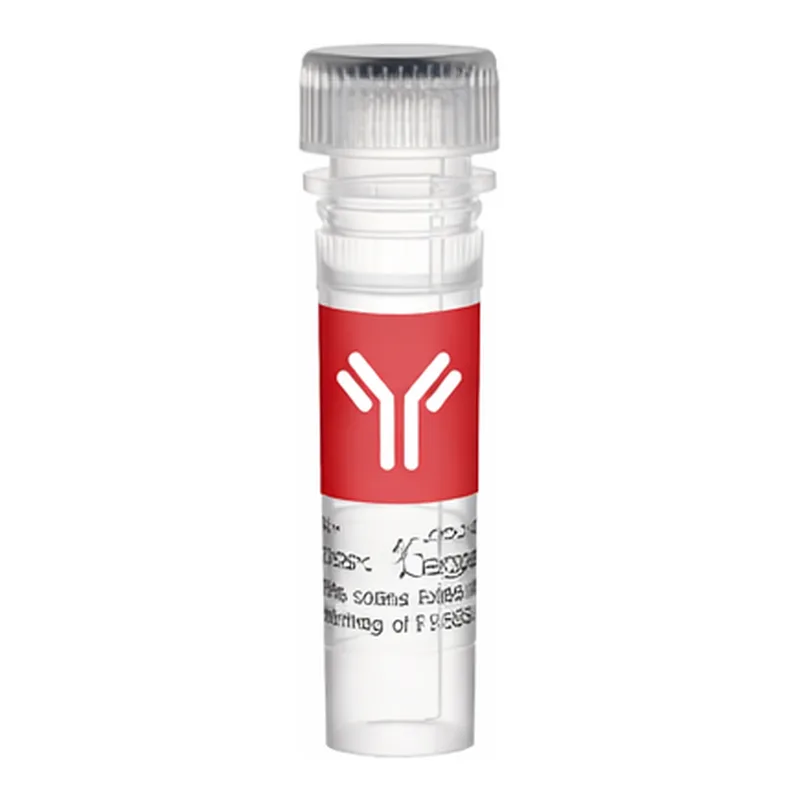
Thermo Fisher Scientific HSF1 Recombinant Rabbit Monoclonal Antibody (009)
Human HSF1 단백질을 인식하는 재조합 토끼 단클론 항체로, 높은 특이성과 재현성을 제공합니다. IHC, ICC/IF, ELISA에 적합하며, 보존제가 없는 액상 형태로 제공됩니다. 연구용으로만 사용 가능합니다.
- 판매단위
- pk
카탈로그
1개 옵션 · 카탈로그 번호를 클릭하면 복사됩니다Thermo Fisher Scientific · Thermo Fisher Scientific HSF1 Recombinant Rabbit Monoclonal Antibody (009)
Applications and Tested Dilutions
| Application | Tested Dilution |
|---|---|
| Immunohistochemistry (Paraffin) (IHC-P) | 1:100–1:500 |
| Immunocytochemistry (ICC/IF) | 1:20–1:100 |
| ELISA | 1:5,000–1:10,000 |
Product Specifications
| Specification | Description |
|---|---|
| Species Reactivity | Human |
| Host / Isotype | Rabbit / IgG |
| Expression System | HEK293 cells |
| Class | Recombinant Monoclonal |
| Type | Antibody |
| Clone | 009 |
| Immunogen | Recombinant Human HSF1 protein (Asp2–Ser529) |
| Conjugate | Unconjugated |
| Form | Liquid |
| Concentration | 1 mg/mL |
| Purification | Protein A |
| Storage Buffer | PBS |
| Contains | No preservative |
| Storage Conditions | Store at 4°C short term; for long-term, store at -20°C. Avoid freeze/thaw cycles. |
| Shipping Conditions | Ambient (domestic); Wet ice (international) |
| RRID | AB_2785216 |
Product Specific Information
This product is preservative-free. It is recommended to add sodium azide (final concentration 0.05%–0.1%) to prevent contamination.
Recombinant rabbit monoclonal antibodies are produced using in vitro expression systems by cloning antibody DNA sequences from immunoreactive rabbits. Selected clones are screened for optimal performance.
Advantages of recombinant rabbit monoclonal antibodies:
- High specificity and sensitivity
- Lot-to-lot consistency
- Animal origin-free formulation
- Broad immunoreactivity due to the large rabbit immune repertoire
This antibody specifically recognizes Human HSF1.
Target Information
All organisms respond to elevated temperatures and environmental stresses by synthesizing heat shock RNAs and proteins. The transcription of heat shock genes is regulated by heat shock factor (HSF), which binds to heat shock response elements (HSEs) composed of three repeats of a 5-nucleotide {nGAAn} module.
Although HSEs are conserved among species, HSF proteins from yeast, Drosophila, and human differ in molecular weight and immunological reactivity. In humans, two HSFs—HSF1 and HSF2—have been identified, sharing 38% sequence identity and binding to the same HSEs.
- HSF1 responds to classical stress signals (heat, heavy metals, oxidative stress).
- HSF2 is activated during hemin-mediated differentiation of human erythroleukemia cells.
HSF1 exists constitutively in the cytoplasm and nucleus as a monomer lacking DNA-binding activity. Under stress, it becomes a nuclear-localized trimer that binds DNA. Phosphorylation of HSF1 is required for maximal transcription of heat shock genes.
For Research Use Only. Not for use in diagnostic procedures. Not for resale without express authorization.
Thermo Fisher Scientific 상품 둘러보기
전체보기
문의
0개 · 배송·재고 문의는 실시간 상담이 빠릅니다아직 등록된 문의가 없어요.