

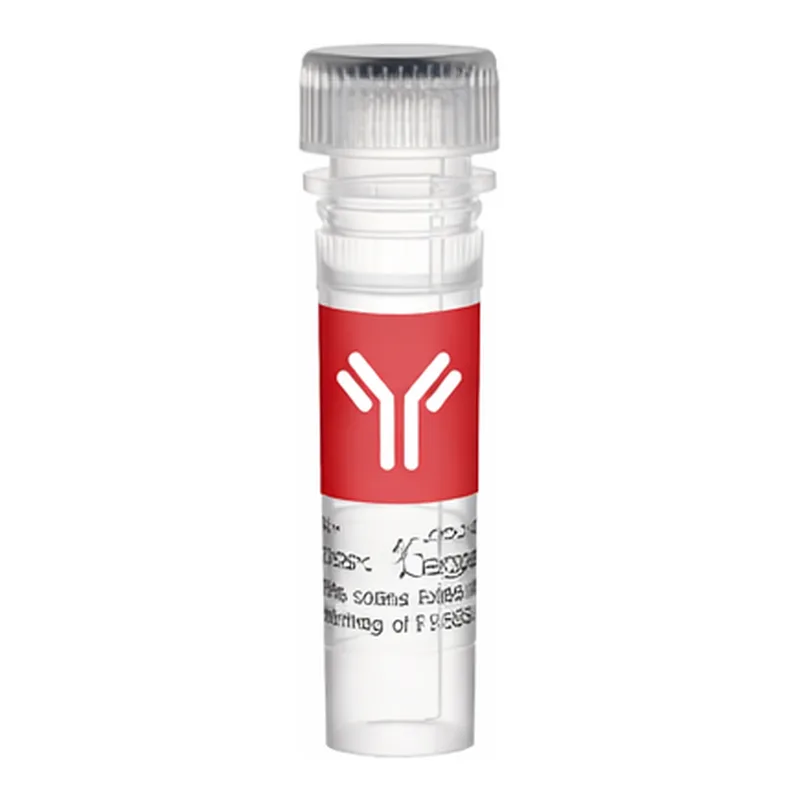
Thermo Fisher Scientific CRYGC Monoclonal Antibody (7C4)
인간 CRYGC 단백질을 인식하는 Mouse IgG2a 단클론 항체로 Western blot 및 ELISA에 적합합니다. 보존제가 없으며 -20°C에서 보관합니다. 렌즈 투명성과 굴절률 유지에 관여하는 단백질 연구에 활용됩니다.
- 판매단위
- pk
카탈로그
1개 옵션 · 카탈로그 번호를 클릭하면 복사됩니다Thermo Fisher Scientific · Thermo Fisher Scientific CRYGC Monoclonal Antibody (7C4)
Applications
Western Blot (WB)
- Tested Dilution: 1–5 µg/mL
ELISA
- Tested Dilution: 10 µg/mL
Product Specifications
| 항목 | 내용 |
|---|---|
| Species Reactivity | Human |
| Host / Isotype | Mouse / IgG2a, kappa |
| Class | Monoclonal |
| Type | Antibody |
| Clone | 7C4 |
| Immunogen | CRYGC (NP_066269, 75–174 a.a.) partial recombinant protein with GST tag (MW of GST tag: 26 kDa) |
| Conjugate | Unconjugated |
| Form | Liquid |
| Concentration | See Label |
| Storage Buffer | Tissue culture supernatant |
| Contains | No preservative |
| Storage Conditions | -20°C, Avoid Freeze/Thaw Cycles |
| Shipping Conditions | Ambient (domestic); Wet ice (international) |
Product Specific Information
Sequence of CRYGC protein:
SIRSCCLIPQ TVSHRLRLYE REDHKGLMME LSEDCPSIQD RFHLSEIRSL HVLEGCWVLY ELPNYRGRQY LLRPQEYRRC QDWGAMDAKA GSLRRVVDLYTarget Information
Crystallins are separated into two classes: taxon-specific (enzyme) and ubiquitous. The ubiquitous class constitutes the major proteins of vertebrate eye lens and maintains the transparency and refractive index of the lens. Lens fiber cells lose their nuclei during development, so crystallins are synthesized and retained throughout life, making them extremely stable proteins.
Mammalian lens crystallins are divided into alpha, beta, and gamma families, with beta and gamma forming a superfamily. Alpha and beta families are further divided into acidic and basic groups. Crystallins possess seven regions: four homologous motifs, a connecting peptide, and N- and C-terminal extensions.
Gamma-crystallins are monomeric proteins lacking connecting peptides and terminal extensions. They are differentially regulated after early development. Four gamma-crystallin genes (gamma-A to gamma-D) and three pseudogenes (gamma-E to gamma-G) are tandemly organized as a gene cluster. Mutations or aging-related changes in these genes are associated with cataract formation.
For Research Use Only.
Not for use in diagnostic procedures.
Not for resale without express authorization.
Thermo Fisher Scientific 상품 둘러보기
전체보기
문의
0개 · 배송·재고 문의는 실시간 상담이 빠릅니다아직 등록된 문의가 없어요.