

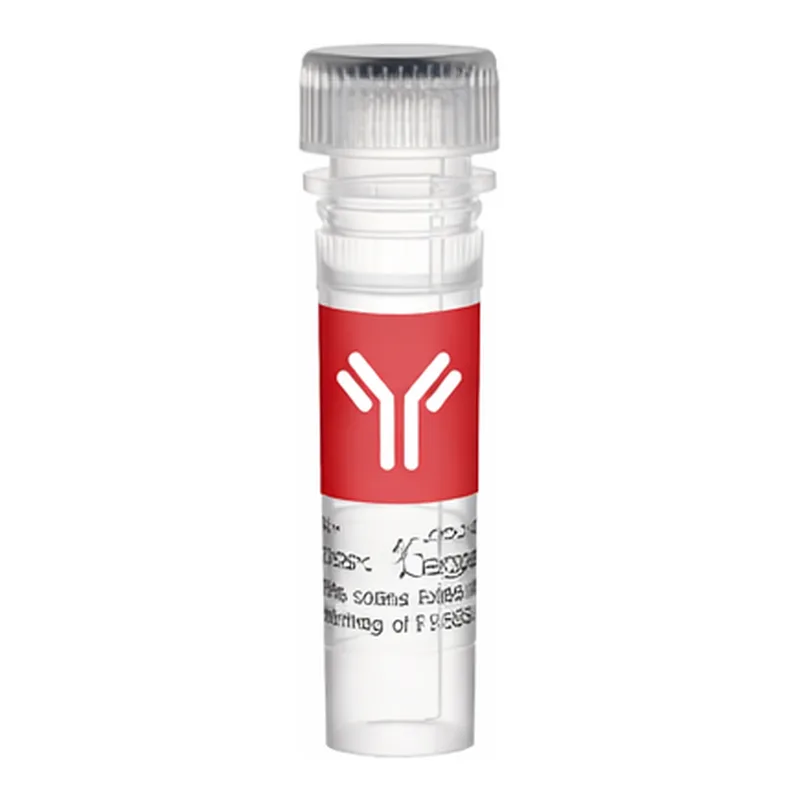
Thermo Fisher Scientific PARN Monoclonal Antibody (OTI2D9), TrueMAB
PARN 단백질을 인식하는 Mouse IgG2b 단클론 항체로, Western blot 및 IHC(Paraffin)에 사용 가능. 인간 PARN(aa 1–266) 재조합 단백질을 면역원으로 제작. 동결건조 형태로 제공되며, PBS와 trehalose 포함. 연구용으로만 사용.
- 판매단위
- pk
카탈로그
1개 옵션 · 카탈로그 번호를 클릭하면 복사됩니다Thermo Fisher Scientific · Thermo Fisher Scientific PARN Monoclonal Antibody (OTI2D9), TrueMAB
Applications
Western Blot (WB)
- Tested Dilution: 1:2,000
Immunohistochemistry (Paraffin) (IHC (P))
- Tested Dilution: Assay-Dependent
Product Specifications
| 항목 | 내용 |
|---|---|
| Species Reactivity | Human |
| Host / Isotype | Mouse / IgG2b |
| Class | Monoclonal |
| Type | Antibody |
| Clone | OTI2D9 |
| Immunogen | Human recombinant protein fragment corresponding to amino acids 1–266 of human PARN produced in E. coli |
| Conjugate | Unconjugated |
| Form | Lyophilized |
| Concentration | 1 mg/mL |
| Purification | Affinity chromatography |
| Storage Buffer | PBS, pH 7.3, with 8% trehalose |
| Contains | No preservative |
| Storage Conditions | -20°C, Avoid Freeze/Thaw Cycles |
| Shipping Conditions | Ambient (domestic); Wet ice (international) |
Product Specific Information
For reconstitution, add 100 µL of distilled water to achieve a final antibody concentration of approximately 1 mg/mL.
For conjugation experiments, perform an additional round of desalting using Zeba Spin Desalting Columns (7K MWCO, 0.5 mL, Product #89882).
Target Information
The PARN protein is a 3'-exoribonuclease similar to the RNase D family, preferentially degrading poly(A) tails of mRNAs. This process is often the first step in eukaryotic mRNA decay. PARN also participates in silencing maternal mRNAs during oocyte maturation and early embryonic development, and in nonsense-mediated decay (NMD) of mRNAs with premature stop codons.
Alternative splicing results in multiple isoforms of this gene.
For Research Use Only. Not for use in diagnostic procedures. Not for resale without express authorization.
Thermo Fisher Scientific 상품 둘러보기
전체보기
문의
0개 · 배송·재고 문의는 실시간 상담이 빠릅니다아직 등록된 문의가 없어요.