

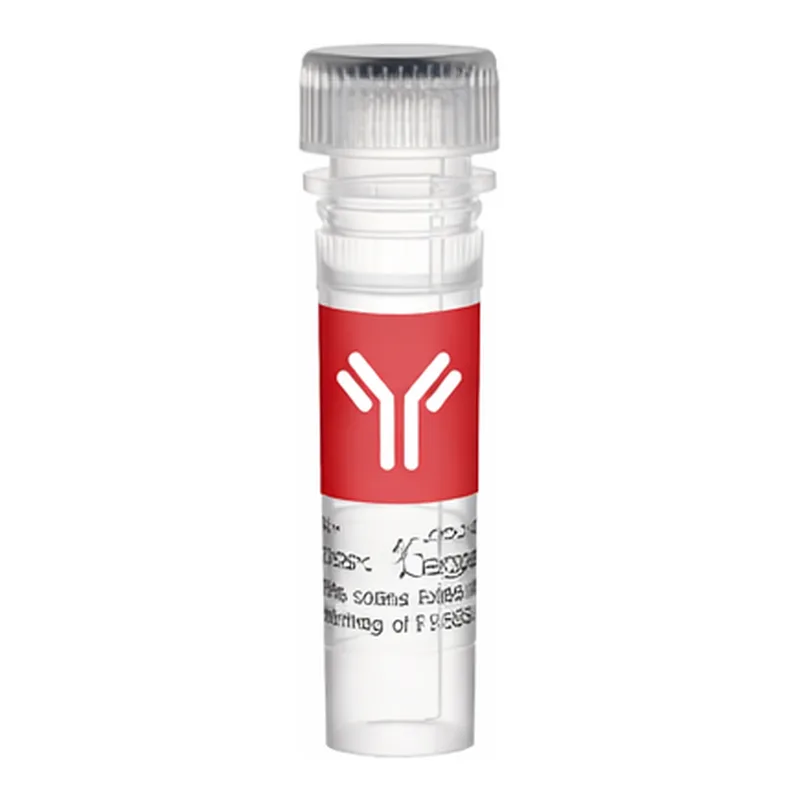
Thermo Fisher Scientific Bassoon Monoclonal Antibody (SAP7F407)
Bassoon 단백질을 검출하는 Mouse monoclonal antibody (Clone SAP7F407). Western blot, IHC, ICC, IP에 적합. 단백질 분해 산물도 인식 가능. Presynaptic 구조 연구에 유용. 연구용으로만 사용.
- 판매단위
- pk
카탈로그
1개 옵션 · 카탈로그 번호를 클릭하면 복사됩니다Thermo Fisher Scientific · Thermo Fisher Scientific Bassoon Monoclonal Antibody (SAP7F407)
Applications and Tested Dilutions
| Application | Tested Dilution / Amount | Publications |
|---|---|---|
| Western Blot (WB) | 1:500–1:1,000 | - |
| Immunohistochemistry (IHC) | 1:400 | 2 publications |
| Immunocytochemistry (ICC/IF) | Assay-dependent | - |
| Immunoprecipitation (IP) | 2.5 µg | - |
Product Specifications
| 항목 | 내용 |
|---|---|
| Species Reactivity | Mouse, Rat |
| Published Species | Mouse |
| Host / Isotype | Mouse / IgG2a |
| Class | Monoclonal |
| Type | Antibody |
| Clone | SAP7F407 |
| Immunogen | Recombinant rat Bassoon fragment (residues 738–1035) expressed as a fusion protein in E. coli |
| Conjugate | Unconjugated |
| Form | Liquid |
| Concentration | 1 mg/mL |
| Purification | Protein G |
| Storage Buffer | PBS with 0.1 mM PMSF, 50% glycerol |
| Contains | No preservative |
| Storage Conditions | Store at 4°C short term. For long-term storage, store at -20°C, avoiding freeze/thaw cycles. |
| Shipping Conditions | Ambient (domestic); Wet ice (international) |
| RRID | AB_2066981 |
Product Specific Information
By Western blot, this antibody detects a ~400 kDa band representing the Bassoon protein. Additional bands between 97–400 kDa are also identified and are reported to be proteolytic degradation products of Bassoon.
Target Information
Bassoon is an approximately 420 kDa protein localized at presynaptic nerve terminals and is believed to play a role in the structural and functional organization of the synaptic vesicle cycle. Bassoon does not belong to any known protein families. It has been found in rat and mouse with 96% sequence identity. The human BASSOON gene has been cloned and localized.
Bassoon is predicted to contain:
- Two double-zinc fingers
- Three coiled-coil regions
- Two polyglutamine domains
The C-terminal polyglutamine domains are of interest because abnormal amplification, as seen in some human proteins like Huntingtin, can cause late-onset neurodegeneration. Bassoon is concentrated at sites opposite to postsynaptic densities in synaptic terminals and colocalizes with GABA(A) and glutamate (GluR1) receptors. Another presynaptic protein, Piccolo, also colocalizes with Bassoon in cultured hippocampal neurons, suggesting roles in cytoskeletal organization at neurotransmitter release sites.
For Research Use Only. Not for use in diagnostic procedures. Not for resale without express authorization.
Thermo Fisher Scientific 상품 둘러보기
전체보기
문의
0개 · 배송·재고 문의는 실시간 상담이 빠릅니다아직 등록된 문의가 없어요.