

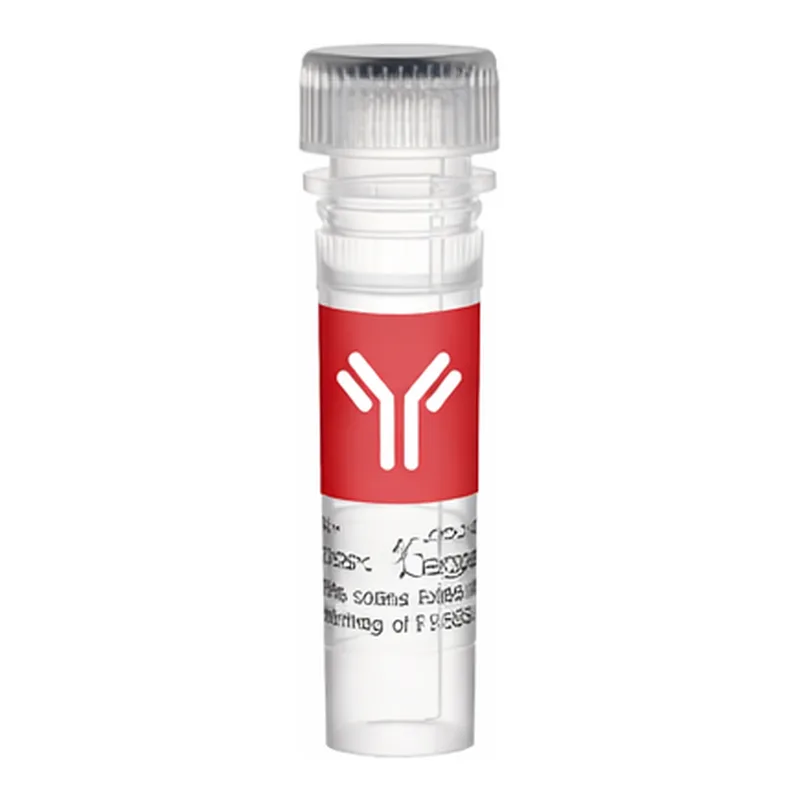
Thermo Fisher Scientific BAIAP2 Monoclonal Antibody (OTI8G8), TrueMAB
인간 BAIAP2 단백질을 인식하는 Mouse IgG1 단일클론 항체로, WB, IHC, ICC/IF에 사용 가능. 무보존제, 동결건조 형태로 제공되며, 재구성 후 1 mg/mL 농도 유지. 세포 이동 및 신경 성장 관련 연구에 적합.
- 판매단위
- pk
카탈로그
1개 옵션 · 카탈로그 번호를 클릭하면 복사됩니다Thermo Fisher Scientific · Thermo Fisher Scientific BAIAP2 Monoclonal Antibody (OTI8G8), TrueMAB
Applications and Tested Dilutions
| Application | Tested Dilution |
|---|---|
| Western Blot (WB) | 1:2,000 |
| Immunohistochemistry (Paraffin) (IHC (P)) | 1:150 |
| Immunocytochemistry (ICC/IF) | 1:100 |
Product Specifications
| Specification | Description |
|---|---|
| Species Reactivity | Human |
| Host / Isotype | Mouse / IgG1 |
| Class | Monoclonal |
| Type | Antibody |
| Clone | OTI8G8 |
| Immunogen | Full length human recombinant protein of human BAIAP2 produced in HEK293 cell |
| Conjugate | Unconjugated |
| Form | Lyophilized |
| Concentration | 1 mg/mL |
| Purification | Affinity chromatography |
| Storage Buffer | PBS, pH 7.3, with 8% trehalose |
| Contains | No preservative |
| Storage Conditions | -20°C, Avoid Freeze/Thaw Cycles |
| Shipping Conditions | Ambient (domestic); Wet ice (international) |
Product Specific Information
For reconstitution, add 100 µL distilled water to achieve a final antibody concentration of approximately 1 mg/mL.
For conjugation experiments, perform an additional desalting step using Zeba Spin Desalting Columns (7K MWCO, 0.5 mL, Product #89882).
Target Information
The BAIAP2 protein is a brain-specific angiogenesis inhibitor (BAI1)-binding adaptor protein that links membrane-bound G-proteins to cytoplasmic effector proteins. It functions as an insulin receptor tyrosine kinase substrate, suggesting a role for insulin in the central nervous system.
BAIAP2 associates with Rho small G proteins, contributing to stress fiber formation and cytokinesis. It is involved in lamellipodia and filopodia formation in motile cells, potentially influencing neuronal growth-cone guidance.
Additionally, it interacts with the dentatorubral-pallidoluysian atrophy gene, associated with an autosomal dominant neurodegenerative disease. Multiple transcript variants encoding distinct isoforms are produced by alternative splicing.
For Research Use Only. Not for use in diagnostic procedures. Not for resale without express authorization.
Thermo Fisher Scientific 상품 둘러보기
전체보기
문의
0개 · 배송·재고 문의는 실시간 상담이 빠릅니다아직 등록된 문의가 없어요.