

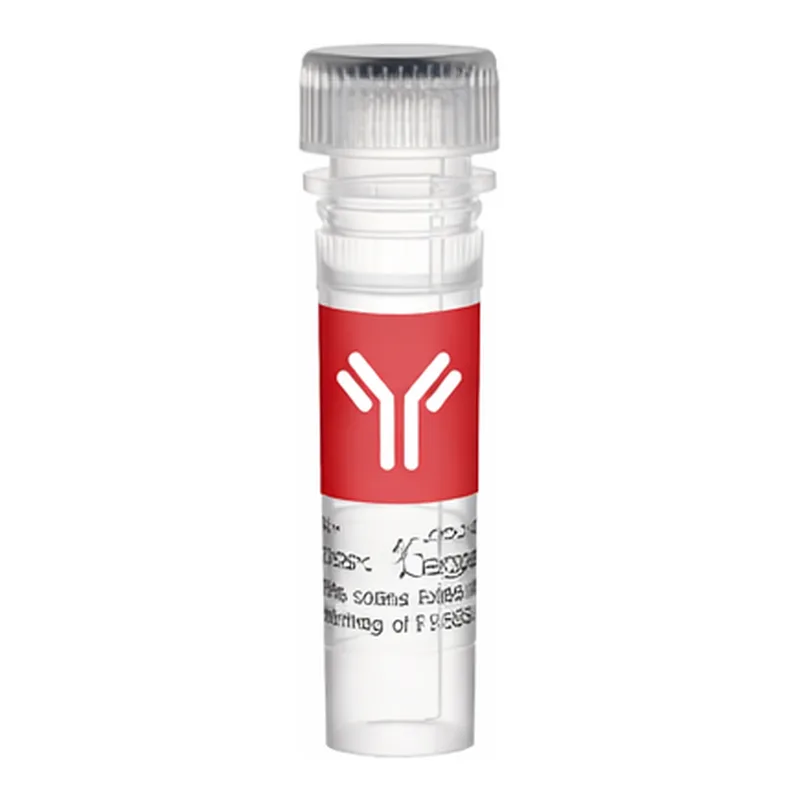
Thermo Fisher Scientific ATP5EP2 Polyclonal Antibody
Thermo Fisher Scientific의 ATP5EP2 Polyclonal Antibody는 인간 ATP5EP2 단백질을 인식하는 토끼 IgG 항체로, Western blot에 최적화되어 있습니다. KLH 접합 합성 펩타이드로 면역화되었으며, Protein A 및 항원 친화 크로마토그래피로 정제되었습니다. 연구용으로만 사용 가능합니다.
- 판매단위
- pk
카탈로그
1개 옵션 · 카탈로그 번호를 클릭하면 복사됩니다Thermo Fisher Scientific · Thermo Fisher Scientific ATP5EP2 Polyclonal Antibody
Applications
- Western Blot (WB): Tested Dilution 1:2,000
Product Specifications
| 항목 | 내용 |
|---|---|
| Species Reactivity | Human |
| Host / Isotype | Rabbit / IgG |
| Class | Polyclonal |
| Type | Antibody |
| Immunogen | KLH conjugated synthetic peptide between amino acids 19–52 of the central region of human ATP5EP2 |
| Conjugate | Unconjugated |
| Form | Liquid |
| Purification | Protein A, Antigen affinity chromatography |
| Storage Buffer | PBS, pH 7.4 |
| Contains | 0.09% sodium azide |
| Storage Conditions | Store at 4°C short term. For long-term storage, store at -20°C, avoiding freeze/thaw cycles. |
| Shipping Conditions | Ambient (domestic); Wet ice (international) |
| RRID | AB_2634961 |
Target Information
Mitochondrial membrane ATP synthase (F(1)F(0) ATP synthase or Complex V) produces ATP from ADP in the presence of a proton gradient across the membrane, generated by electron transport complexes of the respiratory chain.
F-type ATPases consist of two structural domains:
- F(1): contains the extramembraneous catalytic core
- F(0): contains the membrane proton channel
These domains are linked by a central stalk and a peripheral stalk. During catalysis, ATP synthesis in the F(1) domain is coupled via a rotary mechanism of the central stalk subunits to proton translocation. The rotation of the central stalk against surrounding α₃β₃ subunits leads to hydrolysis of ATP in three separate catalytic sites on the β subunits.
For Research Use Only. Not for use in diagnostic procedures. Not for resale without express authorization.
제품 이미지
(이미지 없음)
Thermo Fisher Scientific 상품 둘러보기
전체보기
문의
0개 · 배송·재고 문의는 실시간 상담이 빠릅니다아직 등록된 문의가 없어요.