

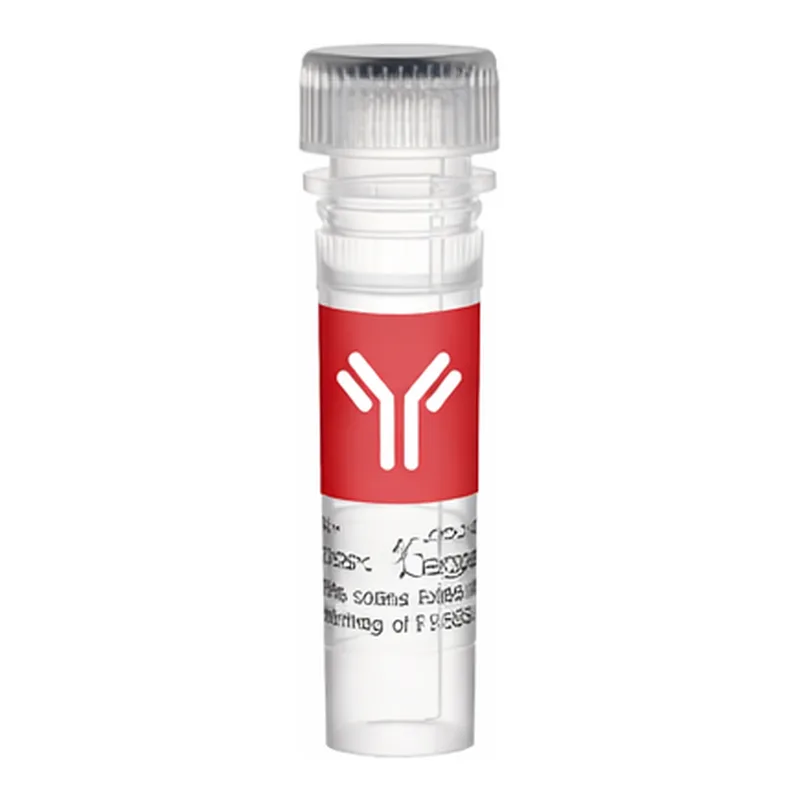
Thermo Fisher Scientific Beta crystallin S Polyclonal Antibody
Beta crystallin S 단백질을 인식하는 Thermo Fisher Scientific의 토끼 폴리클로날 항체로, WB, IHC, ICC, ELISA, IP 등 다양한 응용에 적합합니다. 인간, 마우스, 랫트 시료에 반응하며, 친화 크로마토그래피로 정제된 고품질 항체입니다.
- 판매단위
- pk
카탈로그
1개 옵션 · 카탈로그 번호를 클릭하면 복사됩니다Thermo Fisher Scientific · Thermo Fisher Scientific Beta crystallin S Polyclonal Antibody
Applications and Tested Dilutions
| Application | Tested Dilution |
|---|---|
| Western Blot (WB) | 1:500–1:1,000 |
| Immunohistochemistry (IHC) | 1:50–1:250 |
| Immunocytochemistry (ICC/IF) | 1:50–1:250 |
| ELISA | 1:10,000 |
| Immunoprecipitation (IP) | 1:50–1:250 |
| Immunomicroscopy (IM) | 1:50–1:200 |
Product Specifications
| Specification | Description |
|---|---|
| Species Reactivity | Human, Mouse, Rat |
| Host / Isotype | Rabbit / IgG |
| Class | Polyclonal |
| Type | Antibody |
| Immunogen | C-epitope synthetic peptide within amino acid region 120–178 on mouse BXTIS protein |
| Conjugate | Unconjugated |
| Form | Liquid |
| Concentration | 0.5–1.5 mg/mL |
| Purification | Affinity chromatography |
| Storage Buffer | Proprietary buffer, pH 7.4–7.8, with 0.5% BSA, 30% glycerol |
| Contains | 0.02% sodium azide |
| Storage Conditions | -20°C |
| Shipping Conditions | Ambient (domestic); Wet ice (international) |
Target Information
Crystallins are separated into two classes: taxon-specific (enzyme) and ubiquitous. The ubiquitous class constitutes the major proteins of vertebrate eye lens, maintaining transparency and refractive index.
During development, lens fiber cells lose their nuclei, so crystallins are synthesized once and retained for life, resulting in extreme protein stability.
Mammalian lens crystallins are divided into alpha, beta, and gamma families; beta and gamma crystallins form a superfamily. Alpha and beta families are further divided into acidic and basic groups. Seven structural regions exist in crystallins: four homologous motifs, a connecting peptide, and N- and C-terminal extensions.
Gamma-crystallins are monomeric, highly symmetrical proteins lacking connecting peptides and terminal extensions. They are differentially regulated after early development.
This gene encodes a protein initially classified as beta-crystallin but is monomeric and more similar to gamma-crystallins, representing the predominant gamma-crystallin in adult eye lens tissue.
Mutations or aging-related changes in gamma-crystallins have been associated with cataract formation.
For Research Use Only. Not for use in diagnostic procedures. Not for resale without express authorization.
Thermo Fisher Scientific 상품 둘러보기
전체보기
문의
0개 · 배송·재고 문의는 실시간 상담이 빠릅니다아직 등록된 문의가 없어요.