

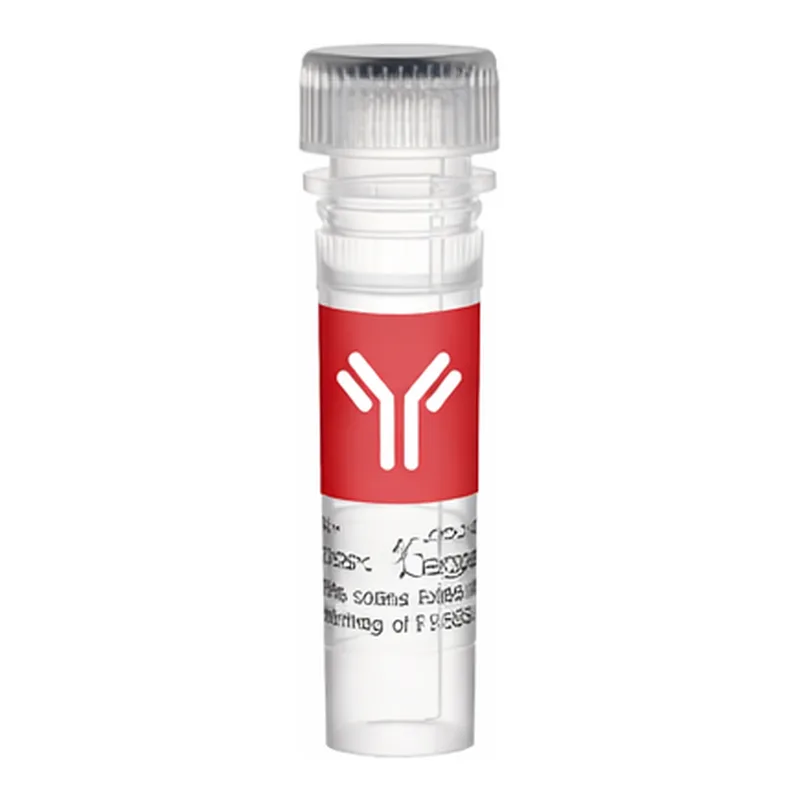
Thermo Fisher Scientific Latrophilin-1 (LPHN1) (extracellular) Polyclonal Antibody
LPHN1 단백질의 세포외 영역을 인식하는 Rabbit Polyclonal Antibody로, 인간·마우스·랫트 반응성. WB, IHC, ICC/IF, Flow Cytometry에 사용 가능. 항원 친화 크로마토그래피로 정제, 동결건조 형태로 제공. 연구용으로만 사용.
- 판매단위
- pk
카탈로그
2개 옵션 · 카탈로그 번호를 클릭하면 복사됩니다Thermo Fisher Scientific · Thermo Fisher Scientific Latrophilin-1 (LPHN1) (extracellular) Polyclonal Antibody
Applications
| Application | Tested Dilution |
|---|---|
| Western Blot (WB) | 1:200 |
| Immunohistochemistry (IHC) | Assay-dependent |
| Immunocytochemistry (ICC/IF) | Assay-dependent |
| Flow Cytometry (Flow) | 2.5 µg |
Product Specifications
| Specification | Description |
|---|---|
| Species Reactivity | Human, Mouse, Rat |
| Host / Isotype | Rabbit / IgG |
| Class | Polyclonal |
| Type | Antibody |
| Immunogen | CEPREVRRVQWPATQ(G), corresponding to amino acid residues 480–494 of rat Latrophilin-1 (extracellular, N-terminus) |
| Conjugate | Unconjugated |
| Form | Lyophilized |
| Concentration | 0.8 mg/mL |
| Purification | Antigen affinity chromatography |
| Storage Buffer | PBS, pH 7.4, with 1% BSA |
| Contains | 0.05% sodium azide |
| Storage Conditions | -20°C, Avoid Freeze/Thaw Cycles |
| Shipping Conditions | Ambient (domestic); Wet ice (international) |
Product Specific Information
Reconstitution: Add 50 µL or 0.2 mL double distilled water (DDW), depending on sample size.
The antibody ships as a lyophilized powder at room temperature. Upon arrival, store at -20°C.
Reconstituted solution can be stored at 4°C for up to 1 week. For longer storage, aliquot and keep at -20°C.
Avoid multiple freeze/thaw cycles. Centrifuge all antibody preparations before use (10,000 × g, 5 min).
Target Information
Adgrl1 (Latrophilin-1) is a calcium-independent receptor with high affinity for alpha-latrotoxin, a neurotoxin from black widow spider venom that induces exocytosis in neurons and neuroendocrine cells.
It acts as a receptor for TENM2, mediating synaptic cell-cell contact and postsynaptic specialization, possibly regulating exocytosis.
The Adgrl1 gene encodes a member of the latrophilin subfamily of G-protein coupled receptors (GPCR), functioning in both cell adhesion and signal transduction.
Proteolytic cleavage within the cysteine-rich GPS domain yields two non-covalently associated subunits at the cell membrane.
Adgrl1 recruits alpha-latrotoxin to the synaptic plasma membrane.
Alternative splicing produces multiple isoforms.
Diseases associated with ADGRL1 include Dermatophytosis and Retinal Degeneration (Late-Onset, Autosomal Dominant).
For Research Use Only. Not for use in diagnostic procedures. Not for resale without express authorization.
제품 이미지
Thermo Fisher Scientific 상품 둘러보기
전체보기
문의
0개 · 배송·재고 문의는 실시간 상담이 빠릅니다아직 등록된 문의가 없어요.