

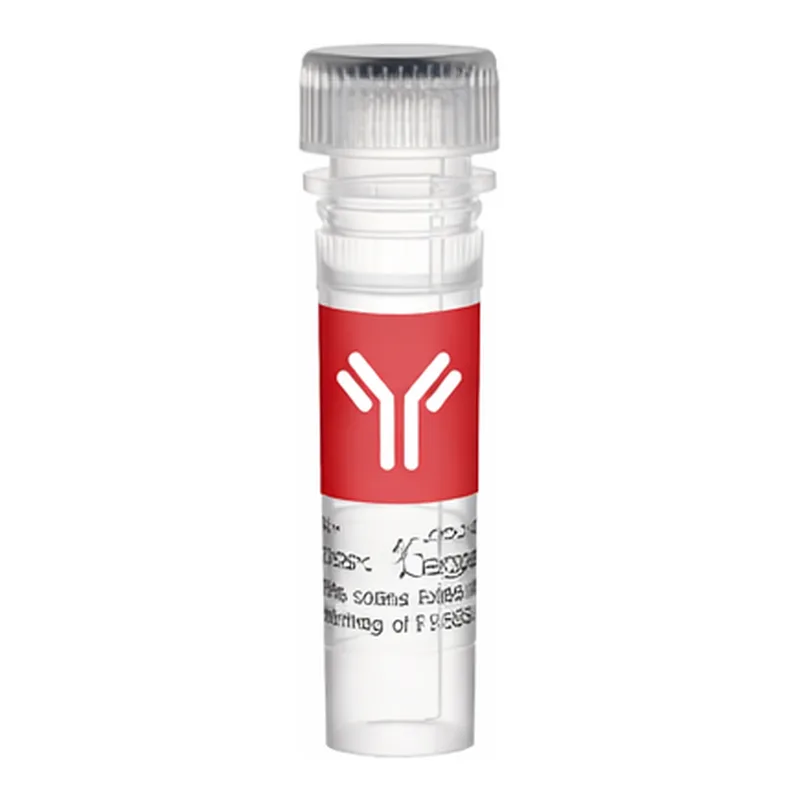
Thermo Fisher Scientific Aldo-keto Reductase Family 1 Member C2/DD2 Monoclonal Antibody (CPTC-AKR1C2-1)
인간 AKR1C2 단백질을 인식하는 mouse monoclonal antibody로, Western blot, IHC, peptide array에 사용 가능. Protein A/G 정제, PBS buffer에 보관. 연구용으로 xenobiotic 및 스테로이드 대사 관련 연구에 적합.
- 판매단위
- pk
카탈로그
1개 옵션 · 카탈로그 번호를 클릭하면 복사됩니다Thermo Fisher Scientific · Thermo Fisher Scientific Aldo-keto Reductase Family 1 Member C2/DD2 Monoclonal Antibody (CPTC-AKR1C2-1)
Applications and Tested Dilutions
| Application | Tested Dilution | Publications |
|---|---|---|
| Western Blot (WB) | 1–2 µg/mL | — |
| Immunohistochemistry (Paraffin) (IHC (P)) | 1–2 µg/mL | — |
| Peptide Array (Array) | Assay-dependent | — |
Product Specifications
| 항목 | 내용 |
|---|---|
| Species Reactivity | Human |
| Host / Isotype | Mouse / IgG2a, kappa |
| Class | Monoclonal |
| Type | Antibody |
| Clone | CPTC-AKR1C2-1 |
| Immunogen | Recombinant human full-length AKR1C2 protein |
| Conjugate | Unconjugated |
| Form | Liquid |
| Concentration | 1 mg/mL |
| Purification | Protein A/G |
| Storage buffer | PBS, pH 7.4 |
| Contains | No preservative |
| Storage conditions | -20°C or -80°C if preferred |
| Shipping conditions | Ambient (domestic); Wet ice (international) |
Product Specific Information
Immunohistochemistry (PFA fixed): Incubate antibody for 30 minutes at room temperature.
Staining of formalin-fixed tissues requires heating tissue sections in 10 mM Tris with 1 mM EDTA (pH 9.0) for 45 minutes at 95°C, followed by cooling at room temperature for 20 minutes.
Target Information
DD1 is also designated AKR1C1, DDH, or DDH1, while DD2 can be designated AKR1C2, dDD, BABP, or DDH2.
AKR1C3 and 3α-HSD are alternate designations for human DD3 (AKR1C18 in rodents), and DD4 can be called AKR1C4, CD, CHDR, or AKR1C6 (in rodents).
DD1 and DD2 are 20α-HSDs, whereas DD3 and DD4 are 3α-HSDs.
These human cytosolic dihydrodiol dehydrogenases are involved in the metabolism of xenobiotics (e.g., polycyclic aromatic hydrocarbons, pesticides, steroid hormones) and catalyze the reduction of ketone-containing drugs using NADH or NADPH as a cofactor.
The 20α-HSD catalyzes the conversion of progesterone to its inactive form, 20α-hydroxyprogesterone.
For Research Use Only. Not for use in diagnostic procedures. Not for resale without express authorization.
Thermo Fisher Scientific 상품 둘러보기
전체보기
문의
0개 · 배송·재고 문의는 실시간 상담이 빠릅니다아직 등록된 문의가 없어요.